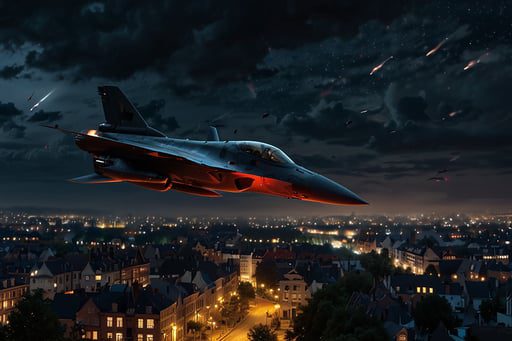

Between November 1989 and April 1990, Belgium experienced the most thoroughly documented and institutionally verified mass UFO sighting in history. Over the course of several months, more than 13,000 people reported seeing large, silent triangular craft moving slowly over the Belgian countryside and cities. The witnesses included police officers, military personnel, air traffic controllers, and ordinary citizens from every walk of life. The Belgian Air Force scrambled F-16 fighter jets twice to intercept the objects — and on both occasions, the craft demonstrated performance capabilities that no known aircraft possessed.
The Night It Began: November 29, 1989
The Belgian wave began on the night of November 29, 1989, when two police officers near the town of Eupen reported a large triangular object moving slowly and silently overhead. The craft was described as flat and black, roughly the size of a football field, with bright white lights at each corner and a pulsating red light in the center. It made no sound despite its enormous size. Over the next several hours, other police patrols in different locations called in similar reports, and radar operators at the NATO Glons air defense center detected unidentified returns in the same area.
What made this initial sighting significant was the near-simultaneous independent confirmation by multiple credible witnesses. The two police officers who first spotted the craft were in different locations and made separate reports without coordinating. Military radar at both Glons and the Semmerzake tracking station detected the object. The Belgian Air Force was alerted but did not scramble interceptors that night — a decision that would be revisited as the sightings continued over the following months.
The F-16 Chase: March 30-31, 1990
The most dramatic incident of the Belgian wave occurred on the night of March 30-31, 1990. Ground radar at two separate military installations simultaneously detected an unidentified object. Two F-16 fighter jets were scrambled from Beauvechain Air Base. The pilots locked their onboard radar onto the target multiple times over a 75-minute engagement — and each time, the object took evasive action that defied physical possibility.
The F-16’s radar data, later analyzed and publicly released by the Belgian Air Force, showed the object performing maneuvers that would be impossible for any known aircraft. In one recorded sequence, the object dropped from 3,000 meters to 1,700 meters in approximately one second — a descent rate of over 1,800 kilometers per hour at an altitude where sonic booms would be expected but none were reported. On three separate occasions, when the F-16s achieved radar lock, the object changed speed from 280 km/h to 1,800 km/h in seconds, then reduced to nearly zero in what appeared to be an instantaneous deceleration. The g-forces required for such maneuvers would have killed any biological pilot.
Official Response: Belgium Takes UFOs Seriously
What set the Belgian UFO wave apart from nearly all other mass sighting events was the official response. The Belgian Air Force did not dismiss, deny, or deflect. General Wilfried De Brouwer, Chief of Operations of the Belgian Air Force, held a press conference in which he openly acknowledged the unidentified nature of the objects, presented the radar data to journalists, and stated that the performance characteristics detected “went beyond the possibilities of existing technology.” He explicitly ruled out American stealth aircraft, secret prototypes, and atmospheric phenomena.
The Belgian government established a formal investigation in cooperation with the Belgian Society for the Study of Space Phenomena (SOBEPS), a civilian research organization. The investigation ran from 1989 to 1993 and produced a two-volume scientific report running to over 1,000 pages. The report concluded that genuine unexplained objects had been observed by thousands of credible witnesses and tracked on multiple independent radar systems, and that no conventional explanation adequately accounted for the evidence. It remains the most comprehensive official government investigation into a UFO event in Western European history.
The Petit-Rechain Photo and the Evidence Controversy
Among the thousands of photographs taken during the Belgian wave, one became iconic: the Petit-Rechain photograph, apparently showing a triangular craft with three lights and a central glow, taken in April 1990. The image circulated worldwide and became synonymous with the Belgian wave. In 2011, however, a Belgian man named Patrick Ferryn came forward to claim he had fabricated the photograph as a hoax using polystyrene foam. His confession was widely reported and damaged the evidentiary standing of the visual record, though it had no bearing on the radar data, military testimonies, or the F-16 engagement that form the backbone of the case.
The revelation about the photograph is a reminder that in any mass sighting event, not all evidence is equal. But the Belgian wave is notable precisely because its most compelling evidence — the radar tracks, the military engagement, the official government acknowledgment — does not depend on photographic evidence at all. General De Brouwer’s public statements and the Belgian Air Force’s release of the F-16 radar data remain among the most extraordinary official admissions regarding UAPs in the history of any nation’s military.
The Belgian Wave Today: An Unsolved Benchmark Case
The Belgian UFO wave of 1989-1990 has never been explained. Three decades of subsequent investigation have not identified any military program, classified aircraft, or natural phenomenon that could account for the simultaneous radar detections, the F-16 engagement data, and the testimony of over 13,000 witnesses. It remains a benchmark case in UAP research — one of the few incidents where multiple layers of credible, official evidence converge on a single conclusion: that structured craft of unknown origin operated over a NATO member country for months, demonstrated performance capabilities beyond known technology, and were observed by enough witnesses and tracked by enough instruments to rule out collective delusion or simple misidentification.
Sources and Further Reading
- De Brouwer, W. (1990). Belgian Air Force official press conference statements and radar data release.
- SOBEPS (1991). Vague d’OVNI sur la Belgique [UFO Wave Over Belgium], Vol. 1. Brussels: SOBEPS.
- SOBEPS (1994). Vague d’OVNI sur la Belgique, Vol. 2. Brussels: SOBEPS.
- Meessen, A. (2012). “The Belgian UFO Wave.” Institute of Physics, Catholic University of Louvain.
- Devereux, P. & Brookesmith, P. (1997). UFOs and Ufology: The First 50 Years. Blandford Press.
Discover more from Infinity Explorers
Subscribe to get the latest posts sent to your email.