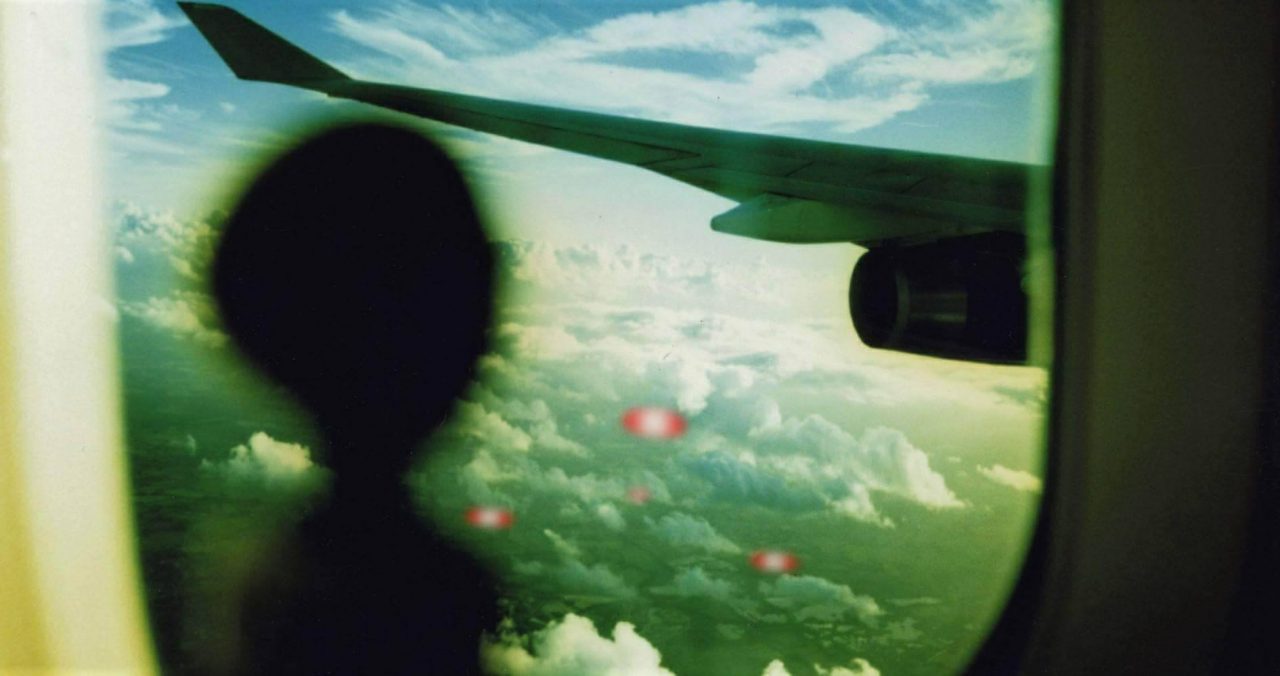

Heathrow Airport, one of the world’s busiest international hubs and one of the most heavily monitored pieces of airspace on Earth, became the site of a UFO incident that was difficult to dismiss precisely because of its location. Security cameras operating continuously around the airport captured footage of an unidentified object flying in close proximity to a commercial airliner on approach or departure — an incident that raised immediate questions about airspace safety, the nature of the object, and why the most surveilled airport in Europe was seeing something that no official authority could readily explain.
The Heathrow Airspace and Why It Matters
Heathrow operates under some of the most stringent airspace management protocols in aviation. The airport sits within a complex of controlled zones extending from ground level to high altitude, monitored continuously by multiple overlapping radar systems, CCTV networks, and air traffic control personnel tracking every object in the vicinity. Unauthorized incursions into Heathrow’s controlled airspace are taken extremely seriously — the 2018-2019 drone incidents at Gatwick and Heathrow that shut down operations and triggered military responses demonstrated how aggressively British aviation authorities respond to airspace violations. An object appearing on security camera footage flying alongside a commercial aircraft at Heathrow is, by definition, an object that was not on the radar systems tracking that aircraft, was not communicating with air traffic control, and was not expected to be there. The location itself elevates the significance of the sighting beyond what the same footage would carry at a rural airfield.
What the Footage Shows
The security camera footage of the Heathrow incident shows an object moving in close proximity to a commercial aircraft — close enough that the relative positions and speeds of the two objects are clearly distinguishable. The UFO does not exhibit the flight characteristics of a drone, bird strike hazard, or balloon: it maintains a consistent relative position to the aircraft rather than drifting or tumbling as a lighter-than-air object would in the wake turbulence zone behind a large jet. Its size, while difficult to determine precisely without known reference distances, appears inconsistent with a small drone. The object’s trajectory and the confidence of its movement alongside the significantly faster commercial aircraft raise the obvious question: what can keep pace with a commercial airliner while remaining invisible to radar and unreported by the flight crew?
Aviation Authority Response
British aviation authorities — the Civil Aviation Authority and NATS (National Air Traffic Services) — have historically maintained the same institutional caution about UAP as their American counterparts. Official responses to Heathrow-area UFO incidents typically invoke the possibility of drone activity, weather balloons, or atmospheric optical effects before acknowledging genuinely anomalous observations. The UK’s Ministry of Defence ran a UFO investigation unit, the Defence Intelligence Staff’s DI55 section, which closed in 2009 — a decision framed publicly as a cost-saving measure but which researchers argued reflected a policy decision to discontinue formal engagement rather than a genuine conclusion that UFOs were no longer operationally relevant. The closure means that incidents like the Heathrow camera footage now enter a bureaucratic void where no official body is mandated to investigate them seriously.
The UK’s History of Airport UFO Incidents
The Heathrow incident is not an isolated event in British aviation UFO history. The original Heathrow UFO sighting of 1954 — in which a metallic disc was observed and photographed by multiple witnesses including airport staff — was one of the best-documented early UAP cases in British records and was formally investigated by the RAF. Manchester Airport has generated multiple UAP reports from pilots and ground crew over the decades. The 1995 encounter near Manchester in which a Boeing 737 crew reported a near-miss with a large unidentified object at 4,000 feet was formally investigated by the CAA, which concluded that the crew had seen a real object but could not identify it. British airspace has a longer and more extensively documented history of UAP encounters than the institutional silence around the topic suggests.
Implications for Aviation Safety and UAP Transparency
Whatever the Heathrow camera footage shows, its primary significance may be less about the nature of the object and more about what it reveals regarding UAP and aviation safety. An object that can operate in controlled commercial airspace, fly in proximity to large passenger aircraft, avoid radar detection, and go unreported by flight crews represents a genuine aviation safety concern regardless of its origin. The United States has moved toward mandatory UAP reporting for military and commercial pilots precisely because the aviation safety argument transcends the politically sensitive question of what the objects are. If the UK and other major aviation nations follow suit — creating protected reporting channels, analyzing UAP data systematically, and sharing findings internationally — incidents like the Heathrow sighting will accumulate into a database that may finally provide answers to the fundamental question that decades of official silence has left open.
Discover more from Infinity Explorers
Subscribe to get the latest posts sent to your email.