

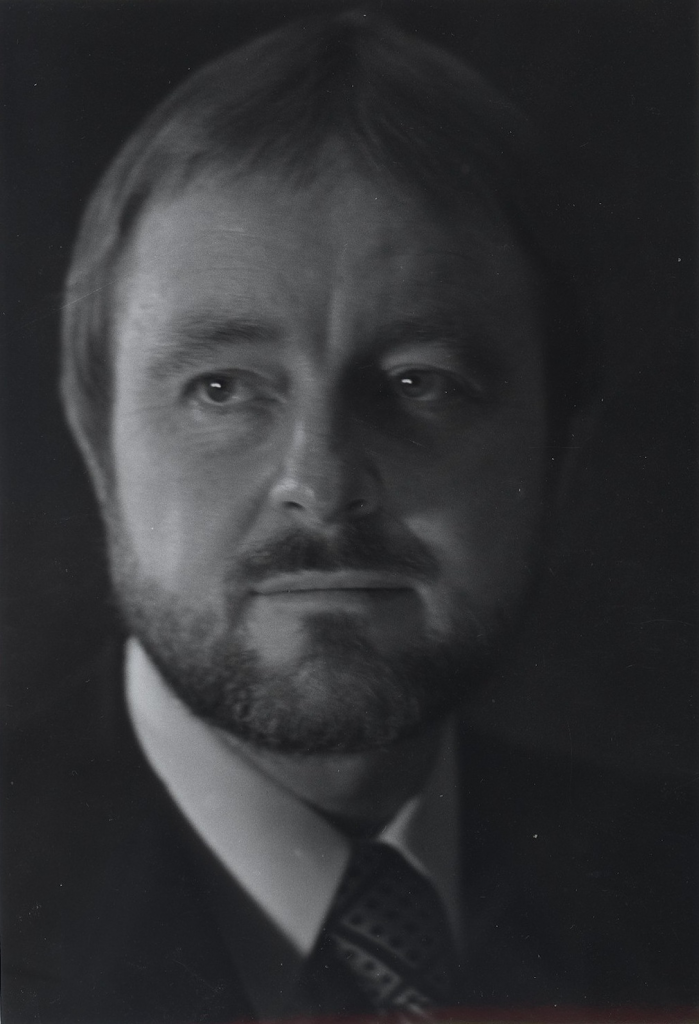

Ingo Swann was not an amateur enthusiast. He was arguably the most tested and documented psychic in American history — a subject and later a co-developer of the CIA’s remote viewing program, a man whose abilities were examined under strict laboratory conditions by physicists and intelligence officers at Stanford Research Institute over more than a decade. When Swann claimed to have been asked to remote-view the Moon as part of an undisclosed intelligence project, and reported finding not a barren landscape but an active, inhabited one, the claim carried a weight that similar statements from less established sources would not. His Moon mission account remains one of the most provocative and carefully detailed accounts in the entire history of UAP research — and one of the most persistently unresolved.
Who Was Ingo Swann?
Ingo Swann came to the attention of researchers at Stanford Research Institute in the early 1970s through a series of documented demonstrations of anomalous perceptual ability — the capacity to describe, with statistically significant accuracy, objects and locations that he had no conventional sensory access to. Physicists Hal Puthoff and Russell Targ, both serious scientists with no prior commitment to psychic phenomena, conducted controlled experiments with Swann that produced results they could not explain through conventional means and that they eventually published in peer-reviewed journals.
These results attracted the attention of the CIA, which funded an expanded program — eventually code-named Stargate — that used remote viewing for intelligence collection over more than two decades. Swann was both a subject and a teacher within that program, helping develop the Coordinate Remote Viewing protocol that became the program’s standard methodology. By the time of the Moon mission he describes in his 1998 book “Penetration: The Question of Extraterrestrial and Human Telepathy,” Swann had been an operational intelligence asset for years, and his handlers were people with serious institutional authority rather than fringe researchers.
The Assignment: Remote Viewing the Moon
Swann’s account describes being approached by a man he identifies only as “Mr. Axelrod” — a handler he had not previously encountered, who came with credentials that cleared him through Swann’s existing CIA contacts but whose precise institutional affiliation was never disclosed. Axelrod asked Swann to remote-view specific coordinates on the Moon. He was given the coordinates in sequence and asked to describe what he found at each location. The sessions were conducted with an unusual level of security precaution — Swann describes counter-surveillance measures taken by Axelrod that exceeded anything in his previous CIA work.
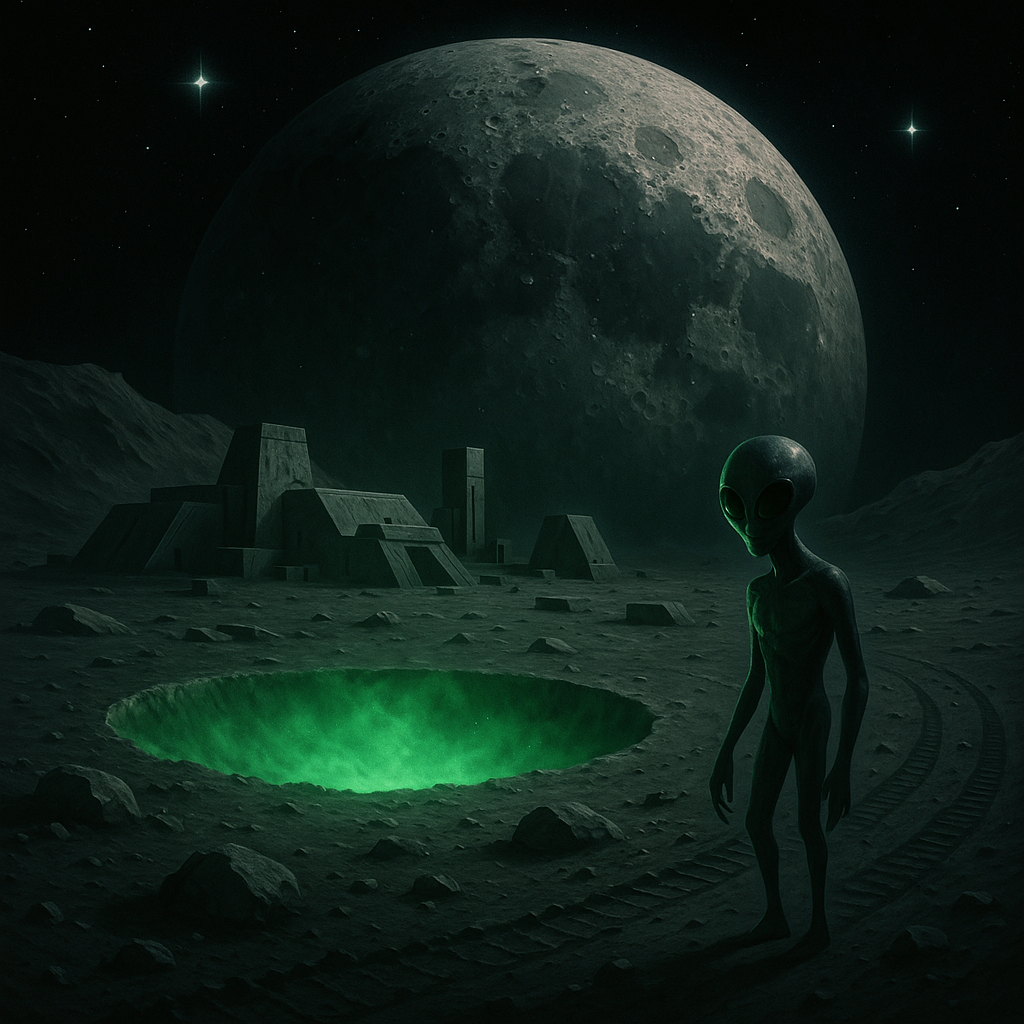
What Swann reports perceiving at the assigned coordinates was not the barren, crater-pocked surface of the Moon as understood from Apollo data. He described structures — geometric, regular, clearly constructed rather than natural — including what he characterized as towers, mining equipment, and what appeared to be artificially lit environments below the surface. At one point during a session, Swann reports perceiving humanoid figures moving in what appeared to be a pressurized environment, and sensing that these figures were aware of his remote viewing presence — a phenomenon described in remote viewing research as “psychic blowback” from a monitored target.
The Moment Swann Was Told to Stop
The most striking moment in Swann’s account is the interruption. During one of the sessions, as he was describing in detail what appeared to be an industrial facility with machinery and humanoid workers, Axelrod abruptly terminated the session and told Swann to stop. The reason given was that continuing was unsafe — not for Swann’s psychological health in the conventional remote viewing sense, but because the entities at the location were actively detecting his presence and the detection posed a risk that Axelrod did not elaborate on. Swann was then told, in terms he described as among the most serious he had encountered in all his intelligence work, never to discuss what he had viewed with anyone.
The instruction was compelling enough that Swann maintained near-total silence about the sessions for approximately two decades. When he finally described them in “Penetration,” he did so with the explicit statement that he was breaking a confidence because he had concluded that the information was too important for humanity to remain suppressed, and that his age and health made it more urgent to put the account on record. He published the book without identifying Axelrod, and without any documentary evidence beyond his own testimony — a decision he acknowledged openly, framing it as a limitation readers would have to accept along with his account.
What NASA’s Own Data Shows — and Doesn’t
Independent researchers who examined Swann’s account against publicly available NASA imagery found several areas of potential interest. Anomalous formations in certain lunar regions — particularly in and around some crater areas — have been cited by researchers as consistent with artificial construction, though lunar geologists have explanations for most of these formations rooted in volcanic and impact processes. The Shard and the Tower, anomalous structures identified in NASA’s Lunar Orbiter photographs in the 1960s and reported by researcher George Leonard, attracted interest as potential corroboration of Swann’s broader claims, though their interpretation remains disputed.
More significant is what NASA has not made fully public. The complete archive of Apollo-era photography and sensor data has never been released to the public in its entirety. Researchers who have filed requests for specific high-resolution imagery have in some cases received responses citing processing delays, data management issues, or in specific cases, classification holds on certain image sets. Whether these gaps reflect bureaucratic inefficiency, routine data management, or deliberate suppression of anomalous imagery cannot be determined from the outside — but the incompleteness of the public record is a documented fact rather than conspiracy speculation.
Swann’s Account in the Context of Current UAP Research
The relevance of Swann’s Moon mission has increased rather than decreased in the years since “Penetration” was published. The post-2017 congressional acknowledgment of UAP programs, the testimony of former intelligence officers about non-human craft and materials, and the emerging scientific consensus that the Moon’s south pole and subsurface contain water ice suitable for sustained human or non-human habitation have all provided contextual support for claims that seemed more exotic in 1998.
Several researchers who have examined Swann’s broader body of work — including his contributions to remote viewing methodology, his documented accuracy in controlled CIA experiments, and his consistent and specific account of the Moon sessions across multiple retellings — argue that his testimony deserves serious investigation rather than reflexive dismissal. Whether the Moon contains alien bases is a question that humanity may eventually be in a position to answer directly. Until then, Ingo Swann’s account stands as one of the most credentialed and specific claims in the history of the contact phenomenon — from a man whose anomalous abilities were tested and documented by the US intelligence community itself.
Discover more from Infinity Explorers
Subscribe to get the latest posts sent to your email.