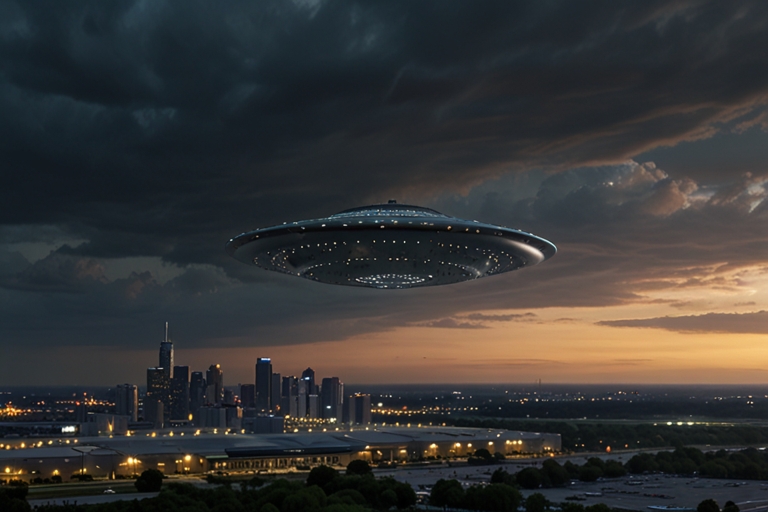

On the afternoon of November 7, 2006, a silent, disc-shaped object hovered over Gate C17 at Chicago O’Hare International Airport — one of the busiest airports in the world — for several minutes before shooting vertically upward at tremendous speed through a thick cloud layer, punching a perfectly circular hole that witnesses said lingered in the overcast sky for several minutes afterward. The incident was witnessed by approximately a dozen United Airlines employees, including pilots, mechanics, and gate personnel, yet the FAA and United Airlines initially refused to investigate. What followed became one of the most embarrassingly documented government cover-up attempts in modern UFO history.
The Sighting: A Disc Over America’s Busiest Airport
The O’Hare Airport UFO sighting of 2006 began around 4:30 PM local time when ramp workers near United Airlines Gate C17 noticed a dark, disc-shaped object hovering motionlessly over the terminal. The object was metallic in appearance — described by witnesses as hard-edged, definitively physical, and completely silent. It sat at an altitude estimated between 1,500 and 2,000 feet, below the cloud ceiling, and showed no lights and no engine noise whatsoever.
Multiple United Airlines employees working on the ramp stopped what they were doing to watch. One mechanic retrieved binoculars for a closer look. Witnesses said the object appeared to be perfectly round and flat — saucer-shaped — and that it stayed absolutely stationary above the gate despite variable wind conditions that day.
Then, after approximately five minutes, the object accelerated straight upward at extreme speed. It pierced the cloud layer so rapidly that it left behind a circular, cookie-cutter hole in the clouds — a clear hole roughly the width of the object’s apparent diameter — that witnesses reported remained visible for several minutes before the clouds closed back together.
Who Witnessed It — and Why That Matters
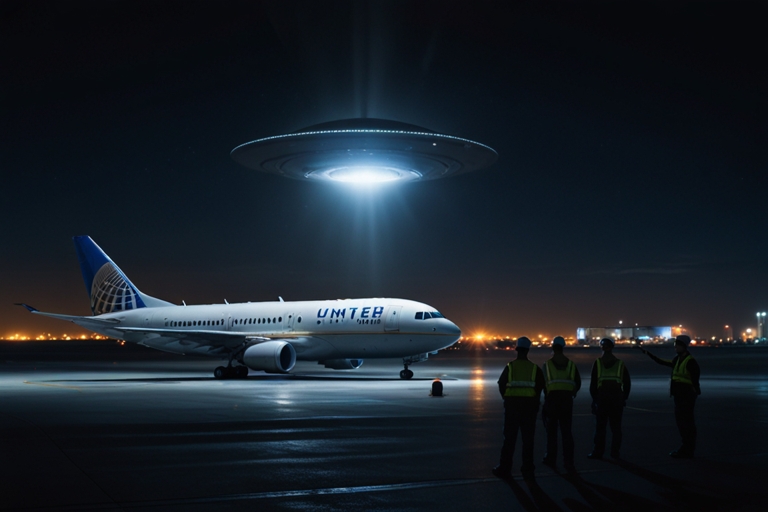
The credibility of the O’Hare UFO case rests substantially on the nature of its witnesses. These were not random members of the public. They were trained aviation professionals — people whose livelihoods depend on accurate aircraft identification and airspace awareness. United Airlines employees at the gate included:
- Ramp workers and mechanics with years of experience identifying aircraft types
- A United Airlines pilot at the gate who stated the object was unlike any aircraft he had ever seen
- Gate employees inside the terminal who saw the object through windows
- Ground crew who were in direct visual proximity to the object
A supervisor at the scene reportedly contacted the United Airlines control tower to ask if there was any traffic over Gate C17. The tower had no record of any aircraft or helicopter in that position. Additionally — and critically — O’Hare operates under controlled airspace with continuous radar surveillance. No object was logged on radar above Gate C17 at the time of the sighting, raising questions about whether the object was radar-invisible, or whether the data was not properly reviewed.
United Airlines and the FAA: A Cover-Up in Plain Sight
What happened after the sighting was, in many ways, more remarkable than the sighting itself. United Airlines employees filed internal reports immediately following the incident. Despite the number of credible witnesses and the fact that an unidentified object had apparently been present in the approach path of one of America’s largest airports — a potential serious aviation safety issue — United Airlines initially declined to file a formal report with the FAA or investigate the incident internally.
The FAA, when contacted by reporters, initially stated there was no record of the incident and no investigation had been opened. Their official position was that the sighting was likely a “weather phenomenon” — specifically, a hole-punch cloud — despite the fact that hole-punch clouds form through entirely different atmospheric processes and do not punch holes in overcast skies from below at high speed.
The story might have ended there except for the Chicago Tribune. Reporter Jon Hilkevitch filed a Freedom of Information Act (FOIA) request with the FAA for any communications related to the November 7 incident. The agency initially stated no records existed. Then, in January 2007, the Tribune published a front-page story on the incident. The article revealed that, contrary to the FAA’s claims, there had in fact been a phone call from a United Airlines supervisor to the FAA’s O’Hare control tower on November 7 reporting the object — and the FAA had a record of it. The agency had simply failed to disclose it.
The Chicago Tribune Story and Aftermath
Jon Hilkevitch’s January 1, 2007 Chicago Tribune article — headlined “In the Sky! A Bird? A Plane? A … UFO?” — became one of the most-read articles in the newspaper’s online history at the time. It generated international media coverage and renewed public interest in government transparency around UFO incidents.
Under pressure from the story’s publication, the FAA agreed to open a review of its radar data from November 7. Their conclusion: the radar showed nothing over Gate C17. Critics noted, however, that a metallic object that is not emitting a transponder signal — or that is using technology capable of defeating radar — would not necessarily show up on standard air traffic control radar. The hole in the cloud layer was, to multiple witnesses, far more compelling evidence than any radar log.
United Airlines ultimately confirmed that several employees had reported the object but declined to comment further, citing the FAA’s finding of “nothing on radar.” The witnesses, for their part, stood by their accounts. Several were frustrated and even angered by the dismissive official response to what they described as an unambiguous, sustained visual observation by multiple trained professionals.
Aviation Safety Implications
Beyond the UFO question, the O’Hare incident raised serious aviation safety concerns that received relatively little official attention. An unidentified solid object operating in the controlled airspace of a major international airport — directly above an active gate — represents exactly the kind of event that aviation authorities are supposed to investigate regardless of what the object turns out to be. The FAA’s initial reluctance to acknowledge the incident, followed by its quick dismissal once forced to respond, drew criticism from aviation safety advocates who argued that the “nothing on radar” conclusion was insufficient for an event reported by multiple credible witnesses.

MUFON and independent researchers noted that the object’s behavior — stationary, silent, radar-invisible, capable of instantaneous vertical acceleration — was entirely consistent with characteristics reported in dozens of other well-documented UAP cases, including several involving commercial airline crews in other parts of the world.
The O’Hare Case in the Context of UAP Disclosure
In the years since 2006, as U.S. government disclosure of UAP information has accelerated — from the Pentagon’s 2017 acknowledgment of AATIP to the establishment of the All-domain Anomaly Resolution Office (AARO) in 2022 — the O’Hare Airport UFO case has frequently been cited as a textbook example of why a formal, transparent reporting mechanism for UAP incidents is necessary. The incident checks every box: multiple credible professional witnesses, physical evidence (the hole in clouds), radar anomaly, official denial, and FOIA-confirmed suppression of communications.
In November 2022, the 16th anniversary of the O’Hare sighting, researchers noted that under the post-2021 UAP reporting framework, such an incident would theoretically be handled very differently — there are now established channels for commercial aviation personnel to report UAP observations, and the stigma around such reports has formally decreased. Whether those mechanisms would have produced a different outcome in 2006 remains an open question.
For the witnesses who watched a disc-shaped object hover silently over Gate C17 and then accelerate through the clouds above one of the world’s busiest airports, the official silence was never a satisfying answer. What they saw remains unexplained — and officially uninvestigated in any meaningful way — to this day.
Sources
- Chicago Tribune — Jon Hilkevitch, “In the Sky! A Bird? A Plane? A … UFO?”, January 1, 2007
- FAA FOIA records — communications related to November 7, 2006 O’Hare incident
- MUFON Case Files — O’Hare Airport, November 2006
- National Aviation Reporting Center on Anomalous Phenomena (NARCAP) — O’Hare report, 2007
- United Airlines internal incident reports (obtained via FOIA, Tribune investigation)
Discover more from Infinity Explorers
Subscribe to get the latest posts sent to your email.