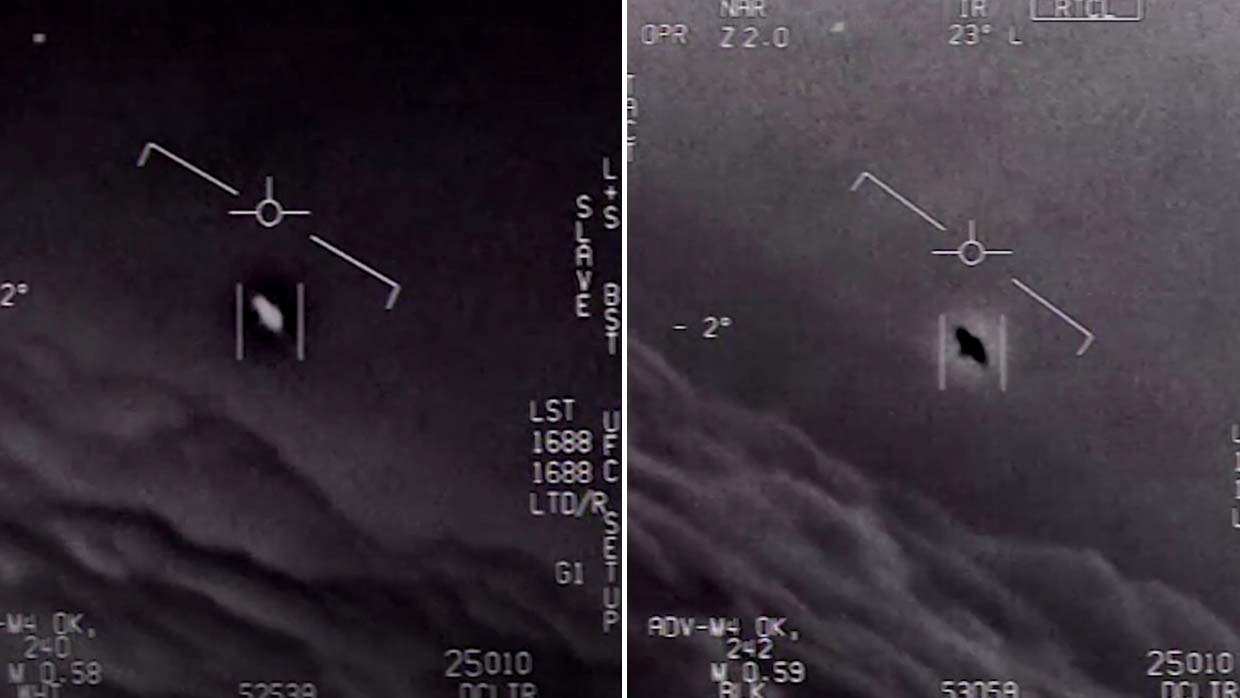

For decades, the United States government officially denied any serious institutional interest in UFOs. The publicly maintained position — that UFO reports were misidentifications, hoaxes, or the products of overactive imaginations — was the stated policy of the Department of Defense and every agency beneath it. The revelation that the Pentagon had been secretly conducting UFO investigations throughout this period of official denial represents one of the most significant institutional admissions in modern American history, and opens questions about what was actually found during those investigations that have still not been fully answered.
The Advanced Aerospace Threat Identification Program
The most significant admission came in December 2017, when the New York Times published an investigation revealing the existence of the Advanced Aerospace Threat Identification Program (AATIP) — a classified Pentagon program that had operated from 2007 to 2012 with a budget of approximately $22 million. The program was run by Luis Elizondo, a career intelligence officer, and was funded largely through the efforts of Senator Harry Reid, who had a longstanding personal interest in UFO research and directed funds through a defense appropriations bill. AATIP investigated videos of military encounters with unidentified aerial phenomena, analyzed materials from alleged UFO encounters, and commissioned studies on advanced aerospace technologies including anti-gravity, warp drives, and exotic propulsion systems. The revelation that such a program existed at all, funded by public money and operating within the Defense Intelligence Agency, directly contradicted decades of official denials.
What the Investigations Found
The public findings from AATIP and its successor programs include the now-famous UAP videos — Gimbal, Go Fast, and FLIR1 — released by the Department of Defense in 2020, showing craft exhibiting flight characteristics that Pentagon officials acknowledged could not be explained by known aerodynamic principles. The videos showed objects rotating against the wind without visible propulsion, maintaining extreme speeds at sea level where air resistance would destroy any conventional vehicle, and transitioning between apparent flight modes without deceleration. Beyond the videos, congressional briefings conducted by Elizondo and others after his resignation from AATIP included descriptions of materials analysis, physiological effects reported by military personnel after UAP encounters, and pattern analysis suggesting the objects were not random atmospheric phenomena but exhibited purposeful behavior in relation to military assets.
The Cover-Up Question
The admission that secret investigations had been ongoing raised an immediate question: why secret? If the objects being investigated were simply misidentified conventional aircraft or natural phenomena, there would be no national security reason to classify the investigation. The classification itself implies either that the investigation found something genuinely anomalous and potentially threatening, or that the objects represent classified programs — American or foreign — that could not be publicly discussed without revealing sensitive intelligence. Neither explanation is fully comfortable. If the objects are genuinely unknown, the public has a right to know that anomalous craft with unknown capabilities are operating in American airspace. If they are classified human programs, the decades of official denial and ridicule directed at civilian witnesses who reported the same objects constitute a serious breach of institutional honesty.
Congressional Action and Escalating Disclosures
The 2017 revelations triggered a cascade of congressional interest that has accelerated through the subsequent years. The Unidentified Aerial Phenomena Task Force was established in 2020, succeeded by AARO in 2022. Congressional hearings in 2023 included testimony from David Grusch, a decorated intelligence officer who stated under oath that the US government possesses non-human craft and biological materials of non-human origin, and that a retrieval and reverse-engineering program has been operating under illegal secrecy outside congressional oversight. Grusch named specific individuals with knowledge of the program and invited congressional investigators to access classified evidence. The fact that such testimony was delivered before Congress, under oath, and with whistleblower protections, without the witness being criminally charged with false statements, suggests that the claims were taken seriously at the highest levels of government oversight.
What the Pentagon Still Won’t Say
Despite the admissions of secret investigations, the release of UAP videos, and the congressional testimony, the Pentagon has never confirmed the extraterrestrial hypothesis. AARO’s annual reports describe most UAP as likely explainable but acknowledge a persistent residual of cases that cannot be resolved with available data. The official position — that UAP are primarily a national security and aviation safety concern requiring better data collection — carefully avoids the fundamental question of whether any of the objects are non-human in origin. Critics argue this is deliberate: that the language of aviation safety and national security creates a framework for continued investigation and classification without requiring an admission that would be impossible to walk back. The Pentagon has moved from denial to acknowledgment — but the distance between “these things exist and we’re studying them” and “we know what they are” remains the most consequential gap in modern government transparency.
Discover more from Infinity Explorers
Subscribe to get the latest posts sent to your email.