
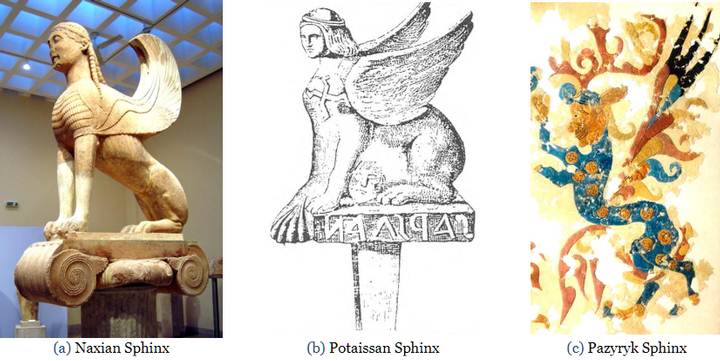
Credit: PZ Revesz, MAA, 2024.

Credit: PZ Revesz, MAA, 2024.
The inscription had baffled scholars for more than a century, but it has finally been deciphered, revealing a short and unusual poem.
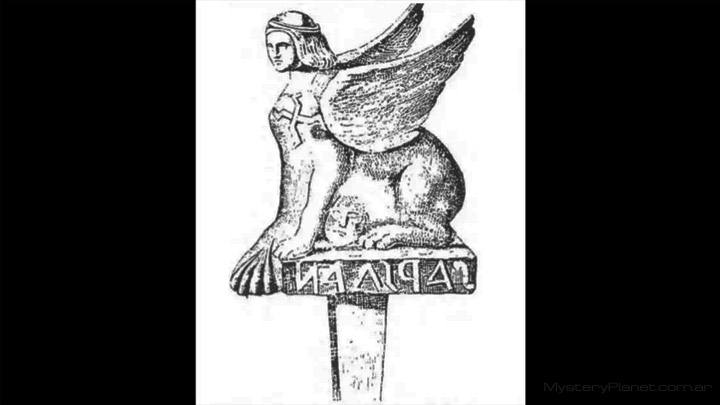
Dating back to the 3rd century, the bronze Sphinx statue originated in Dacia, a Roman province that largely corresponds to modern Romania.
Taking the form of a winged lion, “the sphinx was perceived by the original creators and users of the artifact as a representation of a mythical deity whom they honored and worshiped,” said Peter Revesz, author of a study published in the journal Mediterranean. Archeology and Archaeometry.
After being discovered in the 19th century, the statue was stolen from a European count around 1848. And although it was never recovered, a detailed drawing of it remained, in which an inscription composed of a handful of characters can be distinguished on the base.
For decades, scholars examined the drawing, trying to decipher the inscription. However, they were not successful, perhaps because, in an “unusual” break from ancient norms, it is read from right to left.
«The characters may seem mysterious at first. But once the mirror effect is noticed, they become easily recognizable as letters of the Greek alphabet, some of them in a more archaic form,” said the author of the study who, after examining ancient alphabets, determined that the message was a poem. proto-Hungarian.
Translated into Spanish, it says: “Look, contemplate, worship: here is the sacred lion,” which can be interpreted as a command to venerate the sphinx.
“The deciphered poem is notable because the cult of the sphinx was not part of the predominant ancient Roman mythology that features the Roman gods and goddesses that many people are familiar with today,” Revesz explained. “It is significant that this sphinx statue provides a record of a minority religion within the Roman Empire, for which records are much scarcer.
Depictions of the deity first emerged in Egypt and parts of the Middle East in the third century BC and were later found throughout the Mediterranean world.
The text is also abnormal in that it is written as a metrical poem, while most inscriptions at that time were written in prose.
“By using these poetic features, the scribe chose a specific text that was also carefully and artistically constructed,” Revesz concluded.
Source: Miami Herald
The Dacian Bronze Sphinx: History and Origins
The bronze sphinx at the center of this discovery is a remarkable artifact from Roman-era Dacia, the province that covered much of modern Romania and Moldova. Dating to the 3rd century CE, the winged lion figure represents a fusion of Greek, Roman, and native Dacian religious traditions — a blend typical of frontier Roman provinces where local beliefs absorbed and transformed classical iconography. Sphinxes in the Greco-Roman world carried powerful protective and oracular connotations, often placed at thresholds, tombs, and sacred sites where they were believed to guard against malevolent forces and mediate between the human and divine realms.
The inscription on this particular sphinx had defied translation for over a century because it combined elements of Latin with traces of Dacian — a language that remains only partially understood due to the scarcity of surviving texts. Dacian was spoken across the Carpathian region and belonged to the Indo-European family, but its relationship to other languages of the period remains debated. The few dozen words and names preserved in ancient sources provide only a fragmentary picture of the language, making the decipherment of the sphinx inscription a significant linguistic breakthrough.
What the Inscription Actually Says — And What It Implies
The deciphered text, which takes the form of a short dedicatory poem, reveals the sphinx was created as a protective offering to a deity associated with wisdom and celestial power. The poem references a guardian of thresholds who “comes from beyond the stars” and watches over those who cross the boundary between the known and unknown worlds. For mainstream scholars, this is standard protective dedicatory language common in Roman-era religious artifacts. For ancient astronaut theorists and alternative researchers, the phrase “from beyond the stars” carries obvious significance as a potential reference to non-terrestrial beings worshipped by ancient populations.
The inscription also includes a name or title that does not correspond to any known Roman deity, suggesting it may preserve a Dacian divine name that was simply transliterated into the Latin-script poem. This is significant because it implies the creator of the sphinx was deliberately fusing Roman and indigenous spiritual traditions — potentially preserving knowledge about a being or beings that Dacian tradition identified as celestial in origin. Whether this represents literal ancient astronaut contact or simply the universal human tendency to describe powerful divine entities in cosmic terms, the inscription adds a fascinating new data point to the long-running debate about how ancient peoples conceptualized their relationship with the sky and its inhabitants.
Ancient Inscriptions and the Broader Question of Lost Knowledge
The Dacian sphinx inscription is part of a growing body of newly deciphered ancient texts that are quietly reshaping our understanding of pre-modern religious and cosmological beliefs. From Linear A tablets in Crete to Proto-Sinaitic inscriptions in Egypt’s Sinai Peninsula to the untranslated portions of the Indus Valley script, the ancient world left behind far more written documentation than has been successfully read. Each new decipherment carries the potential to overturn assumptions about what ancient people knew, believed, and experienced. In the case of the Dacian sphinx, a century of silence has finally yielded a poem that speaks — however ambiguously — of beings from beyond the stars, guardians of thresholds, and the enduring human sense that the cosmos is inhabited by more than we can currently see.
The Broader Pattern: Ancient Inscriptions That Reference Sky Beings
The Dacian sphinx is far from the only ancient inscription to reference beings of celestial origin in ways that intrigue modern researchers. The Sumerian King List — a document that records rulers going back to before a great flood — includes dynasties of kings described as reigning for thousands of years before the flood separated the semi-divine early rulers from ordinary human monarchs. The Vedic Sanskrit texts of ancient India describe Vimanas — aerial vehicles used by divine beings — in technical detail that has no obvious mythological function unless it is describing something the authors had actually observed. Egyptian pyramid texts contain passages that describe the pharaoh’s soul ascending to join beings among the stars, using directional and navigational language more consistent with an actual journey than a poetic metaphor.
The decipherment of the Dacian sphinx inscription adds a Roman-era European data point to this global pattern. The phrase referencing a guardian “from beyond the stars” in a 3rd century CE provincial Roman artifact suggests that the concept of sky-origin beings was not confined to the ancient Near East or South Asia but was part of a broader cross-cultural understanding that our ancestors shared about the inhabited nature of the cosmos. Whether these references preserve memories of genuine encounters, reflect a universal human tendency to project divine attributes onto the sky, or describe something in between, they represent a body of evidence that challenges the assumption that pre-modern peoples had no knowledge of — or contact with — intelligences beyond the Earth.
Discover more from Infinity Explorers
Subscribe to get the latest posts sent to your email.