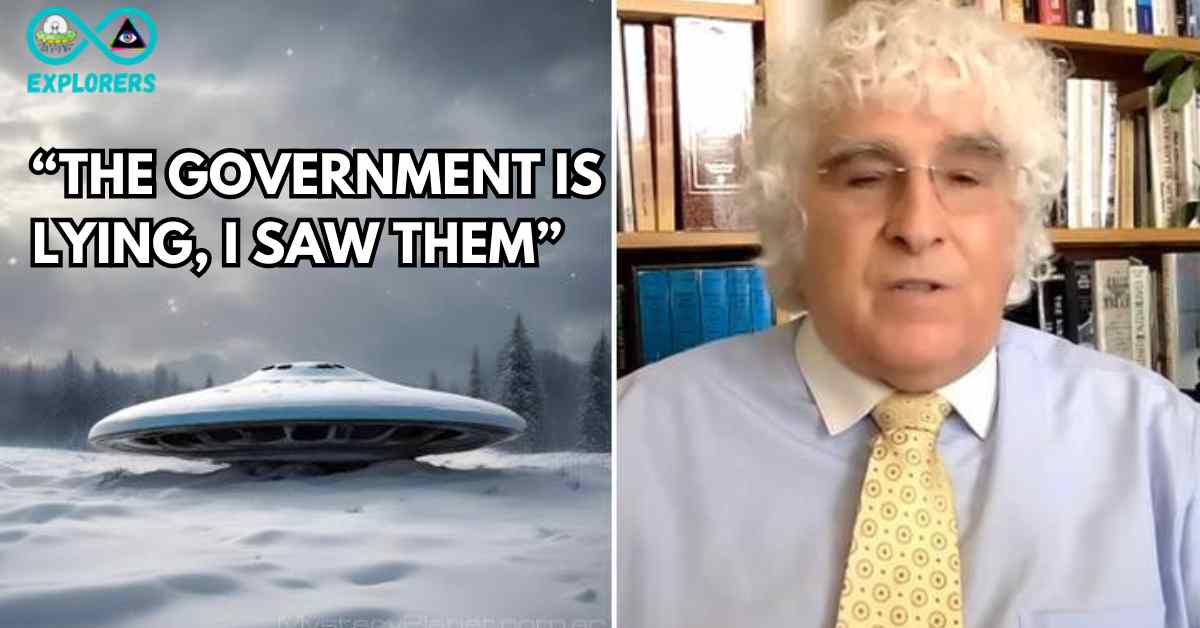

Daniel Sheehan is not a fringe figure. He is a Harvard-educated constitutional attorney who has argued cases before the United States Supreme Court, represented clients in the Iran-Contra investigation, and served as general counsel to the United States Jesuit Conference. When Sheehan claims to have personally viewed classified photographs of a crashed extraterrestrial craft in the restricted archives of the FBI — photographs he was shown while conducting authorized research in the 1970s — his account carries an institutional weight that purely anonymous whistleblower testimony does not. His description of what he saw has been consistent across decades, and it represents one of the most credentialed firsthand accounts of physical evidence for non-human craft in the documented record.
How Sheehan Gained Access
In 1977, Sheehan was working with the newly established Congressional Research Service under the direction of Marcia Smith, who was tasked with preparing a comprehensive briefing on the UFO phenomenon for then-President Jimmy Carter, who had publicly pledged to release government information on the subject. As part of this research effort, Sheehan was granted access to classified materials at the Madison Building of the Library of Congress, where he was given a secured reading room and a collection of files related to Project Blue Book — the Air Force’s official UFO investigation program.
Sheehan has described the access as authorized but not supervised — he was left alone with the materials in a way that allowed him to review more than those overseeing the process may have anticipated. Among the materials he accessed were documents related to an incident that had not been publicly linked to Blue Book at the time, and with those documents came a set of photographs. These were not photocopies or reproductions. Sheehan has consistently described them as original photographic prints showing a craft that had impacted the earth and personnel who appeared to be military conducting an examination of the site and the object.
What the Photographs Showed
Sheehan’s description of the photographs has been detailed and consistent across multiple retellings over four decades. He describes images showing a disc-shaped craft partially embedded in the ground following an impact — not a catastrophic high-velocity crash, but an impact that had deformed one section of the craft while leaving the overall structure largely intact. The craft was silver-metallic in appearance with no visible external seams, joints, or mechanical features on the sections visible in the images. Military personnel in the photographs were wearing standard uniforms and appeared to be documenting and examining the craft.
One detail that Sheehan has emphasized across multiple accounts is the presence of what he described as writing or symbols on the craft’s surface — a series of markings that were clearly intentional rather than structural, located on one section of the visible exterior. He attempted to sketch these symbols while still in the reading room, drawing them on the cuff of his shirt because he had no paper available and was not supposed to be making notes. He later transferred the sketches to paper. The symbols he reproduced have been examined by researchers who have noted similarities to markings described in other crash retrieval accounts, though the comparison is circumstantial rather than conclusive.
The Response from Authorities
When Sheehan reported what he had found to Marcia Smith and to officials connected to the Carter administration’s inquiry, the response he describes is characteristic of the pattern that other UAP researchers have encountered when attempting to surface classified material through official channels. The inquiry was shut down. The promised Carter disclosure never materialized. Sheehan was informed that the materials he had viewed were beyond the classification level of the inquiry he was supporting, and that his access had been, in effect, an error — one that would not be repeated and that he was expected to treat as if it had not occurred.
This response, and the broader failure of Carter’s disclosure effort, led Sheehan to conclude that the classification system protecting UAP-related material operated outside the normal chain of executive authority — that a sitting president requesting disclosure of this information encountered the same walls that civilian researchers faced. This interpretation is consistent with subsequent Congressional testimony from UAP witnesses who have described program structures that bypass normal oversight channels and that are not fully visible even to senior government officials with ostensibly relevant security clearances.
Sheehan’s Continued Advocacy
Rather than retreating from his account, Sheehan has become one of the most active legal advocates for UAP disclosure in the United States. He founded the Romero Institute, a public interest law firm that has worked on UAP-related legal challenges, and has been involved with the Sol Foundation, a Stanford-adjacent research organization focused on UAP policy. He testified before Congressional staff during the pre-hearing preparation phases of the UAP disclosure legislation that culminated in the 2023 hearings, and he has consistently framed the UAP issue as a constitutional question — a matter of whether classified programs operating outside executive and congressional oversight are compatible with democratic governance.
His legal background has shaped how he presents his personal account. Sheehan is careful with language, distinguishes between what he observed directly and what he has inferred from that observation, and acknowledges the limitations of a single viewing of photographs under unusual circumstances decades ago. What he does not do is recant, qualify, or distance himself from the core claim: that he saw physical photographic evidence of a non-human craft in FBI-controlled archives, that the evidence was real, and that the subsequent suppression of Carter’s disclosure effort demonstrated that the information was being protected at the highest levels of the classification system.
Why This Account Matters
The significance of Sheehan’s account lies precisely in the credentials he brought to the encounter. He was not a civilian who stumbled onto classified material. He was an authorized researcher with a distinguished legal career, working under Congressional direction, who viewed materials in a controlled government facility. His account is not anonymous — it is permanently on record, under his own name, with all the professional and legal consequences that entails. In the landscape of UAP witness testimony, where credibility is often inversely proportional to the extremity of the claim, Daniel Sheehan represents an extraordinary case: a highly credentialed witness making an extraordinary claim and maintaining it consistently for nearly fifty years. The photographs he describes, if they exist, would be among the most significant documents in human history. That they remain classified, if they do, is a fact whose implications have not diminished with time.
Discover more from Infinity Explorers
Subscribe to get the latest posts sent to your email.