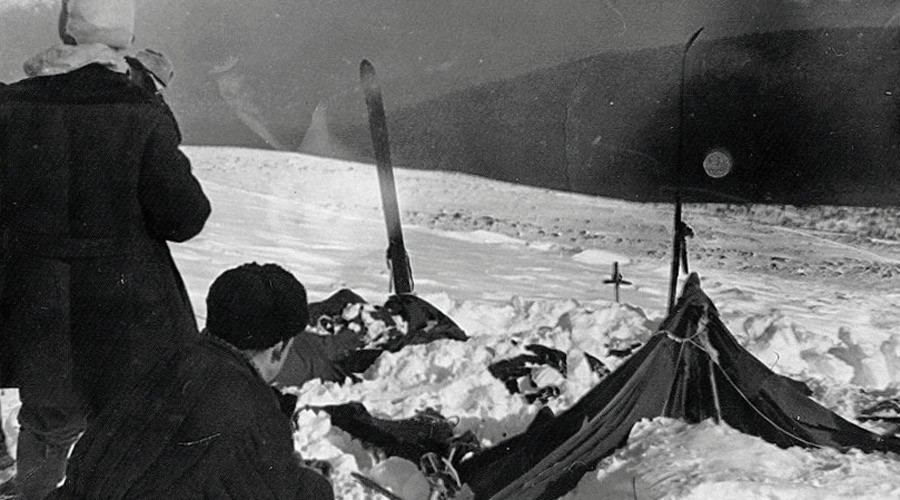

On the night of February 1–2, 1959, nine experienced Soviet hikers died under circumstances so bizarre and contradictory that investigators at the time closed the case with an explanation that explained nothing: death caused by an “unknown compelling force.” The Dyatlov Pass incident — named for the group’s leader, Igor Dyatlov — has remained one of the most intensely studied and hotly debated mysteries in modern history, generating theories ranging from the mundane to the extraordinary. Decades of investigation, newly declassified Soviet documents, and advanced forensic analysis have narrowed the possibilities but have not produced a definitive answer to the question every account returns to: what made nine experienced, healthy mountaineers flee their tent in the middle of the night, in sub-zero temperatures, without their boots?
The Group and the Expedition
The Dyatlov group consisted of eight men and two women, mostly students and graduates of the Ural Polytechnical Institute. All were experienced hikers and skiers rated for the highest difficulty category of Soviet mountaineering expeditions. Igor Dyatlov, the group’s 23-year-old leader, was considered one of the most capable young mountaineers in the Ural region. The group set out in late January 1959 to reach the summit of Otorten mountain in the northern Ural range. They established their final camp on the eastern slope of Kholat Syakhl — a name that translates from the indigenous Mansi language as “Dead Mountain” — on the evening of February 1. Rescue teams who searched for them three weeks later found the tent slashed open from the inside, the group’s belongings still inside, and a trail of footprints leading away into the darkness.
The Bodies and Their Condition
The nine bodies were recovered over several weeks and months, and the conditions in which they were found generated immediate controversy. The first five, found near the tree line, had died of hypothermia. Two of these had their hands and fingers severely damaged, consistent with attempting to climb a tree with extreme urgency. The final four were found months later under several meters of snow in a ravine. These four exhibited catastrophic internal injuries — crushed ribs, a fractured skull, missing eyes and tongue — that the medical examiner described as comparable to injuries produced by a car crash or an extreme pressure wave. Crucially, there was no significant external trauma: the massive internal damage had been inflicted without breaking the skin. One woman was missing her tongue and eyes. No conventional explanation for these injuries — avalanche, animal, human attacker — fully accounts for both the internal damage pattern and the absence of external wounds.
The Physical Evidence and Anomalies
Beyond the injuries, investigators documented several anomalies that have fueled decades of alternative theories. The hikers’ clothing, when tested, showed elevated levels of radioactive contamination — a detail suppressed in the original Soviet investigation and only revealed decades later. Witnesses in surrounding areas reported seeing strange orange orbs in the sky over the Ural mountains on the night of the incident and in the weeks following. The hikers’ skin was described by rescue workers as having a distinctive orange or brown discoloration inconsistent with simple freezing. Some of the hikers’ hair had reportedly turned grey — though this may reflect the decomposition state when recovered. Soviet authorities sealed the case files for 30 years. The combination of radiation contamination, aerial phenomena reports, and the nature of the injuries has made the Dyatlov Pass incident a persistent fixture in both scientific investigation and alternative research.
The Leading Theories
The conventional explanation most seriously pursued in recent years is a slab avalanche — a specific type of snow failure in which a dense layer breaks away from an underlying weaker layer, producing an extremely powerful and fast-moving pressure wave that can cause internal injuries without significant external damage. A 2021 study published in Communications Earth and Environment used computer modeling to show that a small, delayed slab avalanche was physically possible given the slope conditions and could account for the crushing injuries. Critics note that experienced mountaineers would not have camped in an avalanche-prone location, that no avalanche evidence was noted by rescuers, and that the avalanche hypothesis does not explain the radiation contamination, the orange skin discoloration, or the aerial phenomena reports. Military testing in the region has also been proposed: the Ural range was an active Soviet military zone in 1959, and several researchers have pointed to evidence of rocket fuel residue and controlled test events in the area during the relevant period.
The UFO and Paranormal Angle
The UFO hypothesis for Dyatlov Pass draws on the most difficult-to-explain evidence: the radiation contamination, the orange aerial objects witnessed by multiple independent parties, and the nature of the injuries to the ravine victims. Some researchers propose that the hikers encountered a military test of a directed-energy or plasma weapon whose effects on human tissue produced the internal injuries without surface damage, and whose radioactive byproducts contaminated their clothing. Others propose a genuine encounter with an unknown aerial phenomenon whose electromagnetic or physical effects caused both the injuries and the panicked flight from the tent. The Mansi people indigenous to the area have their own traditions about Kholat Syakhl as a spiritually dangerous location, and some local accounts describe the mountain as a place where strange lights appear and where people who camp do not return. Whatever killed the Dyatlov group in 1959, it remains one of the few genuinely unsolved mass death events in modern recorded history.
Discover more from Infinity Explorers
Subscribe to get the latest posts sent to your email.