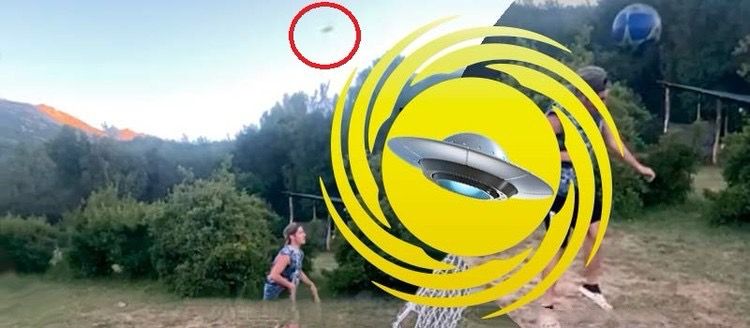


In Argentina, a group of friends gathered at an outdoor park for a relaxing afternoon of volleyball. As one of them pulled out a phone to record the game, none of them noticed the extraordinary object streaking across the sky behind them. It was only when reviewing the footage afterward that the group spotted a high-speed UFO that had transited the entire frame in what appeared to be a fraction of a second.
The Argentina UFO Footage: What the Video Shows
The object captured on video displays several characteristics that make conventional explanations difficult. It moves in a perfectly straight horizontal trajectory at an extraordinary speed — far faster than any commercial aircraft, military jet, or known drone technology could achieve at visible altitude. There is no visible propulsion system, no contrail, and no sound was reported by any of the witnesses at the time. The object appears as a small, elongated shape that traverses the entire video frame in what analysis suggests is no more than two frames of footage — implying a speed of several thousand miles per hour at minimum.
Argentine UFO researchers who examined the footage noted the object’s consistency with other high-speed UAP footage captured across South America in recent years. Argentina has one of the most active UFO sighting records in the world, with the country’s CEFAE (Commission for the Study of Aerospace Phenomena) — a government body — officially tasked with investigating unexplained aerial incidents. Unlike many countries that dismiss such reports, Argentina has maintained institutional interest in UAP research since 2011.
Argentina’s History of Extraordinary UFO Encounters
This incident adds to Argentina’s extensive catalogue of documented UFO encounters. The country has produced some of South America’s most compelling UFO evidence, including the famous 1986 Bariloche incident where a commercial LAN Chile flight encountered a luminous object that maneuvered alongside the aircraft for several minutes, witnessed by both the flight crew and air traffic control. In 1995, witnesses near Buenos Aires photographed a triangular craft hovering above a rural area before accelerating away at tremendous speed. Multiple Argentine military pilots have filed official reports describing objects that outperformed their aircraft in every measurable parameter.
The Andes mountain range, which forms Argentina’s western border with Chile, has been a particular hotspot for UFO activity. Local residents in Andean villages have reported lights, craft, and anomalous objects for generations, with indigenous oral traditions describing sky visitors long before the modern UFO era. Some researchers have speculated that the region’s unique geology — rich in crystalline rock formations and geomagnetic anomalies — may be connected to the unusual frequency of sightings in the area.
What Experts Say About High-Speed UFO Footage
High-speed objects that transit video frames faster than the eye can detect have become one of the most discussed categories in modern UFO research. Unlike hovering or slow-moving objects that can be dismissed as balloons, drones, or weather phenomena, these ultra-fast objects present a genuine analytical challenge. Video analysis experts have noted that some of these objects appear to exceed Mach 10 — ten times the speed of sound — at altitudes where conventional hypersonic vehicles would be easily trackable by military radar.
The 2022 release of UAP footage by the US Department of Defense included objects exhibiting similar high-speed, straight-line trajectories with no visible means of propulsion. The Pentagon’s own assessment of these objects acknowledged that several defied conventional explanation. For the Argentine volleyball group who accidentally captured this footage, the encounter serves as a reminder that extraordinary things can happen in ordinary moments — and that the sky above us may contain far more than commercial traffic and weather systems.
How to Analyze UFO Video Footage: What to Look For
When evaluating UFO video footage like the Argentine volleyball clip, analysts focus on several key parameters. First is apparent velocity — by comparing the object’s size against known reference points in the frame and calculating how many frames it takes to cross the field of view, researchers can estimate minimum speed. Objects that cross a full frame in fewer than three frames at standard 30fps recording are moving at speeds that eliminate most conventional explanations. Second is trajectory consistency — a perfectly straight, undeviating path at high speed rules out birds, insects close to the lens, and most atmospheric phenomena. Third is the presence or absence of aerodynamic features: wings, rotors, exhaust plumes, or navigational lights. The Argentine object displays none of these.
South America has produced several of the most technically credible UFO videos in recent years. Chilean Navy footage released in 2014 showing an unidentified object emitting a plume while being tracked by military aircraft was analyzed by CEFAA — Chile’s official government UFO investigation body — and declared genuinely unidentified after two years of investigation. The Argentine volleyball footage, while less formally analyzed, adds to a growing regional catalogue of high-speed UAP events that challenge both official explanations and public indifference. As smartphone cameras become ubiquitous, the documentation of these events will only improve — and with it, perhaps the scientific community’s willingness to take the question seriously.
Argentina’s CEFAE: The Government Body That Takes UFOs Seriously
Unlike most countries, Argentina has maintained an official government body dedicated to the investigation of unidentified aerial phenomena since 2011. The Commission for the Study of Aerospace Phenomena (CEFAE), operating under the Argentine Air Force, collects and analyzes UFO reports from pilots, military personnel, and civilians. Cases are evaluated using radar data, meteorological records, and witness testimonies, with findings documented in official reports. This institutional infrastructure means that footage like the volleyball clip can be formally submitted for analysis — a significant advantage over countries where such reports have nowhere official to go.
CEFAE’s existence reflects a broader cultural openness in Argentina to the UFO phenomenon that distinguishes it from the more dismissive official stances taken historically in the United States and Europe. Argentine military pilots have filed detailed official reports on encounters that remain unexplained, and the country’s remote regions — from Patagonia to the Andean highlands — generate a disproportionate share of South America’s most compelling sighting reports. The volleyball footage, modest as it appears, is part of a rich and institutionally recognized tradition of Argentine UAP documentation that stretches back decades and continues to be taken seriously at the highest levels of the country’s aerospace establishment.
Citizen Science and UAP Documentation: Why Accidental Footage Matters
One of the most significant shifts in UFO research over the past decade has been the growing role of accidentally captured footage. Unlike deliberate sky-watching sessions, which can be dismissed as the product of confirmation bias, accidental captures — recorded while filming something else entirely — remove the element of selective attention. The witnesses in Argentina were focused on their volleyball game; the UFO was an unintended subject. This type of incidental capture, increasingly common as smartphone cameras become ubiquitous, provides some of the most compelling evidence precisely because it was not sought. As video quality improves and machine-learning tools become available for automated sky surveillance, the documentation of high-speed UAP events like this one will only become more frequent — and more difficult for official bodies to continue ignoring.
The Argentine volleyball UFO remains unidentified. No official investigation has been announced, and the witnesses have not come forward publicly beyond their initial social media posts. But the footage endures — one more data point in the long, unfinished argument about what shares our skies.
Discover more from Infinity Explorers
Subscribe to get the latest posts sent to your email.
One comment