

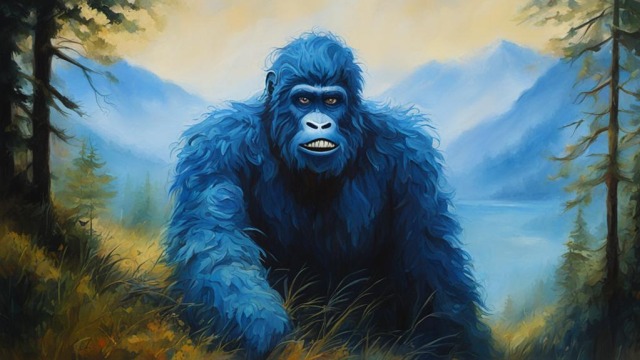

More than a hundred years ago, in the area of the American Ozark mountain plateau, covering the states of Missouri, Arkansas, Oklahoma, and Kansas, there lived a hairy humanoid creature with the fur of a strange unnatural color – it was dark blue Yeti.
This creature was first spotted in the winter of 1865, when experienced hunter Sol Collins was tracking a deer along Spring Creek and saw large tracks on the bank.
At first, it seemed to him that these were the paw prints of a bear, especially since bears were found in abundance in these places. But, having looked closely, he realized that for a bear the tracks were too elongated and looked more like the footprints of a man, only a very large one.
Burning with curiosity, Collins followed the tracks because they were fresh and visible in the newly fallen snow. The creature that left them was somewhere nearby.
Suddenly Collins heard a noise above, at the top of the cliff, and managed to notice how a dark humanoid figure flashed there, and then two large stones rolled down from there. He managed to dodge the falling cobblestones, and at the same time get a better look at this figure. He was very surprised because this creature resembled a man, 3 meters tall, covered from head to toe with fur of a rich dark blue color.
The creature was not just tall, but very muscular, its shoulders looked like huge muscular mounds. It held a thick club in its hands, and while the hunter was staring at it, it grabbed another stone and threw it at the man.
Collins managed to dodge again, but now he got scared and turned and ran away. He reached the city, told other hunters about the blue giant, and then they went in a large crowd to hunt down this creature to catch it and/or kill it.
For several days, Collins and his companions tracked the strange creature and often came across its tracks and the remains of its lunches or dinners – pieces of bloody skins of sheep, pigs, or even dogs. It was clear that this creature preferred to attack livestock.
At one point, the hunters even found a shallow cave filled with pieces of skins, piles of feathers, bones, and other scraps, but the creature itself eluded them.
In subsequent years, many other hunters reported sightings of the blue bigfoot or heard its terrible screams and local newspapers often published stories about the blue beast. But gradually he was seen less and less.
In 1874, there was a new peak in blue yeti sightings. As Ridge Runner magazine wrote, he was first noticed by a certain Oak Collins (no relation to that hunter) while looking for his missing lambs. Again, this happened in the Spring Creek area. Two days later, hunter Cap Turner saw a blue hairy man near Indian Creek. He sat on the shore and caught fish in the water with his huge hands.
When the creature noticed Turner, it jumped up and ran after him, waving a stone ax (!). Fortunately, Turner managed to escape safely.
A few days later, hunter Kal Alsap saw the creature and followed it to a cave. When he climbed into the cave, he found pieces of sheep skins there, but the creature itself had disappeared somewhere. In the following days, several more hunters saw him and he also hid from them in the cave.
By the end of the 19th century, virtually every hunter in the Ozark Plateau region had heard of the blue ape and was trying to find it for fame. But he was still elusive, although he continued to steal sheep from farmers. They guarded their herds with weapons, hired hunters, and combed the plateau in search of the Blue Man, but to no avail.
Then there were reports that a group of hunters managed to surround the blue beast and drive it into a tree, but apparently, it managed to escape again, as no details of this incident have emerged.
In 1911, the Blue Beast reappeared in the Ozark Plateau region and again stole sheep and other livestock. Farmers who saw it noted that the creature moved uncertainly as if it were sick.
And then the following article was published in The Washington Times:
“Six weeks ago, a farmer noticed that two of his lambs had not returned home with the rest of the flock. He searched the hillsides and found bloody sheep’s wool in a hollow deep in the forest. The next day he saw the Blue Man kill a pig in the forest, and ever since then, several other farmers have seen this creature.
His dark blue fur was now more of a dark gray, and his limbs weren’t as muscular as they once were. Still, few hardy residents of the Ozark Mountains would be willing to risk taking on this terrifying creature alone.”
On August 18, 1911, an article appeared in The Sentinel newspaper about the capture of the Blue Man. It began with the fact that two boys saw how the Blue Man crawled out of somewhere on the ground and began to chase their sheep. The boys reported this to the adults and then led a group of hunters to the location where the Blue Man was observed:
“The boys acted as guides, and when they arrived at the site, they discovered a log and an entrance underground, which seemed to be used many times. One of the men dared to push a lantern into the cave, which was of considerable size.
I entered a cave where I saw a man crouched in the depths. He was wearing nothing but a loincloth made of what looked like animal skin. His body was completely covered with short bluish hair, and on his head was a two-foot tuft of hair.
The wild man tried to escape but was caught and turned over to authorities. He couldn’t speak. Wool, animal bones, and feathers were scattered deep inside his cave. There was no evidence that he cooked any food over a fire before consuming it.”
Unfortunately, no further details were received about this
The Capture Operation: How Authorities Responded
captured savage, but Blue People continued to be seen in those forests for some time. In March 1925, the following note appeared in the Nevada Daily News:“Although this man is now dead, many of his children now live in the wild on the banks of Spring Creek, and they are all blue. They walk naked and feed on small wild animals, which they eat raw.
Many reach 7-8 feet tall (2-2.4 meters) and weigh between 300 and 500 pounds (136-226 kg), and can often be seen carrying young horses or cows on their shoulders as they go to their holes or caves. Walking alone at night in these areas is tantamount to death.”
This was the last publication in the American media about the strange Blue Man and his probable descendants from the Ozark plateau; no one else has seen such creatures there since then.
Blue Yeti Sightings in Context: A History of Blue-Tinted Cryptids
Reports of blue or bluish-tinged cryptid creatures are rare but not entirely without precedent in the annals of unexplained animal sightings. The unusual coloration is one of the details that makes the blue yeti case so striking — conventional misidentification of known animals rarely involves anomalous coloring of this specificity. Some cryptozoologists have suggested that the blue tint may result from bioluminescence, a chemical reaction in the creature’s skin similar to that seen in certain deep-sea organisms, or a unique reflective property of its fur or hide. Others have proposed that the sighting may involve a primate species exhibiting a rare genetic condition affecting pigmentation.
The broader category of unidentified bipedal creatures in North America — including Bigfoot, Skunk Ape, and various regional variants — has generated thousands of reported sightings over the past century. While mainstream biology has not confirmed the existence of any such species, the persistence and geographic spread of the reports, combined with occasional physical evidence such as large footprint casts and audio recordings of vocalizations that don’t match any known animal, keeps the question open for serious cryptozoological investigation. A blue variant, if the account is taken at face value, would represent a biologically distinct population from the more commonly reported brown or black-haired bipedal cryptids.
What the Capture Claims Mean for Cryptozoology
The alleged capture of the blue yeti — if it occurred — would represent the most significant moment in cryptozoological history since the concept of the field was formalized. The capture of a living specimen of any unconfirmed species would force a fundamental reassessment of what biologists know about the fauna of North America. It would also raise profound questions about why such a creature has evaded systematic documentation for so long in a continent with extensive wildlife survey infrastructure, trail camera networks, and hunter activity across millions of acres of wilderness.
The fact that no official confirmation of any such capture has been publicly released is consistent with two very different interpretations: either the capture did not occur and the account represents an exaggeration or fabrication, or the capture did occur and the information was suppressed by authorities who determined public disclosure was inadvisable. Given the government’s documented history of compartmentalizing information about UAPs and other anomalous phenomena, the suppression hypothesis is not entirely without precedent — though it remains speculative without direct evidence. The blue yeti case continues to circulate in cryptozoology communities as one of the stranger and more intriguing recent entries in the catalogue of unexplained creatures.
Discover more from Infinity Explorers
Subscribe to get the latest posts sent to your email.
One comment