

Ceres, the largest object in the asteroid belt and the only dwarf planet in the inner solar system, has long been regarded as a geological curiosity — a remnant of planetary formation that never quite made it. That view changed substantially with the arrival of NASA’s Dawn spacecraft, and it has continued to evolve as scientists examine the mission’s data more deeply. What has emerged from that examination is not a confirmed discovery of life, but something arguably more significant in the longer arc of astrobiology: evidence that Ceres possesses, or possessed, the conditions under which microbial life could exist. The implications are profound precisely because Ceres is not an outlier — it is representative of an entire class of objects distributed throughout the solar system.
The Dawn Mission and What It Found
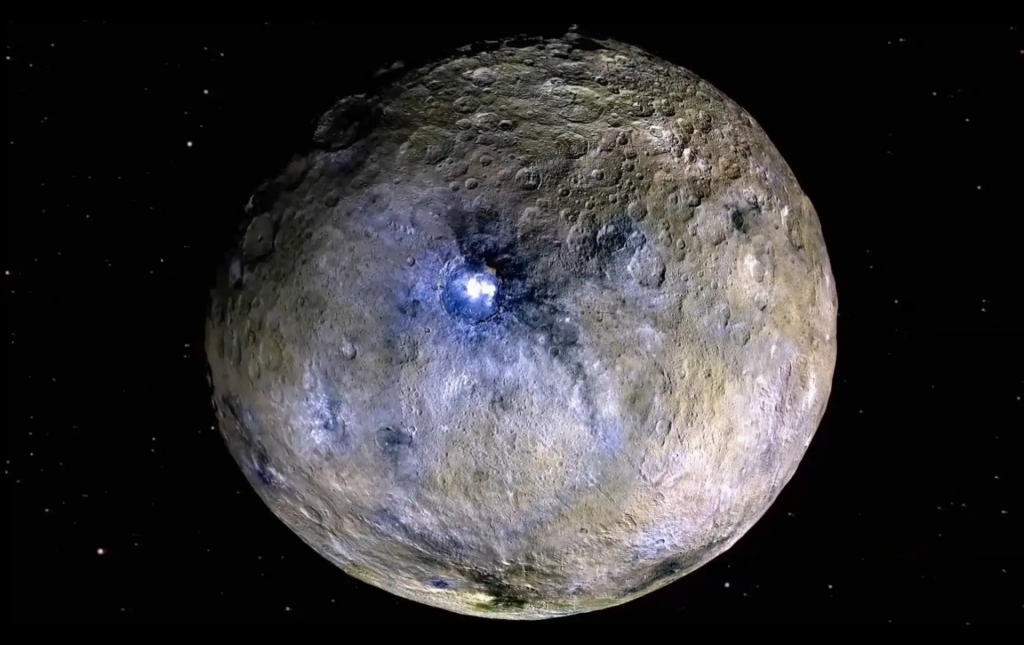
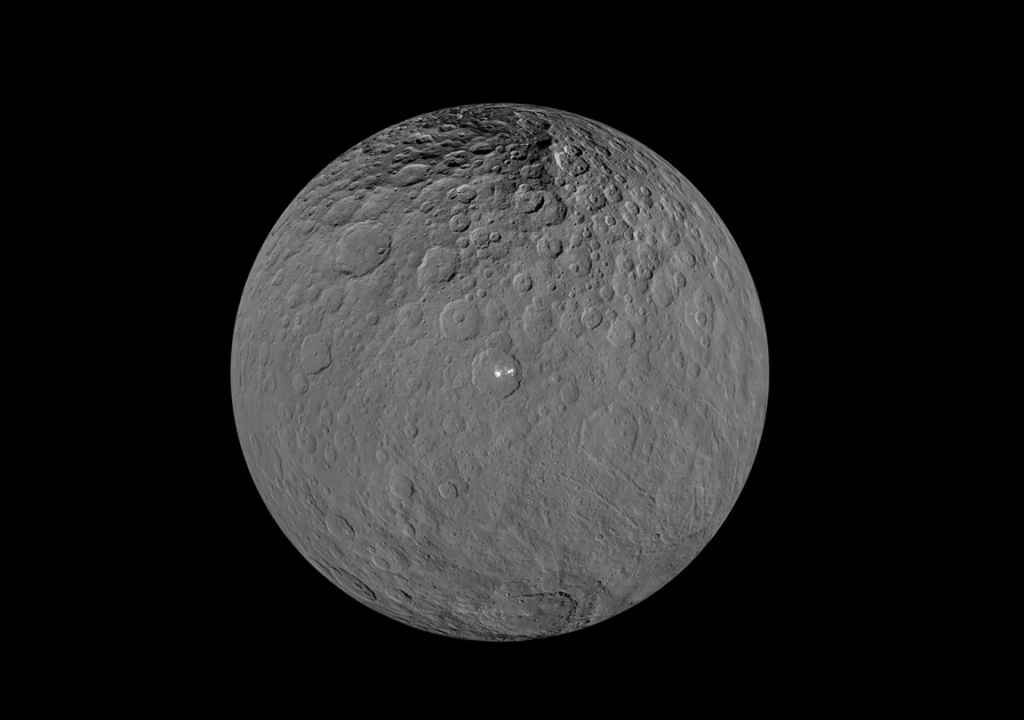
NASA’s Dawn spacecraft entered orbit around Ceres in March 2015, becoming the first mission to orbit a dwarf planet. What it found confounded early expectations. Ceres was not a simple, inert rock. Its surface showed evidence of geological activity far more recent than its age would predict, including bright spots in Occator Crater that early speculation attributed to ice or salt deposits, and that subsequent analysis confirmed were composed largely of sodium carbonate — a compound associated, on Earth, with hydrothermal activity.
The presence of sodium carbonate on Ceres’s surface was significant because it does not survive long in the harsh radiation environment of space without continuous replenishment. Its presence in large quantities at Occator Crater suggested to researchers that it was being actively brought to the surface from below — from a subsurface reservoir or brine pool where liquid water, or at minimum highly concentrated salt water, existed recently enough to be depositing material on the surface. The implications for habitability were immediate: where there is liquid water and mineral chemistry, there is the baseline for life as we understand it.
Evidence of Subsurface Water and Hydrothermal Activity
Analysis of Dawn data published in Nature Astronomy in 2020 provided some of the strongest evidence yet for a persistent subsurface brine reservoir beneath Occator Crater. The study, led by scientists from multiple institutions including NASA’s Jet Propulsion Laboratory, used Dawn’s gravity measurements combined with surface geology to construct a model in which a large subsurface liquid region — not pure water, but hypersaline brine — exists at relatively shallow depth beneath the crater floor. The model estimated this reservoir could be several miles across and perhaps several miles deep.
Critically, the research indicated that the upwelling of material from this reservoir was not a relic event from Ceres’s warmer past but was geologically recent — within the last few million years, and possibly ongoing. Infrared measurements from Dawn’s last months of operation, as the spacecraft was maneuvered into its lowest orbit, detected thermal signatures at the Occator bright spots that were inconsistent with a purely static environment. Something beneath those deposits retains heat in a way that cannot be explained by solar input alone at Ceres’s distance from the Sun.
Organic Compounds: The Biological Connection
Ceres was already known to host organic compounds before the hydrothermal evidence emerged. Dawn’s visible and infrared mapping spectrometer detected organic material on the surface — specifically, aliphatic organic compounds concentrated in a region near the Ernutet crater in the northern hemisphere. The concentration and distribution of these organics suggested to researchers that they had not been delivered by external impacts but had formed locally, either through geological processes within Ceres or through a process that remains unclear.
The combination of organics and liquid water is what elevates the Ceres case from geological interest to astrobiological significance. Neither component alone is sufficient for life — but together, in the presence of an energy source and mineral chemistry, they represent what astrobiologists call a habitable environment. The question of whether an environment is habitable is distinct from the question of whether it is inhabited, but it is the necessary prior question. Ceres, according to the current evidence, passes that test.
What Microbial Life on Ceres Would Mean
If microbial life exists or existed on Ceres, the consequences for our understanding of life in the universe would be far-reaching. Ceres formed in the same protoplanetary disk as Earth, from similar material. If life arose independently in the asteroid belt, it would strongly suggest that life is not a rare, improbable accident that requires the precise conditions of Earth but a chemical process that emerges wherever the basic requirements — liquid water, organic chemistry, energy — are met. This would dramatically increase the estimated number of life-bearing worlds in the galaxy.
There is also the question of panspermia — the hypothesis that life can travel between worlds aboard meteorites or cometary material. Ceres, as the largest body in the asteroid belt, would have been a major source of impactors that struck the early inner solar system, including early Earth. If life ever arose on Ceres, it is at least theoretically possible that Cerean material bearing biological traces reached Earth, or vice versa. The relationship between life on Earth and potential life in the asteroid belt is not necessarily one of complete independence.
The Current Scientific Consensus and Its Limits
It is important to be precise about what the evidence does and does not show. No NASA scientist has claimed to have found microbial life on Ceres. What the research has demonstrated is that Ceres possesses the chemical and physical prerequisites for life — liquid water in the subsurface, organic compounds on the surface, and geologically recent hydrothermal activity providing energy. These are necessary but not sufficient conditions. The leap from “habitable environment” to “inhabited environment” requires direct evidence that does not yet exist for Ceres.
That evidence, if it exists, will require a follow-up mission. Dawn ended its operations in November 2018 when it ran out of fuel. No successor mission to Ceres is currently in development, though the scientific community has repeatedly argued for one. A lander or drilling mission capable of accessing the subsurface brine reservoir would be capable of answering the habitability question definitively — and potentially the life question as well. The technology exists. The will and the funding have not yet materialized. In the meantime, Ceres waits, with its bright spots and its hidden ocean, as one of the most tantalizing candidates for extraterrestrial life in our own solar system.
Why Ceres Matters More Than It Gets Credit For
The Ceres story is undersold relative to the Mars and Europa narratives that dominate public astrobiology discussions. Mars gets rovers and orbiter missions with dedicated PR. Europa gets serious planning for a future lander. Ceres, despite its accessible location, its confirmed liquid water, and its organic chemistry, gets comparatively little attention. Part of this is scale — Ceres is small, its gravity is weak, and it lacks the romantic cultural associations of Mars. But the scientific case for Ceres as a priority target in the search for life is strong, and researchers who work in the field argue consistently that it deserves more attention than it receives. The evidence that NASA has already gathered is not nothing — it is a compelling argument for going back.
Discover more from Infinity Explorers
Subscribe to get the latest posts sent to your email.