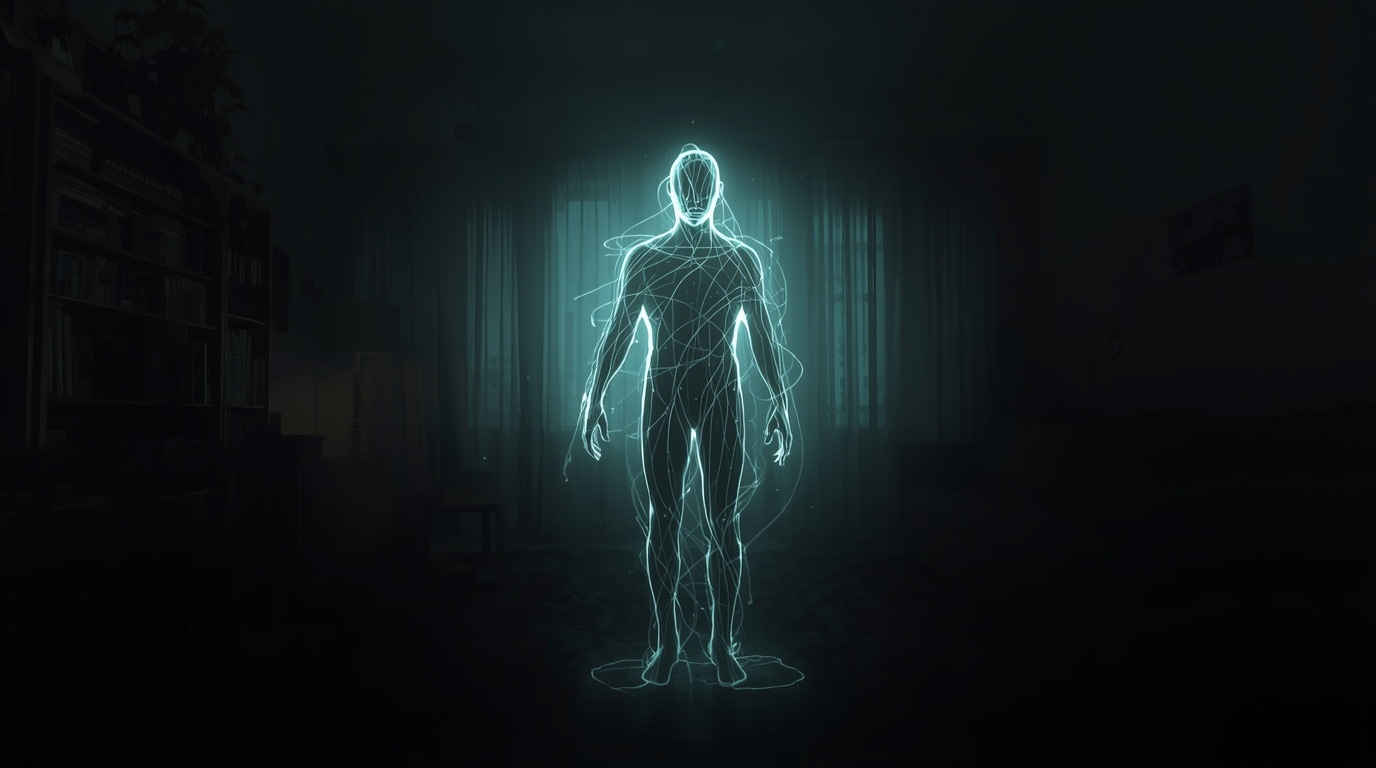

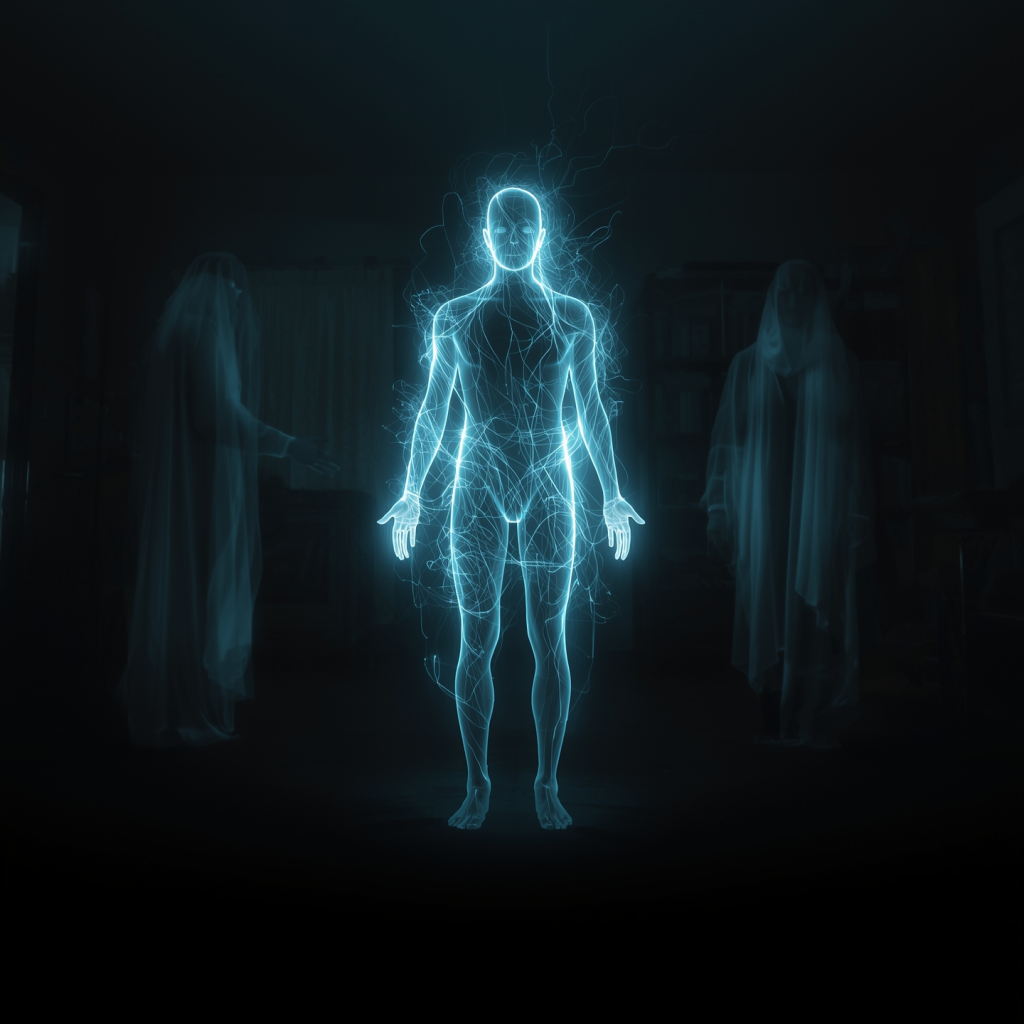
Your body is glowing right now. Not with a light visible to the naked eye — but with a real, measurable, scientifically documented photon emission that radiates continuously from your skin, peaks in the afternoon, concentrates around your face, and stops the moment you die. This isn’t spiritual metaphor or fringe science. It’s been photographed, measured, and published in peer-reviewed journals. And what researchers have found at the moment of death has left even skeptical scientists searching for explanations.
The Discovery: Kobayashi’s 2009 Imaging Study
In 2009, Japanese researcher Masaru Kobayashi and his team at the Tohoku Institute of Technology published a landmark study in PLOS ONE that changed how scientists think about the living body. Using ultra-sensitive CCD cameras capable of detecting single photons in a completely darkened room, they photographed five healthy male volunteers over the course of three days. What they documented was unambiguous: every human body emits a constant stream of visible light photons, thousands of times weaker than what the human eye can perceive.
The emissions weren’t random. They followed precise patterns. Light output was lowest in the morning, peaked in the early afternoon around the face — particularly the forehead and cheeks — and decreased again in the evening. The fluctuations correlated with the body’s circadian metabolic rhythms. This wasn’t heat radiation, which is infrared and exists in a different spectrum. These were visible-light photons, produced as a byproduct of the oxidative biochemical reactions constantly occurring in living cells.
What Biophotons Actually Are
Ultraweak photon emissions (UPE), or biophotons, are produced primarily by the mitochondria — the energy-producing organelles inside cells. As cells metabolize oxygen through oxidative phosphorylation, reactive oxygen species (free radicals) are generated as byproducts. When these molecules return to their ground state, they release the excess energy as photons of visible light. Every living cell in your body is continuously doing this. The result is a faint, coherent light field that permeates and radiates from the entire organism.
What makes biophotons particularly interesting to researchers is their coherence. Unlike random thermal radiation, biophotons show quantum coherence properties — they appear to be organized, not chaotic. Some researchers in the field of quantum biology have proposed that biophoton emissions may play a functional role in cellular communication, acting as a light-based signaling system operating in parallel with chemical signals. This remains an active area of research and has not been definitively confirmed — but the coherence itself is real and documented.
“Your face glows brightest at 2 PM. Your forehead, your cheeks. It dims as evening comes. And at the moment of death, the light surges briefly — then stops completely.”
The Death-Moment Finding
A 2023 study from the University of Calgary and the National Research Council of Canada produced the finding that has generated the most attention. Researchers measuring biophoton emissions in animal subjects documented a consistent and startling pattern: at the moment of death, the photon emission surges — briefly and dramatically increasing — and then stops entirely. The light flares, then goes out.
This pattern was observed consistently across subjects and could not be attributed to simple metabolic rundown. A system running down would show gradually decreasing emissions. Instead, the data showed a terminal surge followed by abrupt cessation — a signature that researchers described as distinct from any known biological process associated with organ failure. What causes the surge is not yet understood. What it means is not yet understood. But it happened, repeatedly, in controlled conditions, and it was measured.
The Deathbed Glow: Centuries of Reports
Hospice nurses and palliative care workers have described, for generations, a phenomenon they call the “deathbed glow” — a subtle luminosity or brightening that some patients exhibit in the hours before death. These accounts exist across cultures and centuries: medieval texts describe saints dying surrounded by visible light, indigenous traditions speak of the spirit-light leaving the body, modern hospice workers report the same phenomenon with striking consistency. Until recently, science had no framework to accommodate these observations. Biophoton research doesn’t fully explain them either — the emissions are far too weak to be seen with the naked eye under normal conditions. But the terminal surge documented in laboratory settings is at least structurally consistent with something happening at the moment of death that isn’t simply metabolic shutdown.
Biophotons and the Aura: Ancient Observation, Modern Evidence
Virtually every major spiritual tradition has depicted human beings as surrounded by a luminous field — the aura in Western esoteric traditions, the halo in Christian iconography, the prana field in Hindu tradition, the qi in Chinese medicine. The universality of this representation, across cultures with no historical contact, has long been noted as suggestive. Skeptics attribute it to psychological projection or artistic convention. Biophoton research doesn’t resolve this debate, but it does establish that there is a real, measurable light field surrounding living human bodies that did not exist in scientific frameworks until the late 20th century.
The correlation between the forehead and cheeks as the brightest emission sites in Kobayashi’s study also maps interestingly onto traditional depictions of halos, which typically surround the head. Whether this is meaningful or coincidental is a matter for individual interpretation. What is not a matter of interpretation is the measurement itself: the light exists, it concentrates around the face, and it is real.
What Science Still Cannot Explain
The scientific understanding of biophotons is incomplete in ways that matter enormously for the bigger questions. Why does the terminal surge occur? What triggers the sudden increase in photon emission at the moment of death, before the system fully shuts down? If it’s purely metabolic — reactive oxygen species flooding out of dying cells — why is the pattern so consistent and so distinct from the gradual decline that characterizes other metabolic markers at death?
Current research is focused on understanding biophotons as biological signals and investigating their potential role in cellular communication and tissue regulation. The death-related findings are a secondary focus, and the research is slow. What exists right now is a confirmed phenomenon — a documented light that lives in you and leaves when you die — that science can measure but not fully explain. Whether the explanation, when it comes, will be purely biochemical or will require a framework that current science doesn’t yet possess, remains one of the most interesting open questions in biology.
“Science can measure the light. It can document the surge at death and the abrupt cessation. What it cannot yet explain is why — or what, exactly, stops.”
Discover more from Infinity Explorers
Subscribe to get the latest posts sent to your email.