

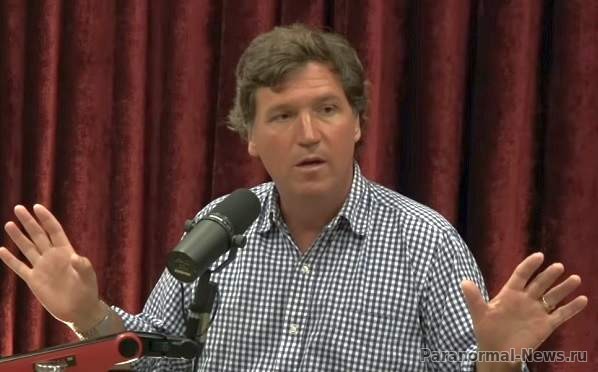
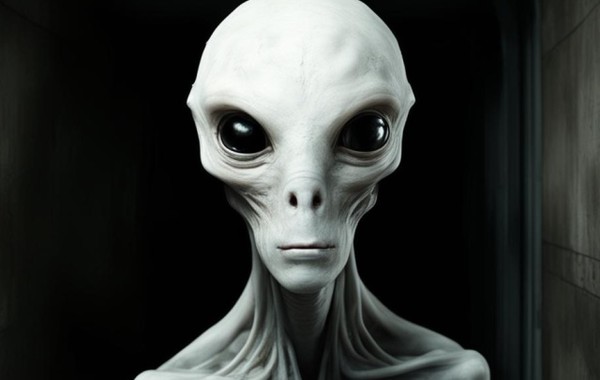
When Tucker Carlson publicly stated that he believes UFOs are not extraterrestrial spacecraft but spiritual or demonic entities, it marked one of the most significant moments of mainstream cultural engagement with an alternative UAP hypothesis that serious researchers have actually debated for decades. Carlson’s comments — made across multiple interviews and podcast appearances in 2023 and 2024 — brought a theological interpretation of the contact phenomenon into prime-time discourse in a way that generated both ridicule and genuine discussion. Whether his conclusion is correct or not, the hypothesis he articulated has a more substantive intellectual foundation than its critics typically acknowledge.
What Tucker Carlson Actually Said
Carlson’s statements on UAP were not a single offhand comment but a sustained position developed across several high-profile conversations, including appearances on Joe Rogan’s podcast and interviews with figures in the UAP research community. His core argument was that the behavior of UAP — their apparent ability to materialize and dematerialize, their interaction with human consciousness, their tendency to appear around spiritually or psychologically significant moments — is more consistent with a spiritual or interdimensional intelligence than with physical craft piloted by biological beings from another star system.
He also drew on his conversations with members of Congress and intelligence officials who had been briefed on UAP programs, noting that some of these individuals had reached similar conclusions independently. Carlson was careful to distinguish between what he was asserting — a hypothesis he found compelling — and what he claimed to know definitively, framing his position as a reasonable inference from available evidence rather than established fact. This nuance was largely lost in the media coverage of his statements, which tended to flatten his argument into simple dismissal.
The Interdimensional Hypothesis: A Serious Research Tradition
Carlson’s position aligns with what UAP researchers call the Interdimensional Hypothesis, or IDH — a framework that has been seriously advanced by some of the most credentialed figures in the field. Dr. Jacques Vallée, the French-American computer scientist and UAP researcher who served as the inspiration for the character Lacombe in Close Encounters of the Third Kind, has argued for decades that UAP cannot be adequately explained by the extraterrestrial hypothesis. His books, including “Passport to Magonia” and “Dimensions,” document the structural parallels between UAP encounters and the fairy folklore, religious visitation accounts, and mystical experiences of pre-modern cultures — parallels he argues are too consistent to be coincidental.
Vallée’s conclusion — shared by researchers including John Keel, who coined the term “ultraterrestrials” to describe beings that may exist in dimensions adjacent to our own rather than on other planets — is that the phenomenon interacts with human consciousness in ways that physical spacecraft piloted by distant aliens would not. The ability of UAP to appear and disappear without physical trace, to be seen by some observers but not others in the same location, to produce psychological transformations in witnesses, and to adapt their apparent form to the cultural expectations of the era they appear in are all features more consistent with a consciousness-interactive intelligence than with a physical technology.
The Spiritual Framing and Its Theological Dimension
Carlson’s specific framing — that UAP may be demonic or spiritually malevolent entities — goes beyond the neutral interdimensional hypothesis into explicitly theological territory. This framing has precedent: researcher Lynn Catoe’s 1969 bibliography on UAP literature, prepared for the US Air Force, noted that a large portion of the contact literature closely paralleled descriptions of demonic encounters in religious texts across cultures. More recently, researcher Dr. Michael Heiser argued from a biblical studies perspective that the beings described in ancient texts as “gods,” “angels,” and “fallen angels” — and the beings described in contemporary UAP contact accounts — may be phenomenologically related.
This theological interpretation is not confined to Christian frameworks. Researchers examining contact accounts across Islamic, Jewish, Hindu, and indigenous traditions have documented similar structural parallels — beings with non-human intelligence who interact with humans, possess superior knowledge and power, operate under a hierarchical authority structure, and are sometimes associated with deception or manipulation. Whether these cross-cultural parallels reflect a single phenomenon encountered across different cultural frameworks, or simply the universal tendency of human minds to pattern-match anomalous experience onto existing spiritual categories, is the central interpretive question that Carlson’s public framing, whatever its limitations, has brought into mainstream discussion.
Pushback from the UAP Research Community
Not all UAP researchers have welcomed Carlson’s framing, even those sympathetic to non-extraterrestrial interpretations. The concern is that the “demonic” label introduces a layer of theological assumption that is neither necessary nor supported by the evidence, and that it risks conflating the phenomenological observation — that UAP behave in ways inconsistent with simple physical craft — with a specific metaphysical conclusion that goes well beyond what the data supports. Researchers like Dr. Garry Nolan have argued that the phenomenon may be better understood in terms of advanced physics — consciousness-interactive technologies or even biological intelligence of a kind that human science has not yet characterized — rather than invoking theological categories.
This debate within the research community is ultimately productive, because it forces a more rigorous examination of what the evidence actually shows versus what interpretive frameworks are being imposed on it. Whether the intelligence behind UAP is demonic, ultraterrestrial, interdimensional, or something for which human language has no adequate category is a question that will not be resolved by assertion. What Carlson’s intervention has done — whatever one thinks of his specific conclusion — is put the spiritual and consciousness dimensions of the phenomenon on the mainstream agenda in a way that purely technical or governmental disclosure discussions have not. That, regardless of his answer, is a genuine contribution to the conversation.
Discover more from Infinity Explorers
Subscribe to get the latest posts sent to your email.
Tucker Carlson is known to be a liar, so I wouldn’t believe anything he says.