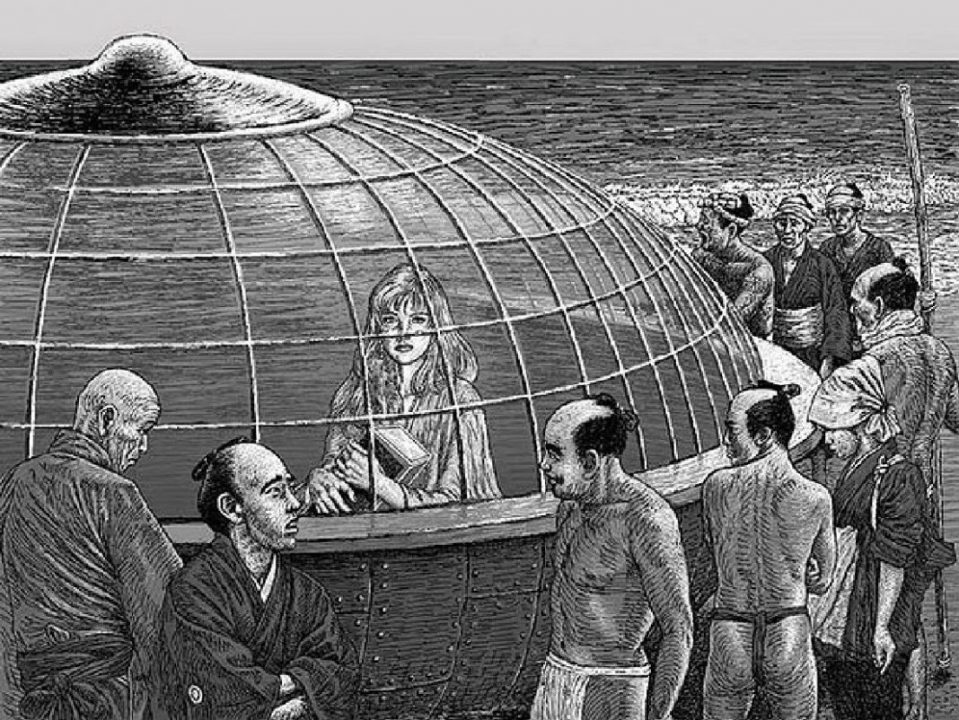

In February 1803, fishermen working the coastal waters of Hitachi Province on Japan’s eastern shore encountered something that would be recorded in multiple independent documents and debated by scholars for more than two centuries. A strange vessel drifted toward the shore — circular, flat-bottomed, constructed from materials and in a configuration that no one present could identify as belonging to any known shipbuilding tradition. Inside was a young woman. She was alive, apparently unhurt, and spoke a language no one could understand. She carried with her objects that defied identification. And then, before any sustained communication could be established, she and her vessel were released back to the sea — an encounter so brief and so strange that it has since become one of the most intriguing potential historical UFO cases on record.
The Primary Sources: How We Know What We Know
What makes the Utsuro-bune (literally “hollow boat” in Japanese) account unusually credible as a historical anomaly is the existence of multiple independent written records. Three separate documents — Toen shōsetsu (1825), Hyōryū kishū (1835), and Ume no chiri (1844) — each provide accounts of the encounter, with significant overlap in detail and some variations that suggest independent sourcing rather than copying from a single original. These were not fringe publications; they were mainstream works of their era, recording curious events alongside other unusual occurrences of the period.
All three accounts describe the same essential elements: a circular vessel, a young foreign woman with unusual physical features, a box she kept close and refused to allow anyone to touch, and a language that defeated all attempts at translation. The documents include illustrations of the vessel that are consistent across sources — a flat-bottomed circular craft with a domed upper portion, windows of glass or crystal, and exterior decorations. These illustrations have drawn considerable attention from researchers, who note their resemblance to descriptions of UFOs from the modern era despite predating the UFO phenomenon by over a century.
The Woman: Physical Description and Behavior
The accounts describe the woman as young — estimates range from 18 to 20 years old — with pale skin, red and white hair, and eyebrows that were shaved and repainted higher on her forehead, a Japanese cosmetic practice of the period that suggests she may have adopted some local custom or that the observers interpreted her appearance through a Japanese cultural lens. Her clothing was described as made of materials of unfamiliar origin and construction. She was calm throughout the encounter, showing curiosity rather than fear — observers noted that she seemed more interested in examining the people around her than distressed by her situation.
The most persistent detail across all accounts is the box. The woman held a lacquered box approximately two feet long and refused with consistent firmness to allow anyone to touch or examine it. When attempts were made to open or take it, she reacted with distress that was out of proportion to her otherwise composed demeanor. What the box contained was never determined. Researchers have proposed interpretations ranging from a communication device to navigational equipment to simply a personal object of profound sentimental or ritual significance. The box’s contents remain one of the most tantalizing unknowns in the entire case.
The Vessel: Its Design and Construction
The craft described in the Utsuro-bune accounts is what has most captured the attention of UAP researchers. The illustrations accompanying the written records show a vessel that is disc-shaped — circular when viewed from above, with a dome or raised section on top. The exterior is described as made from a dark, treated wood below the waterline and iron-plated above, with glass or crystal windows set around the upper section. The interior contained what the accounts describe as carpets and furnishings, and the walls were apparently covered with text or symbols in a script no observer could read.
No propulsion system is described or visible in the illustrations. The craft had apparently drifted to shore rather than being steered there, though whether this was by design or accident is unknown. Its construction, as described, does not correspond to any known maritime tradition — not European, not Chinese, not any of the Pacific cultures whose vessels were known to Edo-period Japanese fishermen. Attempts to explain it as a drifted European or American craft of the period run into the problem that no circular-hulled vessel of this description was built in the Western tradition at this time.
Conventional Explanations and Their Limitations
Skeptical researchers have proposed several conventional explanations for the Utsuro-bune account. The most popular is that the woman was a foreign national — perhaps Russian, Dutch, or from another European country — whose vessel was a prototype of some experimental design, and that her foreignness and the language barrier created the impression of inexplicable strangeness. This explanation runs into difficulties with the vessel’s described shape: no round or disc-shaped vessels of the period are documented in European or American maritime records, and the described construction does not match any known experimental design of the era.
Another proposed explanation is that the accounts are allegorical or fictional — morality tales constructed around a foreign woman symbolizing the dangers of contact with the outside world during Japan’s period of strict isolation. This interpretation is supported by some scholars of Japanese literature who argue the narrative structure fits the conventions of cautionary tale genres. However, it struggles to account for the existence of three independent accounts with consistent physical detail, and for the specificity of the descriptions, which go well beyond what a literary allegory would require.
The Utsuro-bune in the Context of UAP History
For UAP researchers, the Utsuro-bune case holds a particular significance: it represents one of the oldest documented encounters in which a credible primary source describes a craft of unknown origin and an occupant of that craft making direct contact with humans. It predates the modern UFO era by nearly 150 years, predates any cultural contamination from science fiction, and comes from a society that had no particular tradition of aerial visitors or extraterrestrial beings — making it a culturally independent data point.
The case was brought to international UAP research attention largely through the work of Japanese historian Kazuo Tanaka, whose 1990s analysis examined the primary sources in detail and argued for their genuine historical character. Since then, the Utsuro-bune has appeared in academic conferences on UAP history, in investigative books treating the subject seriously, and in the growing body of research that takes a cross-cultural and cross-historical view of the contact phenomenon. Whatever happened off the coast of Hitachi Province in February 1803, it generated documentation that has outlasted every attempt to explain it away — and that, in the study of unexplained phenomena, is itself a form of evidence.
Discover more from Infinity Explorers
Subscribe to get the latest posts sent to your email.