


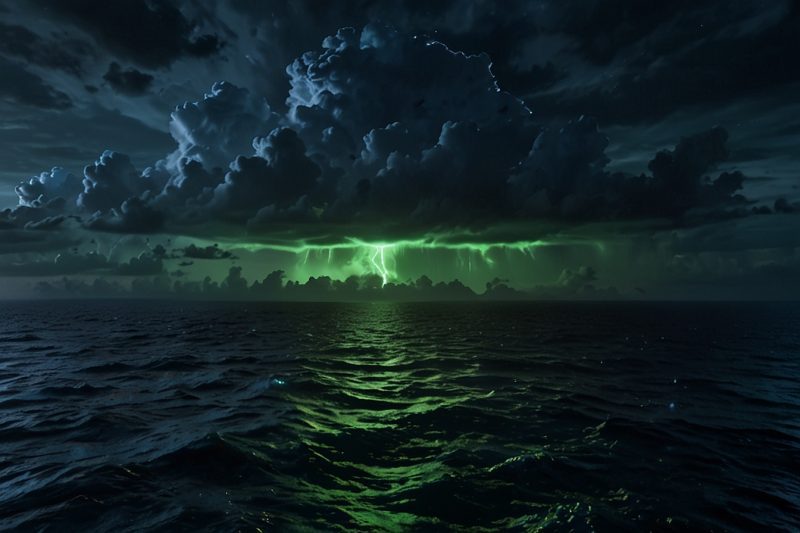
For decades, the Bermuda Triangle has been the world’s most famous geographical mystery — a loosely defined patch of Atlantic Ocean between Miami, Bermuda, and Puerto Rico where ships and aircraft have reportedly vanished under inexplicable circumstances. Scientists have long sought to demystify it, and the methane hydrate theory — which proposes that massive underwater gas eruptions could sink ships and disable aircraft — gained significant traction in the 2000s. But new bathymetric data published in early 2026 has thrown that explanation into doubt, while simultaneously raising a far more unsettling possibility.
What the New Seafloor Data Shows
A joint research team from the University of Miami and the Woods Hole Oceanographic Institution has completed a high-resolution sonar mapping of the seabed beneath the Triangle’s most historically active zones. What they found was unexpected: rather than the cratered, gas-vented seafloor predicted by the methane hydrate model, large sections of the mapped area show unusually smooth, glassy topology — as if sections of the ocean floor have been subjected to intense, focused heat events of enormous magnitude.
“We expected to see a landscape shaped by geological processes we understand,” said Dr. Maria Suarez, the project’s lead geomorphologist. “What we found instead raises questions we don’t currently have the framework to answer.”
The Electromagnetic Anomaly
Simultaneously, a separate study published in the Journal of Geophysical Research documented recurring, localised electromagnetic anomalies within the Triangle that do not correspond to any known geological or atmospheric cause. The anomalies appear as concentrated spikes in the magnetometer data — brief, intense, and highly localised — that recur at irregular intervals. Crucially, their positions on the map correlate with several of the most documented disappearance events, including the 1945 vanishing of Flight 19, a group of five US Navy torpedo bombers that disappeared during a training exercise and whose wreckage has never been found.
The Disappearances Revisited
The Bermuda Triangle’s reputation rests on a body of disappearances that, when examined individually, often have mundane explanations — human error, unexpected weather, mechanical failure. Sceptics have long argued that the Triangle’s disappearance rate is no higher than any comparable stretch of ocean. But the new electromagnetic data has prompted some researchers to revisit the most anomalous cases: those where aircraft reported compass malfunctions, disorientation, and visual phenomena immediately before vanishing.
The most striking of these is the 1978 disappearance of a Cessna 172 whose pilot radioed that his compass was spinning uncontrollably and that the ocean “didn’t look right” before communication was lost. The aircraft was never found. Its last known position, when overlaid on the new electromagnetic anomaly map, places it within metres of the strongest recurring anomaly signature.
Theories the Data Cannot Rule Out
The research team has been careful not to overstate its conclusions. Dr. Suarez’s paper lists several possible explanations for the smooth seafloor topology, including ancient volcanic activity, sediment displacement events, and hydrothermal processes. The electromagnetic anomalies are attributed tentatively to deep crustal stress events — essentially, the magnetic equivalent of micro-earthquakes.
But the team’s own data contains an anomaly that none of these explanations adequately addresses: the electromagnetic spikes show a geometric regularity that is inconsistent with random geological activity. Three of the five strongest recurring anomaly positions form an equilateral triangle with sides of almost exactly 12 nautical miles. “That’s the kind of pattern you expect from human engineering,” one of the paper’s peer reviewers noted in their published comments. “Not from plate tectonics.”
What Happens Now
The Woods Hole team is seeking funding for a deep-diving submersible survey of the smoothed seafloor sections. If the topology was caused by heat events, core samples should reveal a distinctive vitrification signature that would date the event and potentially identify its cause. The electromagnetic study team, meanwhile, has deployed three permanent monitoring buoys to build a longitudinal dataset of the anomaly patterns.
The Bermuda Triangle has been declared a myth many times over. The new data doesn’t resurrect the myth — it replaces it with something more specific, more measurable, and considerably harder to explain away.