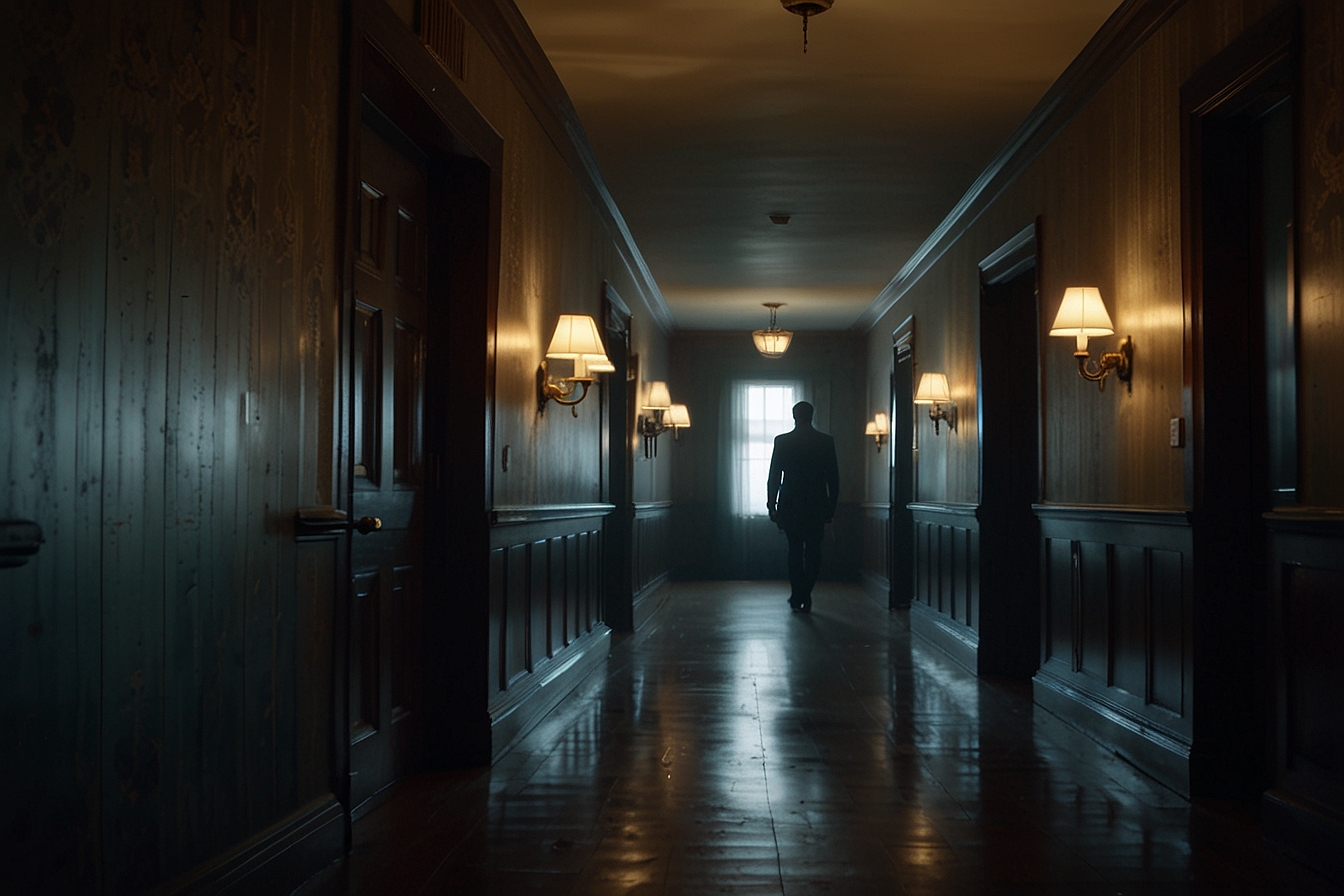

The Stanley Hotel in Estes Park, Colorado — the inspiration for Stephen King’s The Shining — receives thousands of paranormal investigators every year. But in February 2026, a team from the Colorado Paranormal Research Institute conducted what may be the most technologically sophisticated ghost investigation ever performed at the property, deploying equipment typically reserved for military acoustic surveillance and medical imaging research. What they recorded has left even committed sceptics struggling to find an alternative explanation.
The Equipment That Changed Everything
Previous paranormal investigations at The Stanley — and at haunted locations generally — have relied on EMF meters, thermal cameras, and audio recorders. The CPRI team brought something fundamentally different: a phase-coherent acoustic array originally developed for detecting structural anomalies in aerospace components, capable of mapping sound reflections in three dimensions to within centimetre accuracy. Alongside it, they deployed a medical-grade EEG monitoring system to track the neurological states of investigators in real time, and a quantum magnetometer sensitive to field changes as small as one femtotesla.
“We weren’t there to validate ghost stories,” said Dr. Thomas Arriaga, the team’s lead physicist. “We were there to take measurements. Whatever the measurements show, they show.”
Room 217: The Data
Room 217 is the most famous room in The Stanley — where Stephen King himself stayed and had the nightmares that inspired his novel. It is also the room where the team recorded the most anomalous data. At 2:17 AM on February 14th — a coincidence that the team noted but declined to assign significance to — the quantum magnetometer recorded a localised magnetic field fluctuation of approximately 340 femtotesla that lasted for 4.3 seconds. For context, the Earth’s background magnetic field varies by roughly 20-50 femtotesla over the course of a day due to solar activity. A 340 femtotesla spike, localised to a volume roughly the size of a person, with no identified source, is extraordinary.
Simultaneously, the EEG readings of the two investigators present in the room showed a synchronised spike in theta wave activity — the brainwave frequency associated with hypnagogic states and vivid imagery. Both investigators independently reported a sense of “pressure” and the smell of rose perfume, which is historically associated with the ghost of former housekeeper Elizabeth Wilson, who survived a gas explosion in Room 217 in 1911.
The Acoustic Mapping Anomaly
The acoustic array data yielded a separate, equally puzzling result. During a period of complete silence — no investigators speaking, no external noise, verified by the baseline recording — the array detected a coherent sound reflection pattern that did not correspond to any physical surface in the room. In effect, the acoustic data showed something reflecting sound from a position in the room’s centre where there was nothing to reflect it.
The reflection lasted approximately 11 seconds and moved slightly during that time — a trajectory that Dr. Arriaga described as “consistent with a standing human figure taking two or three slow steps.” He has been careful to note that this could represent an equipment artefact or an unidentified atmospheric phenomenon. He has also been careful not to claim that it does.
What Science Can and Cannot Say
The CPRI report, now under peer review, presents its findings without drawing paranormal conclusions. The magnetic anomaly is described as “of unknown origin.” The acoustic signature is described as “unexplained by standard reflective modelling.” The neurological synchronisation is noted but not interpreted.
What the report does say — and what has generated significant discussion in both paranormal research and mainstream scientific communities — is that the three anomalies occurred simultaneously, in the same location, and that no mundane explanation has yet been identified that accounts for all three at once. “One anomaly is a curiosity,” Dr. Arriaga told a conference in Denver last month. “Three simultaneous, correlated anomalies is a research finding.”
The Bigger Picture
The Stanley Hotel investigation is one of several recent instances where serious scientific instrumentation has been deployed in environments traditionally studied only by amateur investigators. A similar project at the Winchester Mystery House in California and a German university study of a reputedly haunted medieval castle in Bavaria have produced comparably anomalous data. None of these studies constitute proof of anything supernatural. But collectively, they suggest that the phenomena being reported at these locations — whatever their ultimate cause — are real, measurable, and worthy of serious scientific attention.
The question haunted locations have always posed is simple: what is actually happening there? For the first time, we may finally have equipment sophisticated enough to find out.
Discover more from Infinity Explorers
Subscribe to get the latest posts sent to your email.