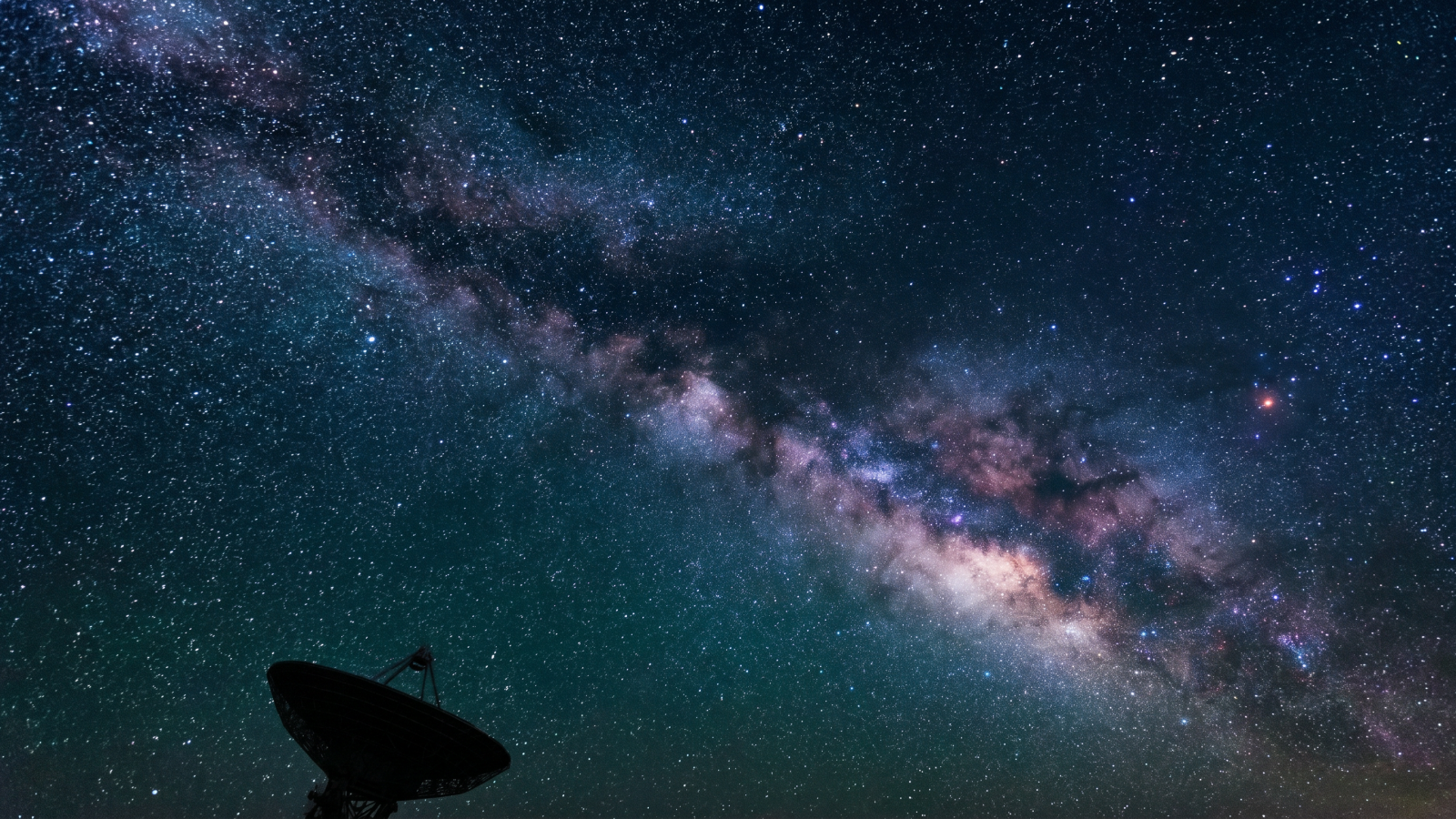

The Dark Forest theory is the proposition that the universe appears silent because every civilisation that has ever existed in it has, with very good reason, chosen to stay quiet. Any species that broadcasts its location to the cosmos invites destruction by an unknown other. The rational equilibrium, given imperfect information and the impossibility of verifying any other civilisation’s intentions, is silence. The forest is full. The animals know it. They are not making noise. And the longer humanity continues to broadcast itself into deep space, the closer we may be to learning exactly what is out there listening.
The theory was popularised in the West by Liu Cixin’s 2008 novel The Dark Forest, the second volume of his Three-Body Problem trilogy. Its underlying logic, however, predates the novel by decades and emerges from real game-theoretic and economic reasoning about strategic communication under uncertainty. It is not a writer’s invention. It is the cold conclusion that several of the twentieth century’s most serious thinkers about extraterrestrial intelligence have quietly arrived at and that the SETI community has, in its more honest moments, refused to dismiss.
The Fermi Paradox: The Question The Theory Answers
The puzzle Dark Forest answers was first articulated, in informal form, by the physicist Enrico Fermi during a 1950 lunch at Los Alamos. The reasoning is straightforward and devastating: there are approximately 200 billion stars in the Milky Way alone, the galaxy is roughly 13 billion years old, and even at slow sub-light interstellar travel speeds (say, 0.01% of the speed of light) a single civilisation could colonise the entire galaxy in a few hundred million years — a small fraction of the time available.
If even a tiny fraction of stars produce life, and a tiny fraction of life produces intelligence, and a tiny fraction of intelligence becomes spacefaring, the Milky Way should be visibly inhabited.
It is not. “Where is everybody?” Fermi asked.
Seventy-five years later, despite radio surveys (SETI, Breakthrough Listen), optical and infrared sky surveys, and an emerging field of techno-signature astronomy, the sky remains silent. The Drake Equation — the formal framework proposed by Frank Drake in 1961 to parameterise the question — has produced credible estimates ranging from “we are the only intelligent species in the galaxy” to “there are thousands of detectable civilisations and we should be hearing them constantly.”
Dark Forest is the answer that gets quietly more compelling the longer the sky stays empty: the sky is silent not because nobody is there, but because everyone is hiding.
The Game Theory At The Core
Liu Cixin’s formulation has two axioms and three logical chains.
Axiom 1: Survival is the primary need of any civilisation.
Axiom 2: Civilisations continuously grow and expand, but the total matter in the universe is finite.
From these axioms, Liu derives three chains that close the trap:
- The chain of suspicion. Two civilisations encountering each other cannot reliably communicate intentions. Any signal could be a lie. Any peaceful gesture could be a feint. Trust is impossible to establish across interstellar distance, and the message-transit time alone — years or centuries — means by the time a peaceful response arrives, the responding civilisation may have changed its mind. The default rational stance toward any other civilisation is therefore suspicion.
- Technological explosion. Because civilisations grow at uneven rates, even a civilisation that is currently less advanced than yours may, in the time it takes for your signal to reach them and theirs to return, have leapt ahead of you. Any other civilisation, however weak now, could be a fatal threat by the time of meaningful contact.
- The dark forest equilibrium. Given suspicion plus the possibility of technological explosion, the only rational strategy for any civilisation that values its survival is to maintain total silence — to never broadcast position, never advertise existence, and to immediately destroy any other civilisation whose position becomes known, before that civilisation can become a threat or alert other listeners.
The metaphor that gives the theory its name: the universe is a dark forest, every civilisation is an armed hunter creeping carefully through the trees, and any movement — any sound — is met with an immediate killing shot before the other hunter can determine who or what made it.
Where The Theory Came From
Dark Forest is not original to Liu Cixin, though his is the most fully developed and culturally influential formulation. The underlying logic appears in serious earlier work by several thinkers:
- David Brin’s “Great Silence” papers (1983 and 1990) explored the possibility that the silence of the cosmos was selected for by predatory behaviour.
- Greg Bear’s Forge of God (1987) presented a fictional scenario in which Earth is destroyed by a self-replicating probe sent precisely because Earth’s radio leakage betrayed its position.
- Robin Hanson’s “Burning the Cosmic Commons” (1998) modelled the colonisation-and-conflict dynamics that Dark Forest depends on.
Liu’s contribution was to systematise the logic as a complete answer to the Fermi paradox and to dramatise it through fiction at sufficient scale that it entered general cultural circulation. Following the Three-Body Problem trilogy’s English-language publication in 2014–2016 and its Netflix adaptation in 2024, “Dark Forest” became one of the few Fermi-paradox solutions to penetrate beyond specialised astrobiology discussion.
The Scientists Who Quietly Believe It
This is the part of the Dark Forest story the popular press tends to underplay. The theory is not, despite the mockery it sometimes receives, a fringe sci-fi idea — it is taken seriously by some of the most credible names in modern astronomy and theoretical physics.
Stephen Hawking, in his 2010 Discovery Channel documentary Into the Universe with Stephen Hawking, articulated the Dark Forest position in clear, deliberate language: any civilisation advanced enough to receive our signals would be advanced enough to destroy us, and we have no reliable way to assess their intentions before they arrive. Hawking’s framing was a direct echo of Liu Cixin’s. He went on, in subsequent interviews, to explicitly recommend that humanity should stop broadcasting and start listening.
Carl Sagan, the public face of SETI for an entire generation, expressed extended reservations about active broadcasting (METI — Messaging Extraterrestrial Intelligence) for decades before his death in 1996. His position, on the record across multiple interviews and his published work, was that human civilisations had no right to commit Earth to a course of action whose consequences would not become apparent for centuries.
A substantial portion of the current SETI Institute and Breakthrough Listen leadership has either publicly endorsed METI-restriction positions or quietly declined to participate in METI broadcasts. The theory’s critics within mainstream astronomy exist. The endorsers, when you actually read what they have said, often outnumber them.
The Signals We Have Already Sent
The Dark Forest debate is not theoretical. Humanity has been broadcasting itself into space for almost a hundred years, and the deliberate signals are only the start of it.
Earth has, since the early 20th century, been leaking radio and television signals into space at energy levels detectable from at least a few light-years away. Every commercial broadcast since the 1930s has been part of a continuous radio bubble expanding outwards from our planet at the speed of light. The bubble is now roughly a hundred light-years across. Hundreds of star systems are inside it.
And then there are the deliberate signals. Several METI broadcasts have been transmitted with the explicit purpose of advertising Earth’s existence:
- The 1974 Arecibo Message to the globular cluster M13, transmitted by the Arecibo Observatory in Puerto Rico, contained an explicit description of Earth’s biology, our solar system, and our location.
- The 2008 “Across the Universe” broadcast transmitted The Beatles’ song of the same name to the star Polaris.
- The 2017 Sónar Calling broadcast from Spain transmitted a deliberate radio message to the planetary system around Luyten’s Star (GJ 273), 12.4 light-years away.
The Sónar broadcast will arrive at Luyten’s Star around 2029. If anyone is listening — and if the Dark Forest theory is correct about what they do when they detect a signal — humanity’s first confirmed contact may not be a welcome one. And we will not know it is coming, because by the time we detect any response, it will already be in the air.
Have The Hunters Already Noticed Us?
This is where the Dark Forest argument crosses from astronomy into something more uncomfortable.
If the Dark Forest equilibrium is correct, an Earth that has been radio-broadcasting for nearly a century, in a galaxy crawling with advanced civilisations, should have already been detected. And a civilisation that has been detected — under the theory’s own logic — should already be the subject of careful, silent observation by whichever hunter detected it first.
The disclosure cycle of the past decade has been unusually consistent with that prediction. The 1977 Wow! Signal, the four-decade pattern of unexplained Hessdalen lights in Norway, the 2017 detection of ‘Oumuamua, the steady stream of credentialed UAP whistleblower testimony from inside the US national security establishment — every one of these is consistent with the picture Liu Cixin’s hunters paint. The forest may not be silent. The forest may simply be silent to us.
Frequently Asked Questions
What is the Dark Forest theory?
The Dark Forest theory proposes that the universe appears silent because every civilisation in it has rationally chosen to hide its location, recognising that any other civilisation is a potential existential threat and that interstellar communication makes peaceful coexistence impossible. It is the most chilling answer ever proposed to the Fermi paradox — and one of the most internally consistent.
Who invented the Dark Forest theory?
The most fully developed formulation comes from Liu Cixin’s 2008 novel The Dark Forest, the second book of his Three-Body Problem trilogy. The underlying game-theoretic reasoning appears in earlier serious work by David Brin (1983, 1990), Greg Bear (1987), and Robin Hanson (1998), among others. The theory is not a fictional invention — it is a fictional dramatisation of decades of academic thinking on the Fermi paradox.
Is the Dark Forest theory taken seriously by scientists?
Yes — by some of the most senior names in modern astronomy. Stephen Hawking publicly endorsed the Dark Forest framing in his 2010 Discovery Channel documentary and went on to explicitly recommend that humanity stop broadcasting and start listening. Carl Sagan expressed extended reservations about deliberate METI broadcasts for decades before his death. A substantial portion of the current SETI Institute and Breakthrough Listen leadership has quietly declined to participate in METI broadcasts on Dark Forest-style grounds.
What is the Fermi paradox?
The Fermi paradox is the apparent contradiction between the high estimated probability of extraterrestrial civilisations in the Milky Way — at least 200 billion stars across a 13-billion-year-old galaxy — and the total absence of detected evidence of any. First articulated by Enrico Fermi during a 1950 lunch at Los Alamos and formalised by Frank Drake’s 1961 equation, it remains one of the most important open questions in astrobiology.
Should we broadcast to extraterrestrial civilisations?
According to Hawking, Sagan, and a substantial portion of the modern SETI community: no. Several METI broadcasts have nonetheless been transmitted, including the 1974 Arecibo Message, the 2008 “Across the Universe” Beatles broadcast, and the 2017 Sónar Calling broadcast to Luyten’s Star. The signals have left Earth. They cannot be recalled. The 2017 Sónar broadcast is scheduled to arrive at its target in approximately 2029.
Have aliens already detected Earth?
If the Dark Forest theory is correct, almost certainly yes — Earth has been radio-broadcasting for nearly a hundred years, and the radio bubble surrounding our planet is now roughly a hundred light-years across, encompassing hundreds of stellar systems. Whether that detection has been acted on — and whether the steady stream of credentialed UAP whistleblower testimony from inside the US national security establishment over the past decade represents the early stages of that detection becoming undeniable — is the question the theory’s modern proponents find harder and harder to dismiss.
Where can I read more about Dark Forest?
Liu Cixin’s The Dark Forest (Tor Books English translation, 2015) is the foundational fictional treatment. For the underlying astrobiology, David Brin’s “The Great Silence” papers and Robin Hanson’s “Burning the Cosmic Commons” remain the standard scholarly references. The Netflix adaptation of The Three-Body Problem (2024) introduced the framework to a much broader audience but condensed the theory’s logic significantly.
Discover more from Infinity Explorers
Subscribe to get the latest posts sent to your email.