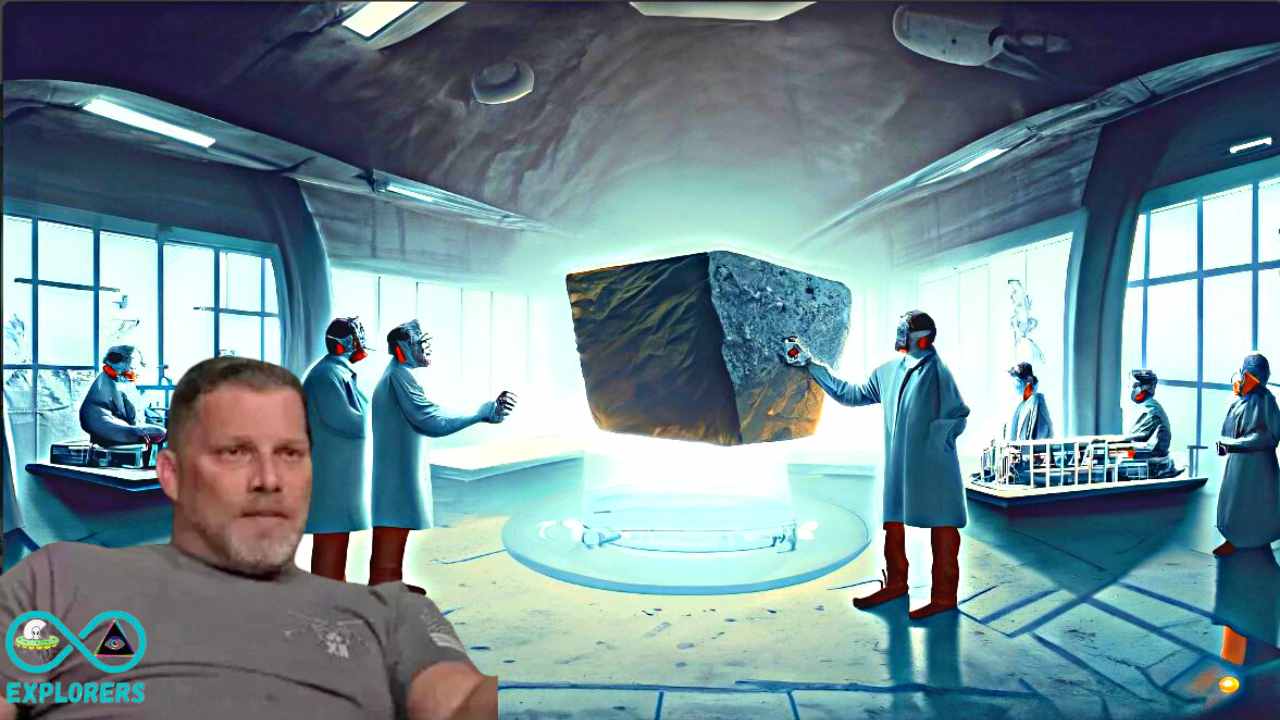



The story of DC Long — a retired United States military officer — adds a first-person account to the growing body of testimony describing classified anti-gravity technology that the US government has allegedly developed and kept hidden from the public for decades. Long’s claims, delivered with the measured specificity of a career military professional, describe direct personal observation of operational aircraft that defied conventional physics, performing maneuvers impossible for any propulsion system based on combustion, jet thrust, or rocket technology. His account intersects with the broader pattern of UAP disclosure testimony emerging from military and intelligence communities and raises fundamental questions about what the United States has been flying in secret.
What DC Long Claims to Have Witnessed
Long describes witnessing anti-gravity capable aircraft during his military service at facilities where classified aerospace programs were conducted. The craft he describes were not conventional aircraft fitted with unusual propulsion — they were fundamentally different in their operating principles, capable of instantaneous directional changes, hovering without rotor or wing lift, and acceleration profiles that would be lethal to a human occupant under normal gravitational force. Long’s description of the craft’s movement aligns closely with the UAP characteristics described in military pilot testimony released publicly during the post-2017 disclosure period: no visible means of propulsion, no exhaust or heat signature, extreme speed transitions from stationary to high velocity. His claim is that these craft are not extraterrestrial but human-made, developed through decades of classified research building on recovered or acquired technology whose origins he does not specify.
The History of Anti-Gravity Research
Anti-gravity research has a longer and more serious history than popular culture suggests. In the 1950s, major American aerospace contractors including Boeing, Lockheed, and Glenn L. Martin Company openly published research into what was then called “electrogravitic” propulsion — the manipulation of gravitational fields through electromagnetic means. Aviation Week covered these programs in 1956 in an article noting that “all major (US) aircraft companies are actively engaged” in anti-gravity research. Then, abruptly, the subject disappeared from open literature. Researchers including Nick Cook, who spent years investigating the topic as an aviation editor for Jane’s Defence Weekly, concluded in his book “The Hunt for Zero Point” that the programs went black rather than being abandoned — that the research continued under the highest levels of classification and produced results that were never publicly disclosed.
Corroborating Testimony From Other Insiders
Long’s account fits within a pattern of testimony from individuals claiming insider knowledge of classified anti-gravity programs. Bob Lazar, whose claims about reverse-engineering extraterrestrial craft at a facility near Area 51 generated enormous controversy starting in 1989, described propulsion systems using element 115 (moscovium) to generate a gravity wave that could bend spacetime around a craft. Colonel Philip Corso, in his 1997 memoir “The Day After Roswell,” claimed that recovered technology from the 1947 Roswell crash was reverse-engineered and seeded into the US defense industrial base — producing advances in integrated circuits, fiber optics, and propulsion systems. William Tompkins, the aerospace engineer who worked with major defense contractors, described working on anti-gravity spacecraft designs informed by intelligence from extraterrestrial sources. These accounts, from individuals with verifiable professional credentials, form a consistent picture of a classified aerospace program operating well beyond publicly acknowledged technology.
The Physics Behind the Claims
The physics of anti-gravity, while not part of conventional aerospace engineering, is not entirely outside mainstream scientific discussion. General relativity establishes that mass and energy curve spacetime, and that a sufficiently dense or energetic system could in principle manipulate gravitational fields. Theoretical frameworks for what physicists call “metric engineering” — the deliberate manipulation of spacetime geometry — have been developed by researchers including Harold “Hal” Puthoff, a physicist who has worked with both private aerospace contractors and US intelligence programs. Puthoff has publicly stated his belief that UAP propulsion involves spacetime metric modification and that classified government programs are engaged in this research. The gap between theoretical physics and engineering application remains enormous by conventional measures — but “conventional measures” may not apply to programs operating outside public knowledge for seventy years.
The Disclosure Context
DC Long’s testimony arrived in the context of an accelerating disclosure environment in which multiple military whistleblowers, intelligence officials, and aerospace insiders have gone on record with claims that would have been career-ending in earlier decades. The 2023 congressional testimony of David Grusch — a decorated intelligence official who stated under oath that the US government possesses non-human craft and biologics — created a framework in which Long’s account of human-made anti-gravity craft becomes part of a larger conversation rather than an isolated claim. Whether the craft Long witnessed were reverse-engineered from recovered non-human technology, developed entirely through human innovation, or represent something else entirely, his account points toward the same fundamental conclusion reached by an increasing number of credible insiders: that the gap between publicly acknowledged aerospace technology and what actually exists in classified programs is far larger, and far more profound, than the official record suggests.
Discover more from Infinity Explorers
Subscribe to get the latest posts sent to your email.