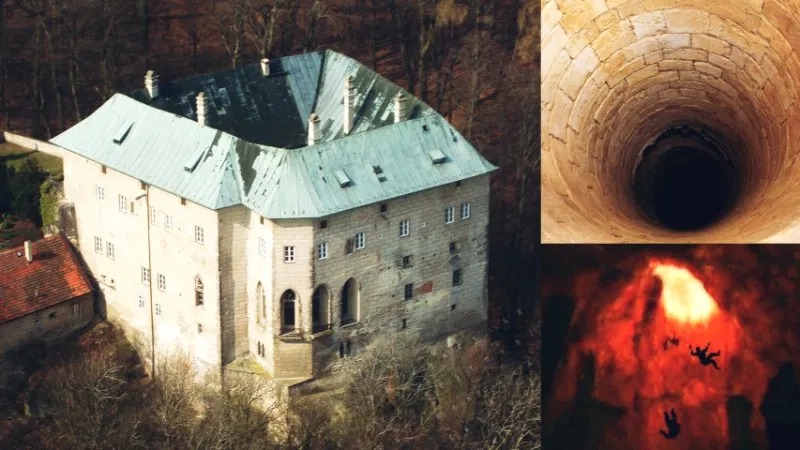

If you set out today to build a castle in the worst possible location in central Europe, you would build Houska Castle.
It sits on a remote forested ridge in the Czech Republic, about thirty miles north of Prague, with no road of consequence leading to it, no river or well anywhere near it, no defensive view of trade routes that needed protecting, and no settlement of value within several days’ march. It was built in the middle of the 13th century, at enormous expense, by a Bohemian king who needed it to exist for reasons he never publicly explained.
The castle has no fortifications facing outward. Its main gate is shallow. Its arrow slits face the wrong direction. The famous medievalist Pavel Kalina has written that Houska Castle “could not have functioned as a defensive fortification against an outside enemy under any plausible reading of its construction.” It was not built to keep enemies out.
According to the legend that has surrounded the castle for over seven hundred years, it was built to keep something in.
Where Houska Castle Stands and Why That Matters
The castle is positioned on a limestone outcropping in the Bohemian forest. There is no village nearby. There is no obvious agricultural land. The construction would have required materials hauled in from significant distance — stone, timber, lime — over terrain that did not lend itself to bulk transport.
The site has one notable feature. Predating the castle by an unknown length of time, before any 13th-century stonework was laid down, there was a hole in the ground at the exact spot where the castle’s chapel now stands. According to the local legends that medieval chroniclers eventually wrote down, the hole was deep enough that nobody could see its bottom. The people in the surrounding region believed it had no bottom. They believed it led somewhere they would not name.
The legends say things came out of it at night.
The 13th-Century Origin Story
The most cited founding account — which appears in several medieval Czech chronicles and oral traditions — credits King Ottokar II of Bohemia with commissioning the castle around 1253. The reason given is consistent across the chronicles. The pit at the site was causing problems, and a structure had to be built that would seal it off from the world.
Before construction began, the legend goes, the king’s engineers experimented on prisoners. They needed to know what was in the pit. They offered death-row prisoners a pardon if they would agree to be lowered into it on a rope and report what they saw.
The most famous version of the story describes a young prisoner who agreed. The rope was lowered. Within a minute, the prisoner began screaming. The engineers pulled him back up. When he emerged, his hair had turned white. His skin was wrinkled. He looked, according to the chroniclers, like he had aged thirty years in the span of ninety seconds underground. He died within days, unable to coherently describe what he had seen.
It is, of course, folklore. There is no surviving primary documentation of the prisoner experiments. What is documented is that the chapel — the first structure built at the site — was constructed directly over the pit. The pit was sealed in stone. The chapel’s altar sits roughly above where the pit’s opening would have been.
The Chapel That Was Built to Seal a Hole
The chapel of Houska Castle is dedicated to the Archangel Michael — the figure in Christian theology specifically associated with sealing demons and casting them down from heaven. This dedication is not subtle. Michael churches exist throughout Europe, but the placement of one directly above an alleged supernatural opening is unusual, and the iconographic program inside the chapel is unusual in a different way.
The walls of the chapel are covered in 14th-century frescoes. Some of the imagery is conventional — biblical scenes, saints, the standard hierarchy. Other parts are not. The chapel contains depictions of female demonic figures that predate, by several decades, the iconographic conventions those figures would later follow in European art. The frescoes were painted before the visual vocabulary they use existed in any standard sense.
Art historians who have studied the frescoes have offered two main explanations. The first is that the painters were working from extremely local folk imagery that has not survived elsewhere — making the chapel a unique window into a regional supernatural tradition. The second is that they were depicting things they, or their commissioners, had specifically been told to depict — beings whose images came from somewhere other than the painters’ imaginations.
What Came Out of the Pit, According to the Legends
The folklore is unusually specific. It is not the vague paranormal vocabulary of generic hauntings. The accounts describe particular things, repeating in different mouths across centuries.
Half-animal hybrid creatures, particularly entities described as having parts of a frog and parts of a bull, were said to emerge from the pit at night and roam the surrounding forest before returning by dawn.
A black, headless horse was reported on multiple occasions over the centuries, including by visitors and by Czech soldiers stationed at the castle during World War II. The horse was said to gallop the castle grounds without a sound.
Large flocks of black birds, sometimes described as crow-like and sometimes described as too large to be any known species, would supposedly rise from the chapel area in dense clouds during the new moon. Multiple chroniclers from the 14th and 15th centuries mention this in nearly identical terms.
Sounds from below have been reported across the castle’s entire documented history — the kind of low, rhythmic, almost-mechanical sounds that visitors describe with words like “machinery” and “breathing” without being able to commit to either.
All of which would be unremarkable folklore — every old castle in Europe has its ghost stories — except for what happened in the 1940s.
The Nazi Occupation
During World War II, the German military occupied Houska Castle. This is itself unusual. There was no strategic reason for them to do so. The castle had no military value. It was not on a supply route. It did not overlook anything that needed to be watched.
The unit that took over the castle was not a regular Wehrmacht detachment. It was a group affiliated with the Ahnenerbe — the Nazi “ancestral heritage” research institute that conducted occult and pseudo-archaeological investigations across occupied Europe. The Ahnenerbe was the same organization that funded expeditions to Tibet looking for the origin of the Aryan race, dug for the Holy Grail in southern France, and excavated supposed runic sites in Scandinavia.
Documented Czech records from the post-war period indicate that the Ahnenerbe team at Houska conducted excavations in and around the chapel. What they were looking for is not specified in surviving Ahnenerbe documentation, much of which was destroyed in the final months of the war. The local oral tradition, which is unreliable but consistent, says they were trying to reopen the pit.
The occupation ended abruptly in 1945. The team withdrew faster than the broader German military retreat would have required, and they left behind equipment that was inventoried by Czech investigators afterward. The inventory included items that have never been publicly explained — drilling apparatus consistent with deep excavation, audio recording equipment that was state-of-the-art for the 1940s, and a set of stone fragments that were later reported to have been removed by Czech archaeologists and never catalogued.
Modern Investigations
Houska Castle is currently open to the public as a heritage site. The chapel is on the tour. Visitors who have spent extended time in the building have reported a consistent set of experiences across decades.
Paranormal investigators using modern equipment — EVP recorders, infrared cameras, electromagnetic field meters — have produced inconsistent results that nonetheless cluster around the chapel area. Voices have been recorded on multiple investigations that the recordists could not identify as having come from any visible source. EMF readings spike near the altar. Cold spots are common.
None of this is the kind of evidence that would convince a skeptic. All of it is the kind of evidence that, repeated independently across decades by people who do not know each other’s results, suggests that something at the site is producing consistent perceptual responses from human visitors.
The castle has been featured in the Most Haunted series, the Ghost Adventures series, and several Czech-language paranormal television programs. The producers of those programs are not impartial observers. But their footage is widely available, and the consistent experiences their participants describe — particularly inside the chapel — are notable for how closely they track centuries-old descriptions written long before paranormal television existed.
Other Alleged “Gateways to Hell” Around the World
Houska is the most documented site of its kind, but it is not unique. Folklore traditions around the world identify specific locations as supposed openings to underworlds — and the pattern of building religious structures at those locations is not unusual.
Hellam Township, Pennsylvania. A small American site with a series of supposed gates to hell, the most famous of which has been demolished and replaced with private property over the decades. Pennsylvania’s folklore tradition around the site dates to the early 20th century.
Stull Cemetery, Kansas. Long believed by local tradition to be one of the seven gates of hell. Pope John Paul II’s plane was rumored — possibly apocryphally — to have avoided flying over Kansas in 1995 specifically to avoid passing over Stull.
Mount Osore, Japan. Considered one of the three holiest mountains in Buddhism specifically because it sits on what Buddhist cosmology identifies as a junction between this world and the realm of the dead. Pilgrimages have continued for over a thousand years.
Hekla Volcano, Iceland. Medieval European writers including Cistercian monks specifically identified Hekla as a portal to hell, based on the volcanic eruptions and the sulfur smell. The identification persisted into the early modern period.
Visiting Houska Today
The castle is open to the public from spring through autumn. Tours of the chapel are included in the standard admission. The pit beneath the chapel — assuming the original opening still exists — is not accessible. The chapel floor has not been excavated since the 14th century, and there is no public access to whatever lies beneath the altar.
For travelers interested in the supernatural side of central European history, Houska pairs naturally with the broader tradition of haunted sites across the Czech Republic — including the bone chapel of Sedlec at Kutná Hora, the Old Jewish Cemetery in Prague, and various Bohemian forest sites that have generated their own folklore over the centuries. Travelers with an interest in older European supernatural traditions will find the region densely layered with material.
Frequently Asked Questions
Can you visit Houska Castle?
Yes. The castle is open to the public during spring, summer, and autumn months. It is approximately a one-hour drive from Prague. Tours include the chapel and most of the main castle structure.
Is the bottomless pit still there?
The original opening, if it ever existed in the form the legends describe, was sealed in the 13th century by the construction of the chapel floor over it. The chapel has not been excavated. Whether anything still exists beneath the floor is not publicly known.
Did the Nazis really occupy the castle?
Yes. The German occupation of Houska during World War II is documented in Czech archives. The specific involvement of the Ahnenerbe — the Nazi occult research organization — is supported by post-war Czech investigative reports, though some details remain contested by historians who emphasize the limits of the documentary evidence.
Is Houska Castle actually the gateway to hell?
No verifiable evidence exists. The “gateway to hell” framing comes from local folklore, the architectural anomalies of the site, and the unusual iconography of the chapel frescoes. It is taken seriously enough by enough people across enough centuries to be a notable cultural phenomenon, but it is not a documented fact in any verifiable sense.
What animals were seen coming out of the pit?
The folklore most consistently mentions hybrid frog-bull creatures, a headless black horse, and large flocks of unusually large black birds. None of these descriptions have been corroborated by modern observation.
Why was the chapel dedicated to the Archangel Michael?
In Christian theology, Michael is the angel specifically associated with sealing demons and casting them down. The dedication is consistent with the legend that the chapel was built to seal the pit — Michael’s iconographic role would have been considered protective at the time of construction.
What’s Actually Strange About Houska
Stripping away the layers of folklore, paranormal television, and conspiracy theory, the genuinely unusual facts about Houska Castle remain hard to explain. A wealthy 13th-century king built an enormously expensive castle in a location that had no military, economic, or political value, dedicated to no clear purpose, with architectural features inconsistent with defense — and the construction centered on a chapel whose orientation, dedication, and frescoes all point toward something the builders specifically wanted to contain.
Either the documented behavior of King Ottokar II’s court was bizarre to the point of irrationality, or there was a reason for the castle that the builders chose not to record. Folklore exists in the gap between those two possibilities. Whether the gap is filled by demons, by superstition, or by something that has not yet been named is the question Houska Castle has been asking visitors for seven centuries.
Discover more from Infinity Explorers
Subscribe to get the latest posts sent to your email.