

Internet researcher Scott Waring — best known for spotting unusual objects in raw NASA rover photographs — has revealed yet another find on the surface of Mars. This time it is something he believes is unmistakably alive: a small pink-green object sitting on the red Martian soil, in an image captured by the Perseverance rover on 4 April 2023.
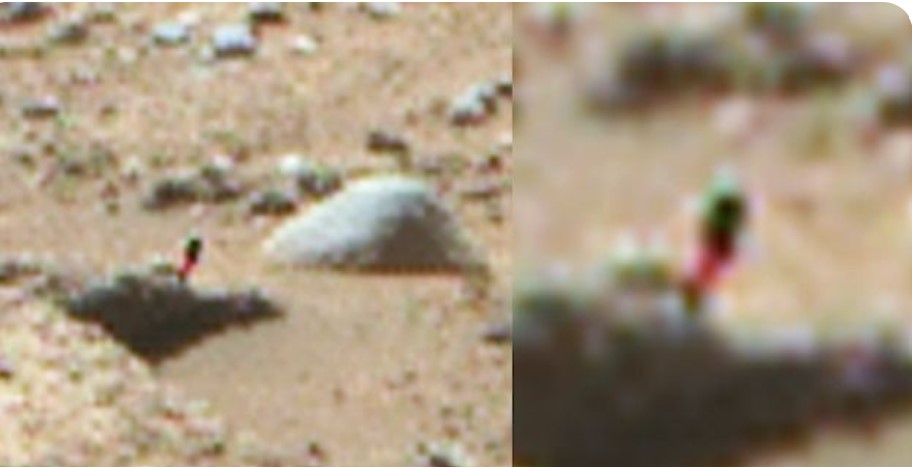
The Pink-Green Object That Should Not Be On Mars
The object in question is small — likely no more than a few centimetres across — but its colouring is the part that has refused to be explained away. It is pink and green. On a planet whose surface palette is supposed to range from rust-red to dust-grey, those are exactly the two colours that signal life back home on Earth.
Even seasoned sceptics have struggled to label it confidently. Is it a mineral the rover has not catalogued before? A piece of debris flaked off the rover itself? An artefact of the camera lens? Or — as Waring is openly arguing — an actual living plant growing in the dust of Mars?
The original photograph, taken on 4 April 2023, can still be viewed on the official NASA Mars 2020 raw-images archive. The image was not deleted, not retouched, not hidden. It simply sits in the open feed — a small object NASA itself has never commented on, in a photograph NASA itself published.
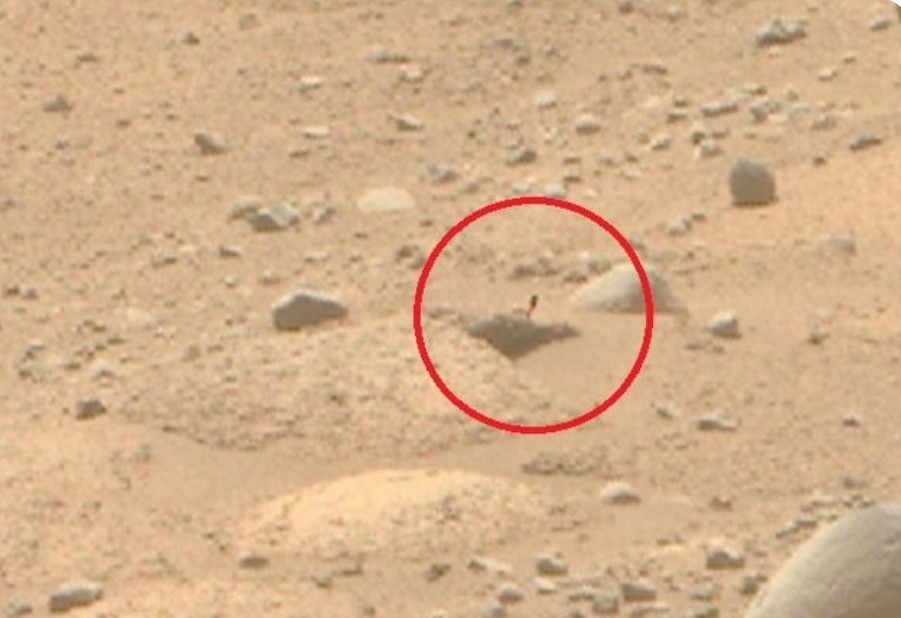
According to Waring, the only explanation that fits both the colour and the structure of the object is that it is a plant — and that its presence proves there is biological life on Mars in vegetable form.
This Is Not Waring’s First Find Like This
The 2023 pink-green object is part of a pattern.
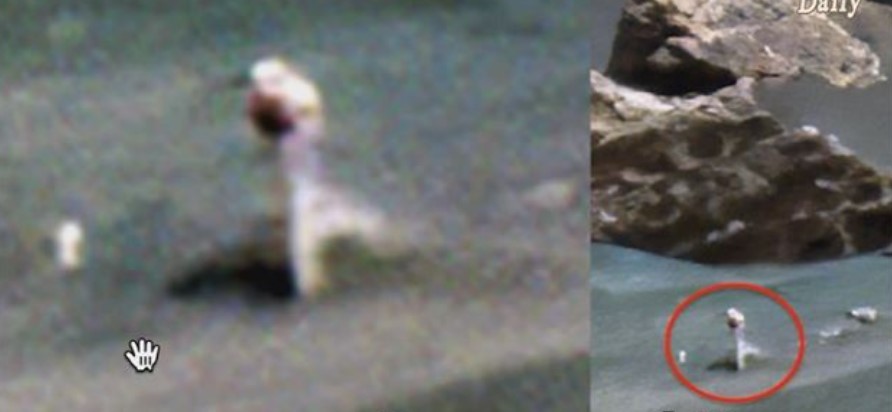
In 2020, the same Waring drew international attention to another Mars photograph — this one showing a small white-petalled growth he immediately christened “the white rose”. The image circulated widely on space-anomaly forums and was rapidly dismissed by mainstream commentators as a wind-shaped pebble. Waring never accepted that explanation. To him, the rose and the pink-green object are the same story told twice: NASA’s own cameras keep photographing things on Mars that, by every textbook standard, should not be there.
The Other Strange Things People Have Found in NASA’s Mars Feed
Waring’s “Mars plant” sits inside a long, well-documented list of objects independent researchers have flagged in NASA’s own publicly-released rover images. We have covered several of the most striking ones on this site:
- The petrified-tree formation photographed on the Martian surface, which to many eyes looks like the fossilised remains of an ancient trunk.
- A series of perfectly cylindrical “deep holes” on Mars that NASA itself has admitted it cannot explain.
- The infamous case of an image NASA was unusually quick to delete from its official Mars feed after a UFO-shaped object appeared in the frame.
- And the recurring mystery of who, or what, is cleaning the dust off NASA’s Mars rovers — solar panels that should have been buried in red dust years ago somehow keep functioning at near-full capacity.
None of these are individually proof of life on Mars. Together, they are a pattern. And the pattern is exactly what people like Scott Waring keep pointing at.
What NASA Has Actually Discovered That Quietly Supports Waring’s Position
NASA’s official line on Mars life remains cautious: no confirmed evidence. But buried inside the agency’s own published research is a string of findings that the masala crowd has been pointing to for years — findings the mainstream press routinely under-reports.
In June 2018, NASA confirmed that the Curiosity rover had detected ancient organic molecules in 3-billion-year-old rocks at Gale Crater, and seasonal spikes of methane in the Martian atmosphere. Methane on Earth is overwhelmingly produced by living organisms. NASA’s own scientists called the findings “exciting” and said they “may, or may not, be of biological origin.”
In 2020 and again in 2021, Italian researchers using ESA’s Mars Express radar reported evidence of liquid sub-surface lakes beneath the Martian south polar cap — peer-reviewed findings published in Nature Astronomy. Liquid water is the single most-quoted prerequisite for biological life.
And in 2022, the Perseverance rover itself returned readings showing complex organics in rock samples from Jezero Crater — the kind of molecules that, on Earth, are most cleanly explained by biological processes.
None of this proves Waring’s pink-green object is a plant. But it does mean the question he is asking — “is there living biology on Mars right now?” — is no longer the fringe question it was a decade ago. NASA’s own findings have quietly moved the goalposts.
So Is It Actually A Plant?
The honest answer is: we don’t yet know. The image is real. The object is small. NASA has not commented. Mainstream space scientists will continue to favour the lens-artefact or unusual-mineral explanations. Scott Waring will continue to favour the plant explanation. And anyone who looks at the original photograph from 4 April 2023 with their own eyes is left to make their own call.
What is no longer up for debate, however, is that NASA’s own rovers keep photographing things on the Martian surface that the agency itself struggles to explain — and that the public, increasingly, is no longer waiting for an official press conference before drawing its own conclusions.
Frequently Asked Questions
Who is Scott Waring?
Scott C. Waring is an American-born researcher and the editor of UFO Sightings Daily, one of the longest-running independent anomaly-spotting websites on the internet. For more than a decade he has been combing through raw NASA and ESA rover and satellite images, publicly identifying objects that he believes the agencies have not adequately explained.
What exactly did Waring find on Mars in April 2023?
Waring identified a small pink-green object in a Perseverance rover photograph taken on 4 April 2023. He argues that the object’s colouring and structure are most consistent with a small plant, and that its presence proves Mars currently hosts biological life in vegetable form.
Has NASA responded to Waring’s claim?
No. NASA has not issued any official statement on Waring’s identification of the pink-green object, just as it did not comment on his earlier “white rose” identification from 2020. The original image remains in NASA’s public raw-images archive, untouched.
What was the “white rose” of 2020?
The “white rose” was Waring’s name for a small white-petalled growth he flagged in a 2020 Mars rover image. Mainstream commentators dismissed it as a wind-shaped pebble; Waring maintained it was botanical. The 2023 pink-green object is, in his view, the same kind of find: photographic evidence of something organic on the Martian surface.
Has NASA officially found evidence of life on Mars?
NASA’s official position is that no confirmed evidence of life on Mars has been found. However, the agency has confirmed the presence of ancient organic molecules in Gale Crater rocks (Curiosity, 2018), seasonal atmospheric methane spikes, and complex organics in Jezero Crater rock samples (Perseverance, 2022). Italian researchers have separately reported evidence of liquid sub-surface lakes beneath the Martian south polar cap.
Why do researchers keep finding strange things in NASA’s Mars images?
Because NASA publishes the raw rover images, without editorial pre-filtering, to its public archives. Anyone with a browser can study them. Over the years independent researchers have catalogued objects ranging from what looks like a petrified tree to perfectly cylindrical deep holes the agency cannot explain, alongside the recurring puzzle of NASA’s rover solar panels remaining dust-free far longer than they should.
Discover more from Infinity Explorers
Subscribe to get the latest posts sent to your email.