
Among the ancient artifacts that have drawn serious attention from researchers exploring the possibility of extraterrestrial contact with early human civilizations, the Palermo Stone occupies a distinctive position. It is not a fringe object — it is a fragment of one of ancient Egypt’s most important historical records, currently housed in the Archaeological Museum of Palermo and studied by Egyptologists for well over a century. Its conventional interpretation is as a royal annals document recording the reigns of predynastic and early dynastic pharaohs. Its unconventional interpretation, advanced by a growing body of researchers, is that it contains encoded information about beings who ruled Egypt before humans — beings whose characteristics and power signatures suggest an origin that was not of this world.
What the Palermo Stone Actually Is
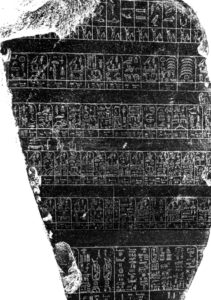
The Palermo Stone is a fragment of a larger stele — a standing stone slab — originally inscribed during the Fifth Dynasty of ancient Egypt, around 2400 BCE, though recording events from a much earlier period. The surviving fragment, roughly the size of a large book, is made of black basalt and covered on both sides with hieroglyphic inscriptions organized in horizontal bands. Each band represents a year, with entries recording significant events: Nile flood levels, religious festivals, military campaigns, and — crucially for alternative researchers — the reigns of rulers who are identified not as human pharaohs but as gods and demi-gods.
Several other fragments of the same or similar annals exist in other collections, including Cairo and London, collectively known as the Royal Annals of the Old Kingdom. Together they provide the most extensive surviving record of early Egyptian royal history, including the Shemsu Hor — the “Followers of Horus” — who are listed as rulers before the first human pharaohs and whose reigns are calculated in spans of hundreds of years each. The mainstream Egyptological position treats these entries as mythological — the Egyptian literary convention of tracing royal lineage back to divine origins. Researchers who interpret the stone differently argue that this dismissal, while convenient, requires rejecting the Egyptians’ own account of their history without sufficient justification.
The Pre-Dynastic Rulers: Gods Who Walked the Earth
The most significant section of the Palermo Stone for alternative researchers is the portion recording what the ancient Egyptians described as their earliest rulers. Before the conventional pharaonic line begins with Narmer and the First Dynasty around 3100 BCE, the stone records rulers identified as the gods themselves — Ra, Shu, Geb, Osiris, Set, Horus — each reigning for centuries. These are not presented in the text as mythological archetypes but as historical rulers, with annual records of events during their reigns in the same format used for the human pharaohs who followed.
This treatment of divine figures as historical administrators is unusual even within ancient Near Eastern traditions. Other cultures mythologized their divine origins, but the Egyptian annals present theirs in the same bureaucratic format as human governance — flood records, tax assessments, building projects. The specificity of the record-keeping suggests to some researchers that the Egyptians were not writing mythology but history, and that the beings described as gods possessed the characteristics of what we would now identify as an advanced civilization: long lifespans, administrative capability, technological capacity for the monumental construction that characterized the period, and origins distinct from the local human population.
The Shemsu Hor: Egypt’s Pre-Human Administrators
The Shemsu Hor — translated variously as “Companions of Horus,” “Followers of Horus,” or “Those Who Follow Horus” — are listed in the Palermo Stone and related Turin King List as a class of ruler who governed Egypt between the age of the gods and the age of human pharaohs. They are neither fully divine in the texts nor human — they occupy an intermediate category that has been the subject of scholarly debate for generations. Their combined reigns, as listed in the Turin King List, amount to approximately 13,400 years.
For researchers who take the ancient astronaut framework seriously, the Shemsu Hor represent the most intriguing element of the entire pre-dynastic record. They appear to be a distinct species or class of being — neither the high gods of the earliest period nor the human pharaohs of the dynastic era — who administered Egyptian civilization during a transitional period. Their role as administrators and transmitters of civilization to the human population that followed them is consistent with accounts from other ancient cultures around the world describing a class of divine or semi-divine teachers who introduced agriculture, writing, architecture, and law to early human societies.
The Technological Implications
The Palermo Stone’s records of construction projects during the pre-dynastic period raise questions that have never been fully resolved. The Great Pyramid of Giza, built during the Fourth Dynasty, represents a level of precision engineering that modern archaeologists still struggle to fully explain using available Bronze Age tools and techniques. The question of whether the construction knowledge required for the Great Pyramid and related structures was independently developed or transmitted from an earlier, more advanced source is not fringe speculation — it is an ongoing debate within academic archaeology, though usually framed in terms of lost Bronze Age techniques rather than extraterrestrial transfer.
Researchers who interpret the Palermo Stone’s pre-dynastic rulers as advanced non-human beings argue that the construction and astronomical knowledge evident in the Giza complex — its precise celestial alignments, its mathematical encoding of pi and the golden ratio, its extraordinary engineering tolerances — is consistent with transmission from beings who possessed this knowledge rather than with independent Bronze Age invention. This argument is speculative but not illogical: if advanced beings governed Egypt for thousands of years before human pharaohs, the transmission of their technical knowledge to human successors would be expected, and the archaeological record of early dynastic Egypt — which shows sophisticated capability appearing relatively suddenly — would be consistent with that transmission.
Mainstream Egyptology and Its Response
Professional Egyptologists have consistently maintained that the pre-dynastic sections of the Palermo Stone and the Turin King List are mythological rather than historical — a record of origin mythology that served political and religious purposes for the Fifth Dynasty scribes who compiled it. The kings listed as gods are, in this interpretation, symbolic claims to divine authority rather than records of actual administrations. The lifespans and reign lengths are conventional numerological expressions rather than literal time measurements. This interpretation is internally coherent and is supported by the broader context of ancient Near Eastern royal ideology.
The limitation of the mainstream interpretation is that it requires the ancient Egyptians to have been recording fiction in the same format and with the same apparent seriousness as fact, without any textual signal distinguishing mythological entries from historical ones. Researchers who push back on this argument are not anti-science — they are applying a principle that historians apply in every other context: that ancient peoples generally knew the difference between their founding myths and their administrative records, and that treating the two as interchangeable imposes a modern skeptical framework onto evidence that was produced in a completely different epistemic environment. The Palermo Stone remains one of the most genuinely contested artifacts in the study of ancient history — and one of the most suggestive for anyone willing to take its claims at face value.
Discover more from Infinity Explorers
Subscribe to get the latest posts sent to your email.