



The question of whether the Bible contains accounts of alien abductions sits at one of the sharpest intersections of religious interpretation and UAP research. For mainstream theology, the answer is an emphatic no — the texts describe divine encounters, angelic visitations, and prophetic experiences that are spiritual in nature and category. For a growing body of researchers who approach ancient texts through the lens of the ancient astronaut hypothesis, the answer is equally emphatic in the opposite direction: the Biblical record is saturated with accounts that match the structural profile of close encounter and abduction experiences reported by modern witnesses, and the theological interpretation is itself a form of cultural translation applied to events that were fundamentally physical in nature. The evidence on both sides is more serious than either camp typically acknowledges.
Ezekiel’s Vision: The Most Analyzed Passage
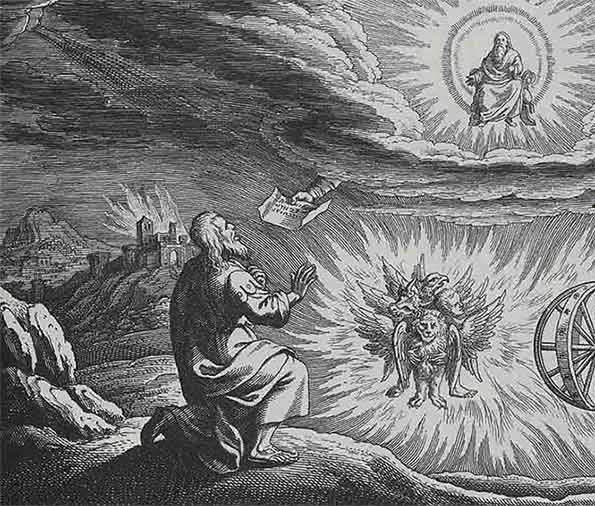
No Biblical text has attracted more attention from researchers looking for ancient UFO and contact accounts than the first chapter of Ezekiel. The prophet describes, in considerable technical detail, an encounter with a wheeled craft descending from a stormy sky — something that NASA engineer Josef Blumrich analyzed in his 1974 book “The Spaceships of Ezekiel” and concluded was a consistent, internally coherent description of a spacecraft design that would be mechanically feasible. Blumrich was not a UFO enthusiast; he was a serious aerospace engineer who approached the text skeptically and changed his view based on what the technical specifications actually described.
Ezekiel’s account includes descriptions of “wheels within wheels,” creatures with multiple faces and wings, a gleaming expanse above them “like awesome crystal,” and a voice that came from above and gave him specific instructions. The encounter resulted in Ezekiel being lifted up — transported — to a different location, a narrative element that maps precisely onto what modern abduction researchers call involuntary transportation. He is later described as sitting stunned for seven days after the experience, a behavioral response entirely consistent with documented post-encounter psychological effects in modern cases. Whether this constitutes evidence of alien contact or divine revelation depends entirely on the interpretive framework applied — but the structural match to modern accounts is not trivial.
Enoch: Taken by Non-Human Beings
The account of Enoch in Genesis is brief in the canonical text — he “walked with God, and he was not, for God took him” — but the apocryphal Book of Enoch, excluded from most modern Bibles but widely read in antiquity and part of the Ethiopian Orthodox canon, provides extraordinary detail about what that taking involved. Enoch describes being approached by tall, luminous beings who transport him through the air to different locations, show him the mechanisms of the cosmos — the “storehouses of snow,” the chambers of wind, the machinery of celestial movement — and then return him to Earth with specific information to pass on to humanity.
The structural profile of Enoch’s account matches modern abduction testimony with uncomfortable precision: approach by non-human entities, involuntary or semi-voluntary transportation, a tour of facilities or environments beyond ordinary human access, communication of specific information, and return to the point of origin. Enoch’s physiological response — his face shining, his transformation, his difficulty communicating what he experienced in human language — mirrors what contemporary abduction researchers identify as characteristic post-experience symptoms. The Book of Enoch’s detailed cosmological information, presented as directly downloaded knowledge from the beings who took him, is one of the most distinctive elements of the account from a UAP research perspective.
Elijah’s Chariot of Fire
The account of Elijah’s departure from Earth in 2 Kings 2 is one of the most vivid transportation narratives in the entire Biblical canon. Elijah does not die — he is taken. A chariot of fire drawn by horses of fire appears, separates Elijah from the prophet Elisha, and a whirlwind carries Elijah into the sky. Elisha watches the ascent and cries out, and then Elijah is gone. Later in the same book, a letter from Elijah arrives — raising the extraordinary implication that he was transported somewhere and continued to communicate, rather than simply ascending to a non-physical realm.
The “chariot of fire” description, interpreted through an ancient astronaut lens, maps onto propulsion-driven aircraft more naturally than onto any known divine iconography of the period. Fire and wheels are not typical imagery for the divine presence in Hebrew scripture — the burning bush is a notable exception, but it is stationary. The chariot of fire moves, ascends, and physically removes a person from the earth. Researchers who treat these accounts as potential technological encounters rather than metaphorical divine narratives argue that the distinction between the two interpretations cannot be resolved purely from the text — it requires prior assumptions about what is and is not possible.
The Nephilim: Genetic Intervention or Mythology?
Genesis 6 describes the “sons of God” (Bene Elohim in Hebrew) taking human women as wives and producing offspring — the Nephilim, giants described as “mighty men of old, men of renown.” The passage is brief and cryptic in the canonical text, but the Book of Enoch expands it substantially, identifying the Bene Elohim as Watchers — a specific class of non-human beings who descended to Earth, interacted with humans physically, taught them forbidden technologies (metallurgy, weaponry, cosmetics, astrology), and produced hybrid offspring.
From a UAP research perspective, the Watcher narrative is one of the most significant passages in ancient literature. It describes non-human beings physically interacting with humans, transferring technology, producing biological hybrids, and operating under a hierarchical authority structure that disapproved of the interaction and eventually intervened. This structure — non-human intelligences, genetic interaction, technology transfer, hierarchical oversight — is a recurrent theme in modern contact and abduction research. Whether the parallel is meaningful or coincidental is a question the evidence alone cannot settle, but serious researchers in both ancient studies and UAP research have found it worth examining carefully.
Paul’s Encounter on the Road to Damascus
The conversion of Paul on the road to Damascus, described in Acts 9, shares several characteristics with modern high-strangeness contact accounts. A blinding light from the sky knocks Paul to the ground and renders him temporarily blind. A voice speaks to him — only Paul can understand it; his companions hear sound but no words. The encounter results in Paul being physically incapacitated for three days, unable to eat or drink. When his sight returns, he has been fundamentally altered — not just theologically converted, but transformed in his mission and purpose in a way he describes as having been given directly to him by the being he encountered.
The blinding light, physical incapacitation, selective communication, and profound personal transformation following the encounter are all elements that appear in documented modern close encounter cases. Researchers who examine the Damascus event through a UAP lens are careful to note that this interpretation neither validates nor refutes Paul’s theological experience — the two readings can coexist. What they argue is that the physical phenomenology of the account is consistent with a genuine anomalous encounter, and that the leap from “anomalous encounter” to “divine encounter” is one that Paul himself made based on the content of the communication, not the physical mechanics of how it was delivered.
What the Pattern Means
Taken individually, each of these Biblical accounts can be accommodated within traditional theological interpretation. Taken together, as a pattern of accounts across multiple authors, centuries, and cultural contexts — all featuring luminous craft, non-human beings, physical transportation, communication of specific information, and post-encounter transformation — they form a body of evidence that ancient astronaut researchers argue cannot be dismissed as coincidence. The mainstream scholarly response is that the pattern reflects universal human psychological responses to the numinous — that all cultures produce similar imagery when describing transcendent experience, and that the structural similarities prove nothing about the physical reality of what was encountered. That response is intellectually defensible. It is also, researchers note, consistent with what you would expect people to say if the events described were real and the implications were considered too destabilizing to engage with directly.
Discover more from Infinity Explorers
Subscribe to get the latest posts sent to your email.
Don’t Forget The…’Close Encounter Of The 3rd Kind’ That Paul Had On The Road To Damascus