
In an era when nearly everyone carries a camera, the possibility of capturing genuinely anomalous events on video has never been higher — and the challenge of distinguishing authentic footage from hoax, misidentification, or digital manipulation has never been more complex. A case from Florida brought both sides of that tension into sharp focus when a local resident submitted video footage claiming to show an individual who did not belong to the present moment — a figure whose clothing, behavior, and interaction with the modern environment appeared fundamentally inconsistent with 2024. The video circulated rapidly, drawing scrutiny from skeptics and serious interest from researchers who study temporal anomaly claims.
The Original Footage: What Was Captured
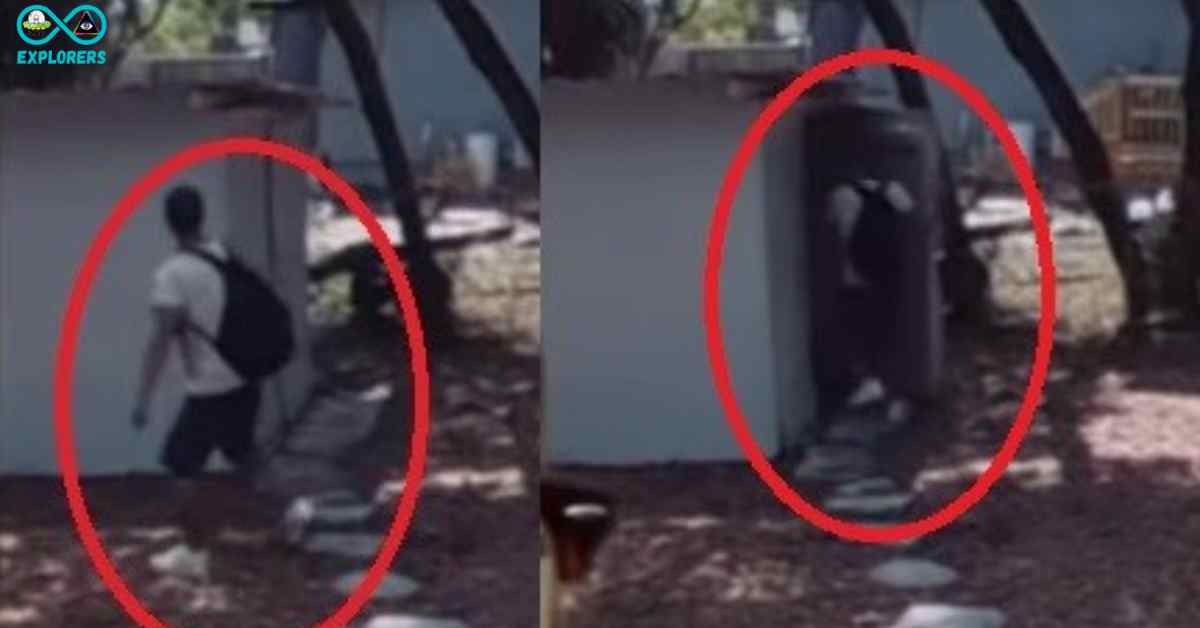
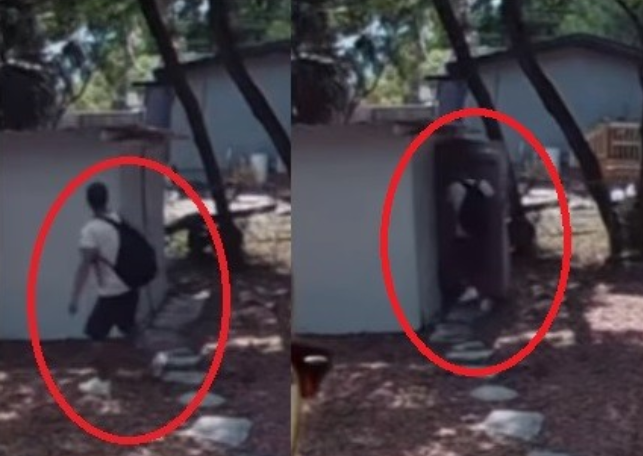
The video, recorded by a Florida resident who reported noticing something unusual at the edge of his property near a wooded area, shows a figure walking along a treeline in broad daylight. At first glance the footage appears unremarkable — a person walking in the distance. What drew the resident’s attention, both at the time and upon reviewing the footage, were specific details that didn’t align with normal observations. The figure’s clothing appeared archaic — not vintage in a deliberate fashion sense, but simply wrong in a way that was difficult to articulate. The movements were stiff and deliberate in a manner that witnesses described as more consistent with extreme disorientation than natural walking.
Most striking was a moment in the footage where the figure pauses, appears to look directly at the camera, and then moves rapidly out of frame in a way that some frame-by-frame analysts described as physically unusual — a speed and angle of exit inconsistent with normal human locomotion at the distance shown. The resident reported that when he went to investigate the location minutes later, there were no footprints in the soft ground near the treeline despite recent rain, and no explanation for how anyone could have accessed or exited the property without crossing observable areas.
What Makes Time Traveler Claims Different from Standard UFO Cases
Claims of time travelers or temporal displacement occupy a different investigative category than UAP sightings or alien contact reports. In those cases, investigators are looking for physical evidence — radar returns, radiation traces, landing marks, physiological effects on witnesses. In temporal anomaly cases, the primary evidence is almost always testimonial and visual, and the mechanism proposed — travel through time — has no scientific framework that allows for testable predictions. This makes both evaluation and debunking considerably more difficult.
What researchers can do is look for internal consistency in the claim, check for signs of digital manipulation in the video, examine the behavior and characteristics of the figure for anachronistic detail, and compare the account against the broader corpus of similar reports. The Florida case was subjected to all of these analyses, with results that were more ambiguous than definitive — which is, researchers note, precisely what a genuine anomaly would look like if one were ever recorded.
Video Analysis: What Experts Found
Independent video analysts who examined the footage applied standard forensic techniques: pixel-level inspection for splice marks or compositing artifacts, shadow and light consistency checks, motion analysis to test whether the figure’s movement matched the expected physics of a human at that distance and frame rate, and metadata examination of the original file. The majority of analysts who publicly commented on the footage concluded that they could not identify definitive evidence of digital manipulation — a finding that is carefully worded, as the absence of detected manipulation is not the same as confirmation of authenticity.
More interesting were the findings around the figure’s clothing. A costume historian who reviewed the footage noted that the garments were consistent with working-class clothing from the 1920s to 1940s — not a costume, but actual period-appropriate construction visible in the way the fabric hung and moved. No vintage fashion expert consulted was able to identify the items as contemporary vintage reproductions, though all acknowledged that sufficiently well-made reproductions could be indistinguishable at video resolution. The question of why anyone would be wearing such items in a rural Florida location in the early hours of a weekday morning was noted as a complicating factor for mundane explanations.
Other Time Traveler Cases: A Pattern of Evidence
The Florida case joins a growing archive of documented time traveler claims that share structural similarities worth examining. The most cited is the Chaplin film anomaly — background footage from a 1928 Charlie Chaplin premiere showing a woman apparently speaking into what appears to be a mobile phone, an object that would not exist for decades. Film historians have proposed explanations ranging from ear trumpet hearing aids to early experimental radio devices, but none fully resolves the visual evidence. A similar case from 1938 DuPont factory footage shows a man holding a thin, dark rectangular object to his face in a posture indistinguishable from someone using a modern smartphone.
These cases, taken individually, are each dismissible through creative alternative explanations. What makes the pattern more difficult to dismiss is the consistency of the anomalous elements across cases that have no connection to each other — the appearance of anachronistic technology or clothing in otherwise mundane historical footage, behavior suggesting disorientation in modern environments, and the absence of the figure in any other recorded context. The Florida case fits this pattern precisely, which is either evidence of a genuine phenomenon or evidence that content creators have studied the pattern well enough to reproduce it convincingly.
Scientific Perspectives on Time Travel Feasibility
Dismissing time travel as categorically impossible is a stronger claim than current physics supports. General relativity permits closed timelike curves — theoretical paths through spacetime that loop back on themselves, enabling travel to earlier points. These solutions exist within the mathematics of Einstein’s equations, though they require conditions — extreme spacetime curvature near massive rotating objects — that may be physically unrealizable. Physicist Kip Thorne’s theoretical work on traversable wormholes proposed a mechanism by which a sufficiently advanced civilization might enable time travel, acknowledging that nothing in known physics explicitly forbids it.
The more practical scientific objection is the information paradox — the question of what happens to causality if a traveler returns to a point before their departure and interacts with the timeline. Various resolutions have been proposed, from parallel universe branching to the Novikov self-consistency principle, which holds that any events caused by time travel were always part of history and cannot create true paradoxes. None of these frameworks are empirically tested, but they represent legitimate scientific speculation rather than pure fantasy — a fact that serious researchers argue should inform how anomaly cases like the Florida footage are evaluated.
What to Make of the Florida Case
The honest assessment of the Florida time traveler footage is that it remains unresolved. It has not been definitively proven fraudulent, and it has not been confirmed as genuine. The resident who submitted it has maintained his account consistently, has not sought financial gain from the footage, and has cooperated with independent investigators who requested access to the original uncompressed files. These are not the behaviors typically associated with deliberate hoaxers, though they are also consistent with sincere misidentification of something mundane.
What the case does, regardless of its ultimate explanation, is illustrate the genuine investigative difficulty that temporal anomaly claims present. Unlike physical craft or physiological effects, a figure walking at the edge of a treeline leaves almost no evidence once the moment has passed. The camera is the only witness, and cameras — as every digital forensics expert will acknowledge — are imperfect and manipulable tools. For those who take the time travel hypothesis seriously, the Florida footage represents one more data point in a case that, frustratingly and fascinatingly, refuses to close.
Discover more from Infinity Explorers
Subscribe to get the latest posts sent to your email.