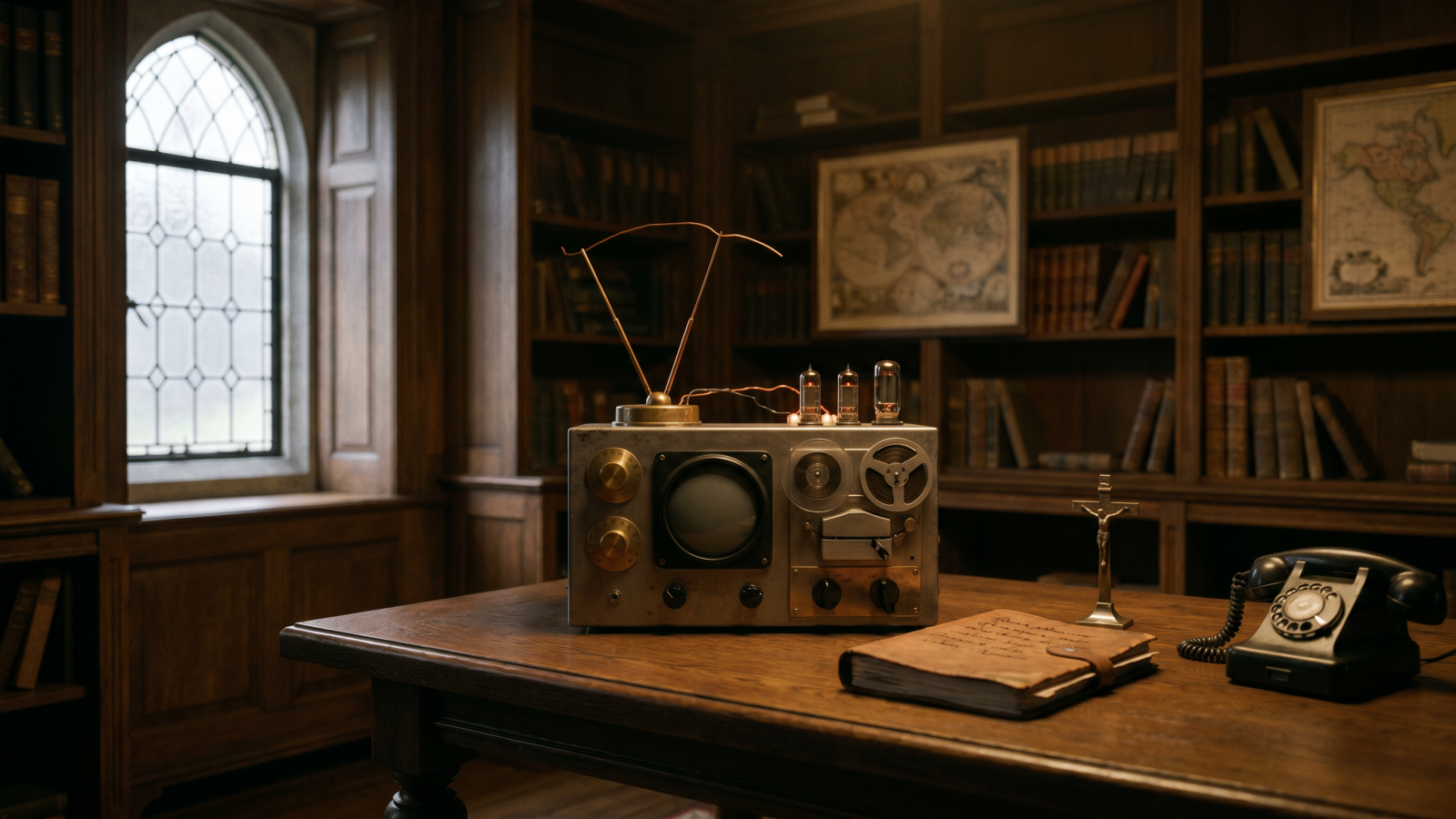

The Chronovisor was the name attached to a device an Italian Benedictine priest built — and then was forced to deny — in the late 1950s: a machine, he and his collaborators said, that could view past events directly, including the trial and crucifixion of Christ. The priest, Father Pellegrino Ernetti of the Abbey of San Giorgio Maggiore in Venice, described the project as a collaboration with twelve scientists working under conditions of strict Vatican secrecy, including the Italian physicist Enrico Fermi and the German Nobel laureate Wernher von Braun. The Vatican has never publicly acknowledged the project. The Vatican has never publicly denied it either. Sixty years after the device first surfaced in the Italian press, the question of what really happened inside the walls of San Giorgio Maggiore in those years is one the Holy See has chosen to leave open.
Who Was Father Ernetti?
Pellegrino Maria Ernetti (1925–1994) was no fringe figure. He was a Benedictine monk of the Abbey of San Giorgio Maggiore in Venice, a serious musicologist with a specialisation in pre-polyphonic Christian chant, a Vatican-licensed exorcist, and the holder of teaching positions at the Conservatorio Benedetto Marcello in Venice and the Pontifical Academy of Music in Rome. His published work on Gregorian and Ambrosian chant is still cited in specialist musicology to this day.
This is the part of the story the modern dismissers tend to skip. The Vatican does not grant exorcism faculties, music-academy chairs, and decades of papal access to fantasists. Whatever Ernetti was doing inside San Giorgio Maggiore from the 1950s onward, the institution that ran his career thought he was credible enough to keep him at the centre of its most sensitive academic and ecclesiastical work for forty years.
The 1972 Announcement
The Chronovisor entered the public record in 1972, when the Italian magazine La Domenica del Corriere published a feature interview with Ernetti under the headline “A machine that photographs the past has been invented.” Ernetti described, in cautious but specific terms, a device built over years of collaborative work that could “reconstruct” past events by reading what he called “energetic traces” — the cumulative electromagnetic residue, in his framing, that every event leaves on the surrounding universe.
The Chronovisor, as he described it, was an antenna-and-receiver apparatus tuned to those residues. With it, the team had recovered:
- A photograph of the face of Christ on the cross.
- The transcribed text of a Latin play — Thyestes by the Roman tragedian Quintus Ennius — a lost work attested in classical sources but with no surviving manuscript.
- Reportedly, other recovered material that has never been publicly released.
The establishment response was immediate and unusually well-coordinated. The historian Vittorio Messori announced that the photograph of Christ was, in fact, an inverted and altered image of a wooden crucifix at the Sanctuary of Love in Collevalenza, Umbria. Classical scholars announced that the Thyestes text was either a forgery in late-medieval Latin or a partial copy of a different known work. In the space of a few years, the mainstream consensus was that the Chronovisor evidence had collapsed.
What that consensus never adequately explained was why a priest in the middle of a successful Vatican career would have risked everything by faking evidence in a national magazine. The simple-hoax framing has never accounted for the structure of Ernetti’s life before or after 1972. He continued to teach, to exorcise, to publish in musicology, to maintain his Vatican access. A man caught in a deliberate national fraud — at the height of the Italian press’s appetite for ecclesiastical scandal — does not usually do that.
The 1994 “Retraction” That Confirmed The Device Had Existed
In 1994, the year of Ernetti’s death, a French Catholic journalist named François Brune — who had spent decades documenting the Chronovisor story and had been in extended personal correspondence with Ernetti for years — published an interview in which Ernetti finally addressed the controversies head-on.
What the international press characterised afterwards as a “retraction” was nothing of the sort. According to Brune, Ernetti made three crucial admissions:
- The photograph published as Christ on the cross had indeed been the Collevalenza crucifix — but Ernetti said it had been deliberately substituted, to protect the genuine photograph the team had recovered, which was considered too theologically dangerous to publish.
- The device itself had existed. Ernetti’s underlying claim, that he and the team had built and operated a working Chronovisor, was reaffirmed.
- The device had subsequently been dismantled at Vatican instruction. The institutional Church, in Ernetti’s account, had taken the position that what the device could see was not safe for general human consumption — and had ordered its destruction.
Brune’s narrative has been contested. His later work on Instrumental Transcommunication and related paranormal-religious phenomena has been used to discredit his standing as a neutral witness. The Vatican has never officially confirmed or denied any element of his account. The standard ecclesiastical response when asked about the Chronovisor is that “no such device has ever been the subject of an official inquiry” — which is, when read carefully, not a denial of its existence at all.
The Names On Ernetti’s Team
The Chronovisor narrative gains its remaining structural credibility from the calibre of the twelve scientists Ernetti said helped develop it. The two most famous names on his list are Enrico Fermi and Wernher von Braun.
Enrico Fermi — the Italian-American physicist whose work on neutron-induced radioactivity won the 1938 Nobel Prize, and who personally led the first sustained nuclear chain reaction in 1942 — died in 1954. The mainstream dismissal of his alleged involvement points to that date as proof that Fermi could not have worked on a device Ernetti dated to “the late 1950s.” What that dismissal conveniently glosses over is that Ernetti’s own framing of the project always described an early theoretical phase, dating back to the late 1940s, in which the underlying physics was worked out before any physical apparatus was assembled. Fermi was alive, in Italy, and quietly in personal correspondence with senior Catholic clergy throughout exactly that period.
Wernher von Braun — the German rocket scientist whose Operation Paperclip biography is documented elsewhere on this site — was, in the relevant decades, a publicly-practising Catholic with extensive correspondence with Catholic clergy on both sides of the Atlantic. His Marshall Space Flight Center papers do not name the Chronovisor explicitly. They do, however, reference a number of recipient-redacted letters with Italian Catholic figures during the relevant years. The official position is that those redactions are administrative. The unofficial reading is more interesting.
The remaining ten members of Ernetti’s team have never been publicly named. Brune’s accounts mention several first names without surnames. The surnames have never surfaced — which is exactly what one would expect of a project the modern Vatican prefers to leave unconfirmed.
Why The Story Refuses To Die
The Chronovisor narrative survives in 2026 not because it is a particularly elaborate hoax, but because every attempt to definitively kill it has failed at the same wall: the Vatican will neither confirm nor deny.
If the device had genuinely been a fabrication — a publicity stunt by an eccentric monk — the Vatican could have ended the story in a single press release at any point in the past half-century. It has not. If it had genuinely never existed — if Ernetti had simply been imagining it — the institutional response would have been documentary disinterest rather than institutional silence. Institutional silence, in the Roman Catholic Church, is rarely accidental.
For believers, the device represents what the Vatican has always quietly held: direct empirical access to the founding events of Christianity. For paranormal researchers, it is one more piece in the long pattern of suppressed-Vatican-technology narratives — alongside the declassified Vatican-CIA archives, the speculation around the Vatican’s secret astronomical operation at Mount Graham, and the broader question of how much the institutional Church has always known about subjects it has publicly declined to comment on.
Frequently Asked Questions
What is the Chronovisor?
The Chronovisor is a device the Italian Benedictine priest Father Pellegrino Ernetti claimed in 1972 to have helped build at the Abbey of San Giorgio Maggiore in Venice — a machine capable of viewing past events directly by reading the “energetic traces” every event leaves on the surrounding universe. According to Ernetti, the device successfully recovered both a photograph of Christ on the cross and the text of the lost Roman play Thyestes by Quintus Ennius before being dismantled at Vatican instruction.
Did the Chronovisor really exist?
According to Father Ernetti and the French Catholic journalist François Brune, who interviewed him at length in his final years: yes. According to the institutional Vatican: no comment. The two pieces of physical evidence Ernetti originally published in 1972 were criticised by mainstream commentators within a few years, but Ernetti himself, in his 1994 final interview, said both that the published evidence had been deliberately substituted to protect the genuine recovered material and that the device itself had existed and been operated.
Who built the Chronovisor?
Ernetti said the project was a collaboration of twelve scientists working under Vatican secrecy. The two famous names he attached to the team were the Italian physicist Enrico Fermi (who worked on the theoretical foundation in the late 1940s before his death in 1954) and the German rocket scientist Wernher von Braun (a practising Catholic with extensive clergy correspondence in the relevant decades). The remaining ten members of the team have never been publicly named.
Did Father Ernetti recant the Chronovisor story?
No — though the international press has often characterised his 1994 interview that way. According to François Brune, who recorded the interview shortly before Ernetti’s death, the priest admitted that the photograph published as Christ on the cross had been a deliberate substitution to protect the genuine recovered image. He reaffirmed that the device itself had existed and stated that it had subsequently been dismantled at Vatican instruction.
Has the Vatican ever commented on the Chronovisor?
No. The Vatican has never officially confirmed or denied the device’s existence. The standard ecclesiastical response to inquiries is that the Chronovisor has “never been the subject of any official inquiry” — a careful phrasing that critics have read as a non-denial and that proponents have read as confirmation by omission. In sixty years, the Vatican has not issued a single press release ending the story.
What was Father Ernetti’s other work?
Ernetti was a credentialed musicologist specialising in pre-polyphonic Christian chant, a Benedictine monk of the Abbey of San Giorgio Maggiore in Venice, a Vatican-licensed exorcist of the Diocese of Venice, and a teacher at both the Conservatorio Benedetto Marcello in Venice and the Pontifical Academy of Music in Rome. His published work on Gregorian and Ambrosian chant is still cited in specialist musicology. He was not a fringe figure — and the institution that ran his career for forty years has never publicly disowned him.
Discover more from Infinity Explorers
Subscribe to get the latest posts sent to your email.