


South America has produced some of the most detailed and rigorously documented close encounter cases in the history of UFO research — a fact often overlooked in English-language accounts that focus heavily on North American and European incidents. Among these, the abduction account of Paulo Coutinho stands out for its combination of physiological evidence, multiple witness corroboration, and the unusually thorough investigation it received from Brazilian UFO researchers who brought medical and technical expertise to their analysis. What Coutinho described was not a vague, dreamlike experience but a physically specific, psychologically harrowing encounter that left lasting marks on both his body and his psychology — and that continues to challenge conventional explanations.
The Night of the Encounter
Paulo Coutinho was a Brazilian farmer living in the state of Minas Gerais when the incident occurred. He was outdoors in the evening when he first noticed a light that did not behave like any aircraft or natural phenomenon he recognized — it changed direction sharply, descended toward his location at speed, and then hovered at low altitude. Coutinho reported attempting to move away from the object but experiencing a paralysis that prevented him from doing so — a symptom reported with high frequency across close encounter accounts globally, and one that researchers have documented extensively enough to treat as a characteristic feature of high-strangeness encounters rather than a culturally learned narrative element.
What followed was a period of missing time. Coutinho’s next clear memory was of lying on the ground, some distance from where he had been standing, with the object gone and a period of several hours unaccounted for. His clothing was burned in specific areas consistent with exposure to intense heat or radiation. He reported physical sensations including skin irritation, nausea, and disorientation that persisted for days after the encounter. When neighbors found him, his physical condition — disheveled, disoriented, with the clothing damage — was immediately apparent and was documented by multiple community members before any investigation began.
What Coutinho Later Remembered
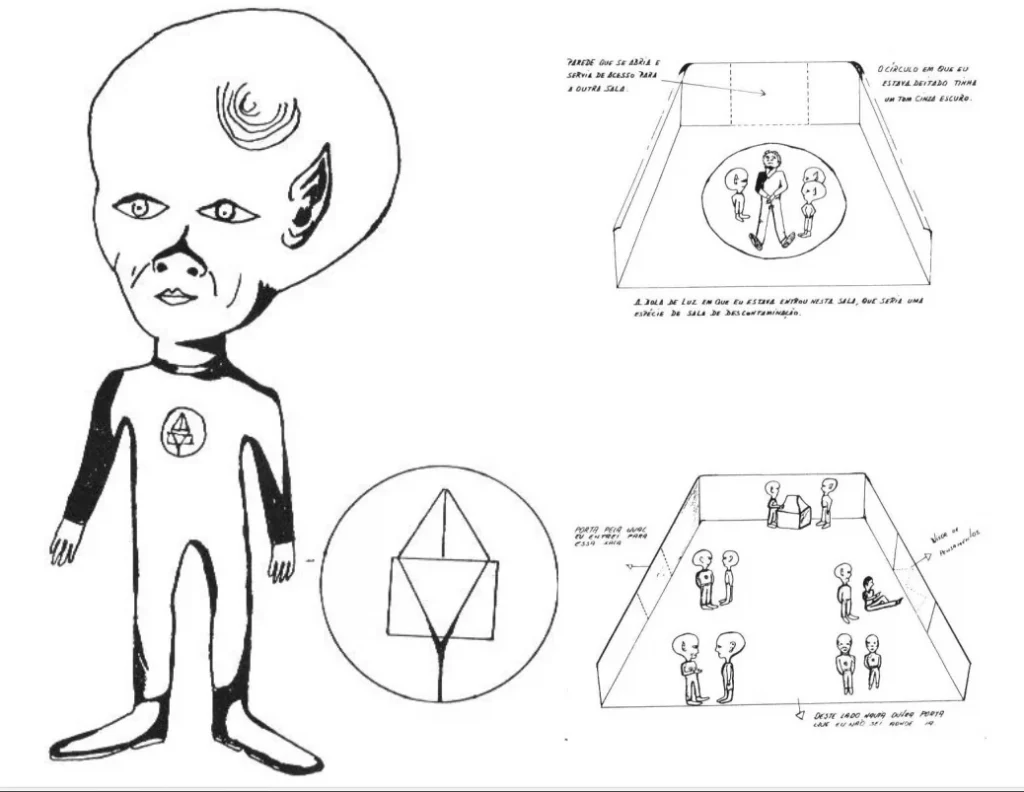
The recovered memories that emerged in the days and weeks following the encounter — through both spontaneous recall and sessions with Brazilian researchers trained in hypnotic regression — described the interior of a craft and contact with beings whose characteristics have become familiar in the global abduction literature but which Coutinho had no prior exposure to through media or research. He described being examined by entities that were roughly humanoid but proportionally different from humans, communicating in non-verbal ways that he experienced as images and impressions rather than speech, and being subjected to a physical examination that he found disturbing but that did not involve overt violence.
Specific details from Coutinho’s recalled account that researchers found noteworthy included his description of the interior surfaces — smooth, without visible joints or mechanisms, lit by diffuse illumination with no identifiable source — and the nature of the examination, which focused on areas of his body associated in other accounts with biological sampling. The absence of the dramatic or aggressive elements that characterize popular fictional depictions of abduction, and the presence instead of procedural, almost clinical interactions, is a pattern that researchers across multiple countries have documented as characteristic of genuine high-credibility accounts as opposed to culturally influenced narratives.
The Medical and Physical Evidence
Unlike many abduction accounts that rest entirely on testimony, the Coutinho case produced physical evidence that was examined by medical professionals. The burn patterns on his clothing were analyzed and found to be inconsistent with any conventional heat source — the distribution and intensity of the damage suggested exposure to a form of radiation or directed energy rather than fire or contact burns. Skin lesions documented in the days following the encounter showed characteristics that treating physicians found unusual: they did not follow the pattern of any known dermatological condition, they healed at an anomalous rate, and their distribution on his body corresponded to areas he had indicated during the examination description.
Blood work and neurological assessments conducted within weeks of the incident revealed elevated markers consistent with radiation exposure, though the levels were not immediately dangerous. These physiological findings were part of what moved the Coutinho case from anecdotal testimony to a medically documented event — a category that Brazilian researchers have consistently argued deserves more systematic attention than it receives from the mainstream scientific community. The combination of independently documented physical effects and a consistent, detailed narrative from a witness with no prior history of mental health issues or public claims about UAP placed the case in the highest credibility tier of Brazilian encounter documentation.
Brazil’s UFO Research Infrastructure
Part of what distinguishes the Coutinho case is the quality of the investigation it received. Brazil has one of the most developed civilian UFO research infrastructures in the world — a fact that reflects both the frequency of encounters documented in the country and a cultural openness to serious investigation that sometimes contrasts with more dismissive attitudes in North America and Europe. Organizations including the Comissão Brasileira de Ufologia (CBU) and the work of researchers like Claudeir Covo and others brought genuine investigative rigor to the Coutinho case, cross-referencing his account with other documented encounters in the Minas Gerais region and maintaining contact with him over years to assess the consistency of his account.
Brazil also has the distinction of being one of the few countries where the military has officially acknowledged UAP investigation. Operation Prato in the Amazon in 1977, which involved the Brazilian Air Force documenting and investigating encounters with craft that were injuring local residents, remains one of the most thoroughly documented government UAP investigations in any country’s record. This institutional context — where UAP is taken seriously at official levels in ways that are more advanced than in many other nations — gave the civilian researchers investigating Coutinho’s account access to resources and expert networks that enhanced the quality of their work.
Long-Term Effects and Coutinho’s Account Today
The long-term psychological effects of the Coutinho encounter follow a pattern documented in high-quality abduction research globally: persistent hypervigilance, recurrent dreams related to the experience, a profound shift in worldview and spiritual outlook, and a sense of being marked or chosen in ways that the experiencer finds both meaningful and burdensome. Coutinho has maintained the consistency of his account through multiple interviews over many years, with the minor variations that characterize genuine memory rather than the fixed-script consistency that characterizes rehearsed fabrication.
The Paulo Coutinho case will not resolve the fundamental question of what abduction experiences are — physical events involving non-human intelligences, anomalous psychological phenomena of unknown mechanism, or something that resists clean categorization in either direction. What it does is provide a specific, physically documented, investigatively scrutinized data point that cannot be dismissed on grounds of insufficient evidence or witness unreliability. In the growing body of serious research on the contact phenomenon, cases like Coutinho’s represent the empirical core — the encounters where the evidence extends beyond testimony into the realm of documented physical reality, demanding engagement rather than dismissal.
Discover more from Infinity Explorers
Subscribe to get the latest posts sent to your email.