

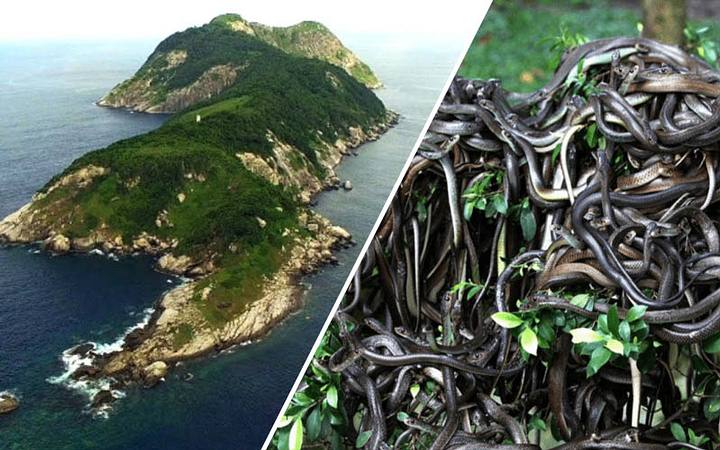
About 33 kilometers off the coast of Brazil, in the South Atlantic Ocean, a small mountainous island popularly known as Snake Island is kept isolated from humanity for good reason: 400,000 of the world’s deadliest poisonous snakes live there, some of which are capable of melting the human skin.
History Of The Snake Island (Ilha de Queimada Grande)
With its 430,000 square meters, the Ilha de Queimada Grande is also known as the “Island of Serpents. ” The reason is explicit: Researchers and biologists estimate that in some places there is up to one snake per square meter.
Since the sea level rose about 11,000 years ago and cut the island’s contact with the mainland, snakes have developed in a different way: they are five times more poisonous than their mainland relatives.
They hunt and eat birds but not the native birds of the island because they already know how to flee from their attack rather they hunt larger migratory birds which made their venom became more powerful.
As for a large number of snakes, it is explained by the fishermen of the area that it was pirates of yesteryear who filled the place with snakes to protect a treasure that they hid there.
You might also be interested in reading about the mysterious suicide forest in Japan
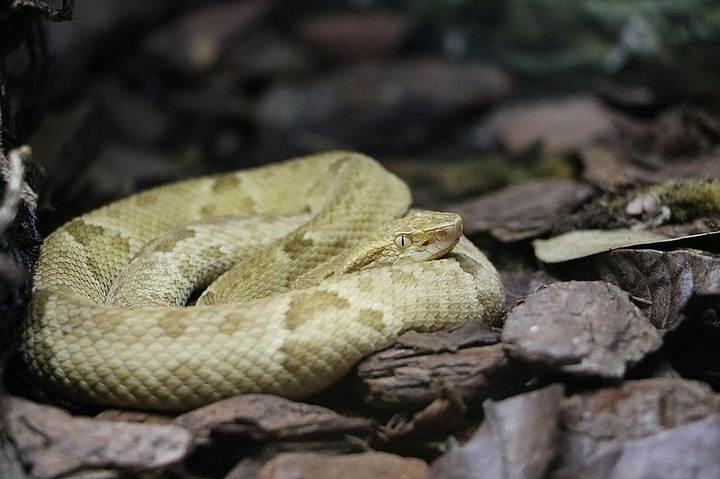
But of course, that’s just a legend. Like the one that tells that a fisherman, having lost his engines, was pushed by the current to the coasts of Ilha de Queimada Grande. When the boat was finally found, there was nothing left of the man but torn clothing, blood, and bones, undoubtedly the work of the island’s most infamous tenant: the “golden spearhead” ( Bothrops insularis ), whose poison can rot the flesh. down to the bone.
To conclude, it should be noted that what really makes Ilha de Queimada Grande worthy of dedicating an article on this website is that —beyond the unverifiable legends— no one until now has managed to explain how or why this incredibly density of snakes mortals ended up on an island.
In the last twenty years there have been only a handful of scientific expeditions, but none managed to come up with a satisfactory explanation.
Today the waters surrounding the island are patrolled by the Brazilian navy with a strict policy of restricting access, which can only be bypassed with a special government authorization.
Why Snake Island Is Banned to Humans
Ilha de Queimada Grande sits about 33 kilometers off the coast of São Paulo state, Brazil. The Brazilian Navy controls access. No civilian visit is permitted without a federal scientific permit, and even those are issued only a few times per year, typically to herpetologists from the Instituto Butantan. The reason is simple in arithmetic terms: a 110-acre island holds an estimated 2,000 to 4,000 golden lancehead vipers (Bothrops insularis), giving the island the highest density of venomous snakes anywhere measured on Earth — somewhere between one and five snakes per square meter in the densest pockets.
The ban exists for two parallel reasons. The first is to protect humans. The golden lancehead’s venom is roughly five times more potent than that of the mainland lancehead (Bothrops jararaca), and untreated bites have a mortality rate estimated at 7 percent. The island is not visited by emergency medical services. Anyone bitten there would die before any rescue could reach them. The second reason — equally serious in the eyes of the conservation biologists involved — is to protect the snakes. The golden lancehead is found nowhere else on Earth. The IUCN classifies it as critically endangered. Habitat disturbance, illegal poaching for the exotic-snake trade, and accidental introduction of new pathogens could wipe out the entire species in a single season.
How the Snakes Got There
Approximately 11,000 years ago, at the end of the last ice age, rising sea levels separated what is now Ilha de Queimada Grande from the Brazilian mainland. A population of mainland lancehead vipers was stranded on the new island. With no terrestrial prey available — the island is too small to support any significant mammal population — the snakes shifted their diet to migratory birds passing overhead.
This is where their evolution becomes interesting. Most viper venom is calibrated to immobilize ground-dwelling prey, which the snake then tracks via heat-sensing pits and the chemical trail of dying tissue. A bird, struck in the air, will fly away before the venom takes effect — and the snake will lose it. The Snake Island lanceheads evolved a venom that is approximately three to five times faster-acting than the mainland version, capable of killing a small bird within seconds rather than minutes. They also evolved a distinctive golden coloration that helps them blend into the canopy where they hunt.
This evolutionary acceleration is, ironically, what makes the species so medically valuable. The same hyper-potent venom that kills birds in seconds contains compounds being studied for blood-pressure medication, anticoagulants, and treatments for circulatory disease. Captopril — one of the most widely prescribed blood-pressure drugs in the world — was originally derived from a related Brazilian viper’s venom. The compounds being isolated from golden lancehead venom may yield the next generation of similar drugs.
The Lighthouse Keeper Legend
The island’s automated lighthouse, built in 1909 to warn shipping away from the coast, is the only human-built structure on the island. From 1909 to roughly 1925, the Brazilian Navy stationed lighthouse keepers and their families there. Two stories from that period have entered local folklore — both unverifiable in primary documents, both extensively retold.
The first: a keeper and his entire family were killed by snakes that entered the keeper’s residence through an open window one night. They were found days later, all four of them, bitten multiple times. The second: in a separate incident, a Navy fishing boat anchored offshore lost a sailor who went to the island to gather firewood. He was found dead on the beach, bitten extensively. Both stories appear in tourist-oriented retellings and in Brazilian newspaper features about the island. Neither appears in the actual Brazilian Naval archives of the period, which are now partially digitized. The archives do record the decision to automate the lighthouse in 1920, with the operational explanation cited as “difficulty in maintaining personnel on the island.” Whether that difficulty was specifically snake-related, or simply the logistical strain of supplying a remote outpost, the official record does not say.
The folklore probably encodes a real underlying fact — keeping personnel on Snake Island was indeed extraordinarily difficult, and snakebites likely did contribute to whatever specific incidents prompted the automation decision. Whether the keeper’s-family story is literally accurate or an after-the-fact dramatization is unrecoverable from the available evidence.
What Scientists Find When They Visit
The Instituto Butantan — Brazil’s leading venom-research institution, founded in 1901 — conducts a research expedition to Snake Island roughly once every 2-3 years. Expeditions are kept brief (typically 48 hours), travel in groups of 4-6 researchers in full puncture-resistant boots and leggings, and are accompanied by emergency antivenom supplies and a Navy support vessel anchored offshore. The expeditions have produced most of what is currently known about the golden lancehead’s behavior, diet, breeding cycle, and venom chemistry.
The most consistent finding across decades of expedition reports: the snake density on the island appears to be slowly declining, despite the species’s protected status. The leading hypotheses are inbreeding depression (the population is small and genetically isolated), a still-poorly-understood fungal disease that has been documented in a small subset of specimens, and accidental introduction of competitor species or parasites by the very researchers studying them. The species could go extinct within a few decades if the trend continues. Whether the ban on civilian access will protect it long enough to recover, or simply preserve the conditions of its decline, is an open question.
The Illegal Pet-Trade Problem
A single golden lancehead can fetch $10,000 to $30,000 on the international black market for exotic reptiles. This has created an ongoing law-enforcement problem for the Brazilian Navy and the Federal Police. Approximately every two to four years, an illegal landing party is intercepted attempting to remove specimens from the island. Most of the smugglers are connected to broader exotic-wildlife trafficking networks based in Europe and the United States. Convictions have been infrequent — the vessels usually disappear into Brazilian or international waters before authorities can intercept them — but the smuggling itself appears to continue regardless of the ban.
The Brazilian government’s response has been to increase Navy surveillance overflights and to coordinate with the World Customs Organization on intercepting golden lancehead specimens that appear in international shipments. Despite these efforts, an estimated 50-100 golden lanceheads are illegally removed from the island every year. The species cannot afford that level of attrition.
Frequently Asked Questions
Where is Snake Island?
Ilha de Queimada Grande — commonly called Snake Island — is a 110-acre Brazilian island located approximately 33 kilometers off the coast of São Paulo state. It is part of the Itanhaém municipality but sits well into the Atlantic Ocean.
Why is Snake Island banned?
The Brazilian Navy bans civilian access for two reasons: (1) to prevent human deaths, since the island holds an estimated 2,000-4,000 highly venomous golden lancehead vipers and is far from any emergency medical care; and (2) to protect the critically endangered golden lancehead viper species, which exists nowhere else on Earth.
How many snakes are on Snake Island?
Estimates range from 2,000 to 4,000 golden lancehead vipers across the island’s 110 acres, giving it one of the highest known densities of venomous snakes anywhere on Earth — between one and five snakes per square meter in the densest pockets. The total population has been declining over recent decades.
Is the golden lancehead venom medically useful?
Yes. Compounds from golden lancehead venom are being studied for blood-pressure medication, anticoagulants, and treatments for circulatory disease. The widely-prescribed blood-pressure drug captopril was originally developed from venom of a related Brazilian viper, and similar derivative drugs are likely from the golden lancehead.
Has anyone died on Snake Island?
Two early-20th-century deaths are recorded in folklore — a lighthouse keeper’s family killed in their residence, and a Navy sailor bitten while gathering firewood — but neither story is fully verifiable in primary Brazilian Naval archives. What is verified: the Navy’s 1920 decision to automate the lighthouse cited “difficulty in maintaining personnel on the island” as the reason. The folklore probably encodes real but undocumented underlying incidents.
Can you visit Snake Island legally?
Only with a federal scientific research permit, typically issued to credentialed herpetologists from the Instituto Butantan or international research collaborators. Tourist visits, casual landings, and unpermitted scientific work are all prohibited and subject to federal prosecution.
This story was substantially expanded May 2026 with the evolutionary history of the golden lancehead, the lighthouse-keeper folklore reviewed against archival evidence, the Instituto Butantan expedition findings, and the ongoing illegal pet-trade pressure. Status: strange but true. Snake Island and its viper population are fully documented in scientific literature; some of the folklore around the lighthouse keepers is unverifiable.
Discover more from Infinity Explorers
Subscribe to get the latest posts sent to your email.