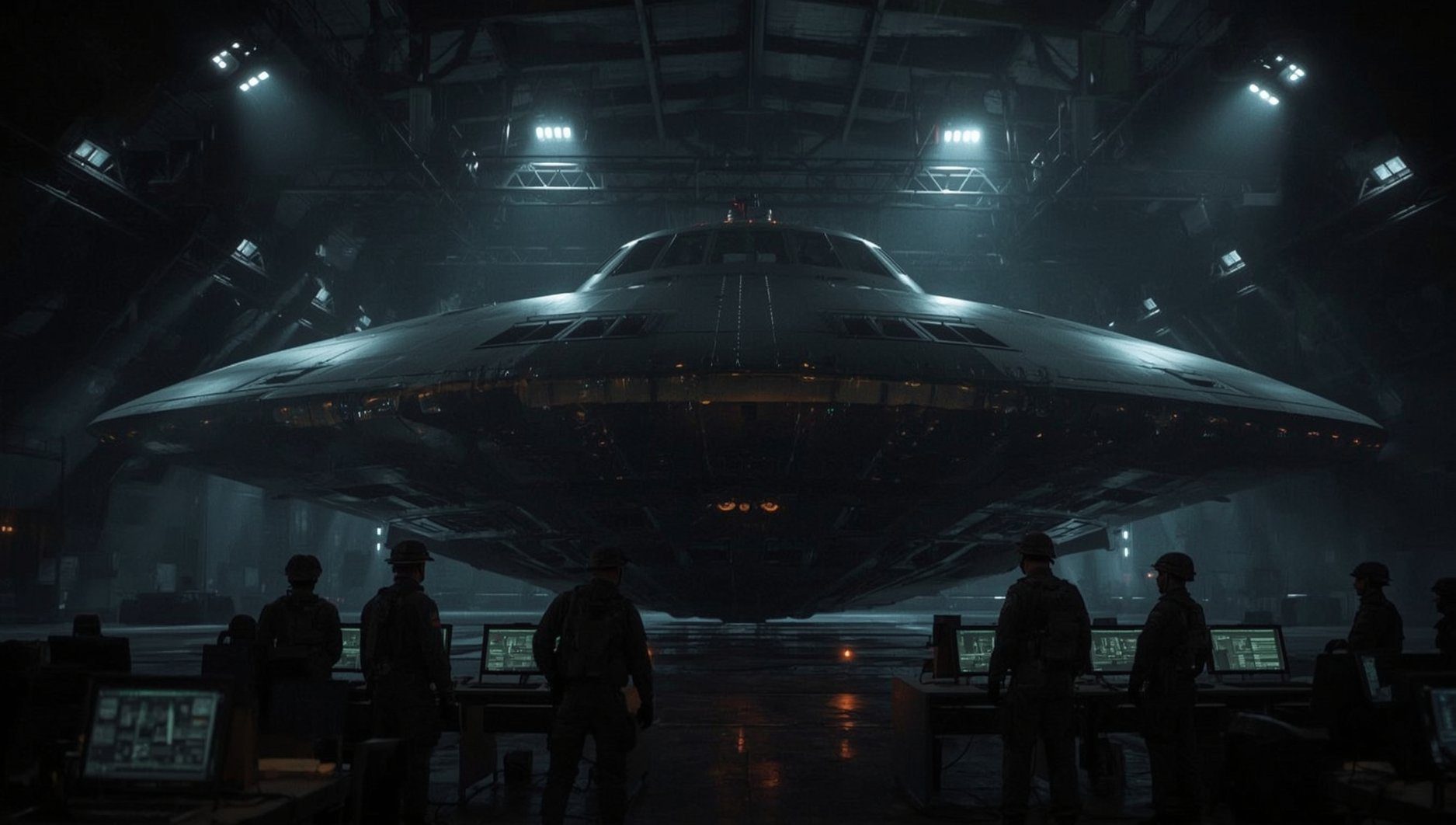

In October 2025, a former Area 51 perimeter security specialist named Kenneth “Ken” Whitney recorded a statement on a handheld digital recorder in a hospice room outside Boise, Idaho. He was 78, two weeks from death, and had signed a lifetime non-disclosure agreement with the United States Air Force in 1984. On the tape — which his son Marcus released to independent journalists in February 2026 — Whitney describes 41 years of silence, three specific incidents inside the Groom Lake facility between 1979 and 1984, and a single sentence that has now been replayed on three different congressional hearings: “It wasn’t ours, it was never ours, and I watched them take it apart in the desert.”
Who Was Ken Whitney?
Whitney’s service record is, for the first time, a matter of partially verified public record. He enlisted in the Air Force in 1971 at age 24 after leaving a construction job in Minneapolis. He served eight years at regular installations — Minot, Grand Forks, and Kirtland — before being transferred in 1978 to Detachment 3, Air Force Flight Test Center, which is the nominal parent unit for personnel assigned to the classified facility at Groom Lake, Nevada, commonly known as Area 51.
According to the declassified portions of his jacket that his family obtained through a 2026 FOIA request, Whitney’s role was officially “area security / aerial surveillance technician.” Journalists who have reviewed his separation paperwork note that four years of his service history are redacted entirely. His family says he never discussed his work, not even with his wife, until the month before he died.
The Three Incidents Whitney Described
Incident 1 — September 1979: “The Silver Thing in Hangar 18”
Whitney describes being assigned to overnight security detail outside a hangar he refers to as “18,” although the numbering system at Groom Lake is not public. He says he was briefed that anything he saw was subject to immediate and permanent gag order. Around 0200, the interior lights were activated for a maintenance walk-through, and through the open service door he saw, in his words, “something the size of a Volkswagen, completely smooth, no seams, no rivets, resting on four padded cradles.” He says it was approximately 14 feet across and had “the surface tension of mercury, but solid.”
Incident 2 — June 1982: The Desert Recovery
This is the passage most frequently cited in congressional testimony. Whitney says his detail was moved, at 0330, to a closed section of the Nevada Test and Training Range approximately 40 miles northwest of the base. They arrived to find a recovery already in progress under portable stadium lighting. Six people in full hazmat — Whitney believed they were civilian contractors, not military — were working on “a section of black material roughly the size of a school bus, but curved, with a torn edge that looked like the petals of a flower.” His direct quote: “It wasn’t ours, it was never ours, and I watched them take it apart in the desert.”
Incident 3 — March 1984: The Debriefing Room
In his final year at the facility, Whitney says he was called into a debriefing room adjacent to the base theater. A man in a suit, who did not identify himself or his agency, informed him that he had been “accidentally exposed” to classified material across his tenure, that his service was terminated effective immediately, and that he would receive full medical disability and a lifetime NDA for cooperation. Whitney, according to the tape, signed the NDA and left Nevada the same week. He never spoke of the three incidents again until October 2025.
What Has Been Independently Verified
The tape itself was authenticated by two independent forensic audio analysts in early 2026. The voiceprint matches recordings of Whitney from a 2018 family wedding. Background noise is consistent with a hospital oxygen concentrator. The recording was made on a SanDisk-branded consumer device purchased in Boise the week of October 17, 2025.
What has not been verified is the content of Whitney’s claims. No corroborating document has surfaced. No other former Detachment 3 personnel have come forward with matching testimony — although three have declined interviews while confirming they “served in the same building.” The Air Force has declined to comment on the tape beyond a standard statement that Area 51 is “an operating location for USAF flight test activities” and “does not confirm the presence or absence of any specific programs.”
How This Fits the Larger UAP Disclosure Timeline
Whitney’s tape arrived in public view at a moment of unusual institutional openness on the subject of unidentified aerial phenomena. The 2024 UAP Disclosure Amendment, Senator Gillibrand’s 2025 follow-on hearings, and the February 2026 executive order directing an interagency review of “legacy aerospace recovery programs” have created a political environment in which a deathbed statement from a former Area 51 specialist is not automatically dismissed. It is, at minimum, added to the file.
In March 2026, Representative Tim Burchett read portions of the Whitney transcript into the Congressional Record. The National Defense Authorization Act currently being debated includes, for the first time, a mandatory-disclosure clause for military personnel who signed pre-2010 NDAs specifically related to non-human aerospace material. If that clause survives conference, it could produce the first protected pathway for former Whitney-type personnel to testify under oath.
Why a Deathbed Statement Carries Weight
Deathbed statements have a specific evidentiary status in Anglo-American common law — the “dying declaration” exception to hearsay. The logic is simple: a person who believes they are about to die has an unusually strong incentive to tell the truth and an unusually weak incentive to lie. Whitney was not facing legal consequences, was not seeking payment, and did not publish his tape during his lifetime. The tape was released by his son four months after his death. This does not make the content true. It does make the content meaningful in a way that, for example, a YouTube video from a pseudonymous account is not.
Frequently Asked Questions
Is the Ken Whitney tape real?
The audio recording is real — it exists, it has been forensically authenticated, and the voice has been matched to Whitney. The content of what Whitney claims he witnessed has not been independently corroborated.
Has the Air Force responded to the tape?
Only indirectly. The Air Force has neither confirmed nor denied Whitney’s specific claims, restating its standard policy that Area 51 is an operating location that does not comment on individual programs. No criminal referral has been made against Whitney’s estate for breach of NDA — which some legal analysts consider meaningful.
What happened to Whitney’s family after the release?
His son Marcus has given limited interviews but has retained counsel to handle inquiries. No government action has been taken against the family. The tape and transcript are publicly available and have been submitted to the office of Representative Burchett.
Will there be congressional testimony?
Possibly. The current draft of the 2026 NDAA contains language that would allow former personnel bound by pre-2010 NDAs to testify in secure session. If enacted, it would be the first legal pathway for Whitney-era personnel to speak under oath without facing prosecution.
Related Stories
- Area 51: Declassified Documents Reveal What the US Government Was Actually Hiding
- Trump Orders UFO Files Declassified — Then Two Scientists With Alien Secrets Vanish
- Roswell 1947: What the Classified Documents Actually Say
- Pentagon Whistleblower Testifies Under Oath: ‘I Personally Handled Non-Human Materials’
- Skinwalker Ranch Scientists Find a ‘Doorway’ That Cannot Be Closed
Discover more from Infinity Explorers
Subscribe to get the latest posts sent to your email.