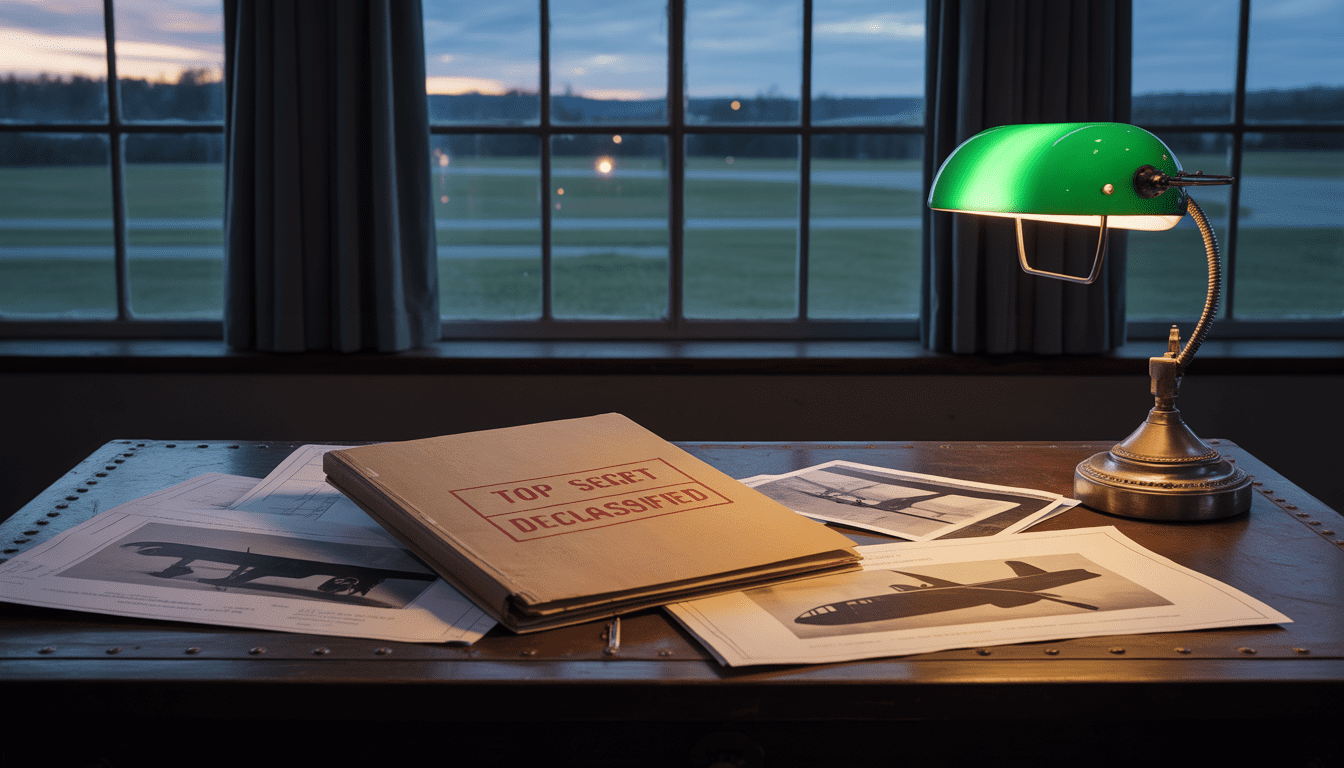

For more than 70 years, Area 51 has done what the U.S. government’s most famous non-installation does best: stayed useful by staying quiet. The site officially did not exist until 2013, when the CIA finally released an unredacted version of a 1992 historical study of the U-2 program and admitted — on paper — what hundreds of aerospace engineers, pilots, and aircraft spotters had known since 1955. Area 51 is real. It is at Groom Lake, Nevada. And it has been a test range for the most classified aviation platforms in American history.
Between 2013 and 2026, a steady drip of FOIA releases, NRO and DIA declassification reviews, and a new wave of Senate testimony has filled in a picture of what actually went on there. Here’s what the declassified documents support, what they don’t, and why so much of the UFO lore around Area 51 has a mundane — but genuinely astonishing — aeronautical explanation.
What the declassified record now confirms
The publicly released program history identifies Area 51 — officially “Groom Lake,” internally “Paradise Ranch,” operationally “Homey Airport” (ICAO: KXTA) — as the flight-test home of a continuous chain of classified aircraft running from the mid-1950s to the present:
- Lockheed U-2 (first flight 1955): the reason the base was built, under CIA Project AQUATONE.
- A-12 OXCART and SR-71 Blackbird: Mach-3 reconnaissance platforms tested under CIA and later Air Force cognizance.
- Lockheed Have Blue / F-117 Nighthawk: the first operational stealth aircraft, whose radar cross-section testing generated many of the famous early 1980s “UFO” reports.
- Captured foreign aircraft, including Soviet MiGs, evaluated under the Constant Peg / HAVE programs at neighboring Tonopah.
- RQ-170 Sentinel and follow-on unmanned platforms, some of which remain partially classified today.
Every one of these platforms, at some point during its test program, was mistaken by civilian witnesses for a UFO. The CIA’s own 1997 study estimated that more than half of U.S. UFO reports in the late 1950s and 1960s were U-2 or A-12 overflights — the aircraft’s silver skin reflected sunlight long after the ground had gone dark.
The persistent UFO claims — what the record says and doesn’t say
The famous claims — Bob Lazar’s 1989 allegation of reverse-engineering at “S-4,” the Roswell-to-Area-51 relocation story, and descriptions of “Element 115” — are not supported by the declassified record. The 1947 Roswell debris was documented in 1994 (the final Air Force report, The Roswell Report: Case Closed) as wreckage from Project MOGUL, a classified acoustic-balloon array used to detect Soviet nuclear tests. No document in the current declassified record places non-human biologics or craft at Groom Lake.
That said, the declassified record has two genuinely interesting silences:
- Program locations in the FOIA releases are redacted in a pattern that would make unusual sense if any non-aeronautical work existed. Intelligence historians like Jeffrey Richelson have noted that certain 1980s-era documents show location redactions inconsistent with known programs, but no smoking gun has emerged.
- The 2023 Senate testimony of David Grusch — a former intelligence officer — asserted under oath that non-human retrieval and reverse-engineering programs exist, but named no location. Grusch’s claims remain unsubstantiated in the public record but have prompted ongoing AARO investigation.
Why the “UFO hangar” lore is so sticky
Five factors sustain the Area 51 UFO mythology long after the aeronautical explanation has been confirmed:
- Real secrecy. The base is an active classified installation with a 25-mile-radius exclusion zone. Real secrecy generates real rumors.
- Real displays of impossible-looking tech. An F-117 flying at night in 1981 looked exactly like a UFO to anyone who wasn’t read into the program.
- Deliberate cover stories. The Air Force actively used UFO reports as cover for U-2 overflights — the declassified 1997 CIA study admits this.
- The Bob Lazar moment. A charismatic 1989 television interview, still unretracted, seeded a specific, testable set of claims that have defined UFO discourse for a generation.
- Cultural compounding. The X-Files, Independence Day, and 30 years of video games made Area 51 shorthand for “the government hides aliens” — regardless of what the documents actually say.
The 2026 context: AARO, Congressional hearings, and what’s still classified
The Pentagon’s All-domain Anomaly Resolution Office (AARO), established in 2022, has since been the clearinghouse for UAP-related claims. Its 2024 Historical Report concluded there is no verified evidence the U.S. government possesses recovered non-human technology, while explicitly leaving room for ongoing review. In 2026, AARO’s public mandate has expanded to include FOIA-driven disclosure of program locations and legacy-program documentation — a process that will, over the next few years, either confirm or rule out the most serious extraordinary claims.
In the meantime, the honest, document-backed answer to “what is Area 51 hiding?” is: extraordinary, human-engineered aviation — some of the most advanced aircraft ever built — tested in total operational secrecy, for reasons that had nothing to do with aliens and everything to do with the Cold War and its successor conflicts.
Frequently Asked Questions
Is Area 51 really a secret base?
Not since 2013. The CIA publicly acknowledged the site in a declassified history of the U-2 program. It remains a fully operational, highly classified flight-test facility administered by the U.S. Air Force and Defense Intelligence Agency.
Does the U.S. government have recovered alien technology?
No declassified document confirms this. AARO’s 2024 Historical Report found no verified evidence. Former intelligence officer David Grusch testified under oath in 2023 that such programs exist, but his claims remain unsubstantiated in the public record.
What was Project MOGUL and why does it matter for Roswell?
Project MOGUL was a classified acoustic-balloon array used to listen for Soviet nuclear tests at high altitude. The 1994 Air Force report identified a MOGUL flight, NYU Flight 4, as the source of the debris recovered outside Roswell, New Mexico in July 1947.
Can the public ever visit Area 51?
No. The installation is inside a military operating area with clearly posted exclusion boundaries. The closest legal public viewpoint is Tikaboo Peak, roughly 26 miles east. Trespassing is prosecuted under federal and Nevada state statutes.
Related Stories
- Former Area 51 Guard Breaks 40-Year Silence Before His Death
- Newly Authenticated 1947 Documents Describe Roswell Bodies at Wright-Patterson
- Pentagon Whistleblower Testifies Under Oath: ‘I Personally Held Non-Human Materials’
- Trump Orders UFO Files Declassified — Then Two Scientists Vanish
- Skinwalker Ranch Scientists Find a ‘Doorway’ That Cannot Be Closed
Discover more from Infinity Explorers
Subscribe to get the latest posts sent to your email.