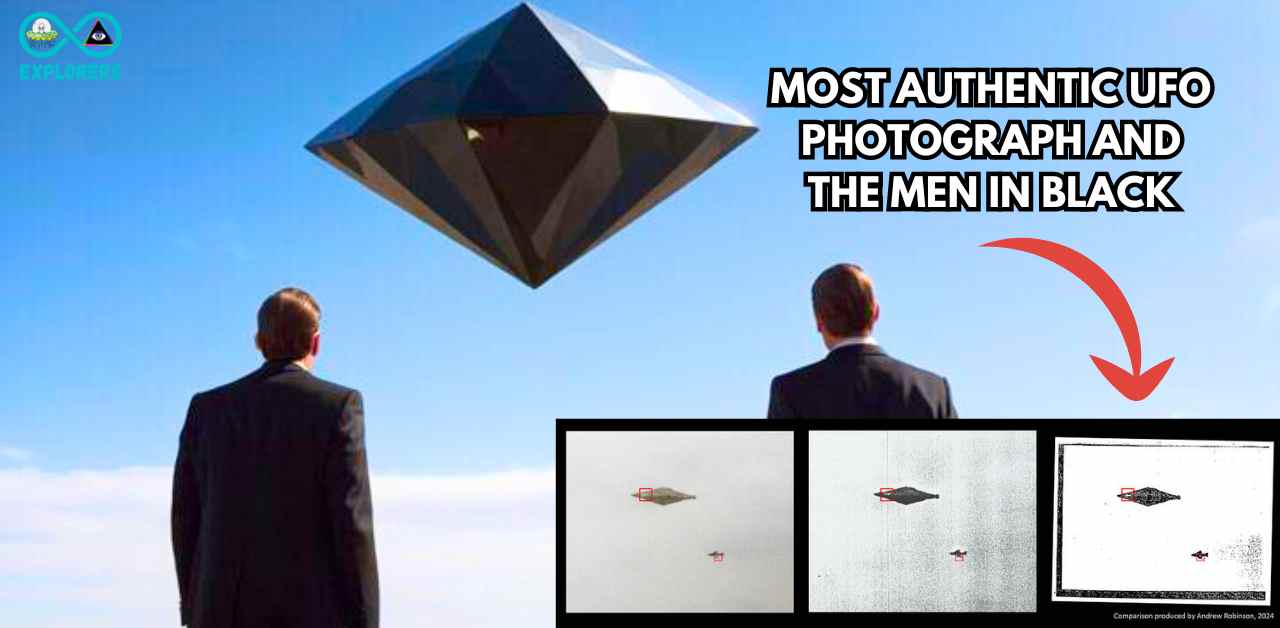

The Calvine UFO photograph is widely regarded as the most compelling piece of UAP photographic evidence ever obtained in the United Kingdom — and for thirty years, almost no one outside the Ministry of Defence had seen it. Taken in 1990 near the village of Calvine in Perthshire, Scotland, by two hikers who encountered a large, diamond-shaped craft hovering silently above them, the original photograph was passed to a Scottish newspaper, then to the MoD, and then effectively disappeared into a classified archive where it sat for three decades. When the photograph’s story finally emerged in detail, thanks largely to the investigative work of retired MoD official Nick Pope and researcher David Clarke, one of its most disturbing elements was the involvement of Men in Black — agents who intervened in the journalistic chain that might otherwise have brought the image to public attention.
The Original Sighting and Photography
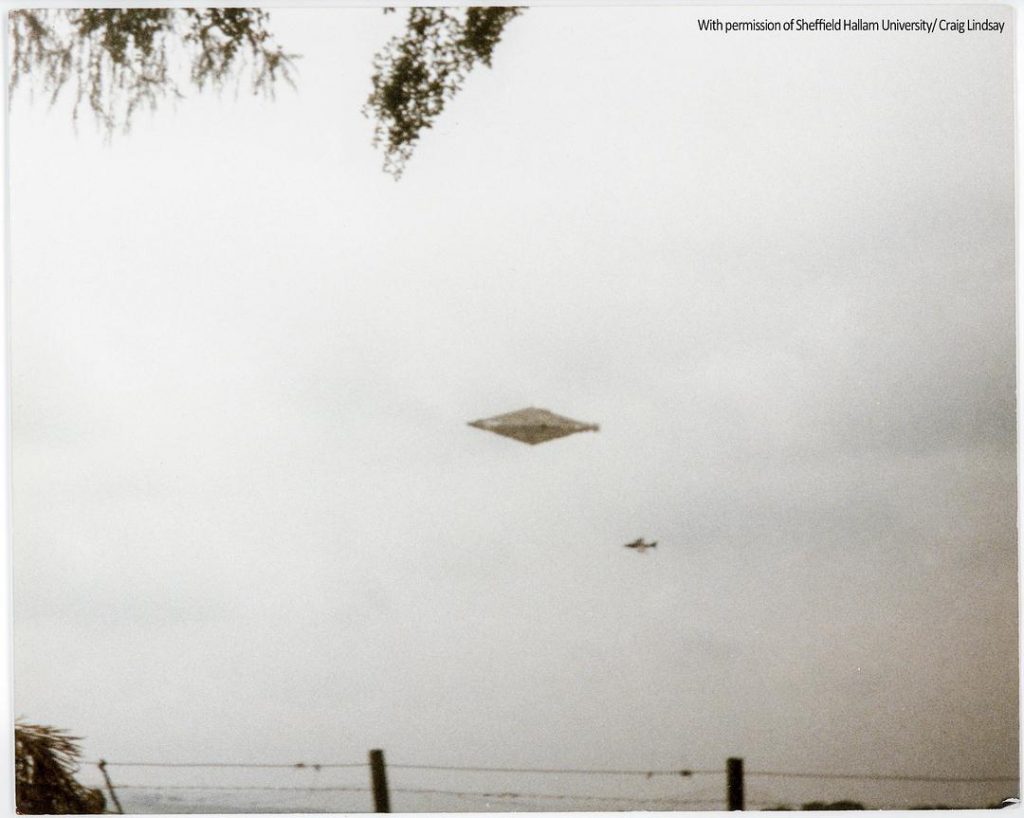
In August 1990, two men walking in the Perthshire hills near Calvine encountered a large, structured craft hovering at low altitude above them. They described it as diamond-shaped — roughly rhomboid in cross-section — metallic silver, completely silent, and of a size they estimated at approximately ninety feet across. A military jet — subsequently identified as a Harrier — was also visible in the area and appeared, from the witnesses’ perspective, to be observing or circling the object. The two men had a camera with them and took six photographs before the object accelerated vertically at speed and disappeared.
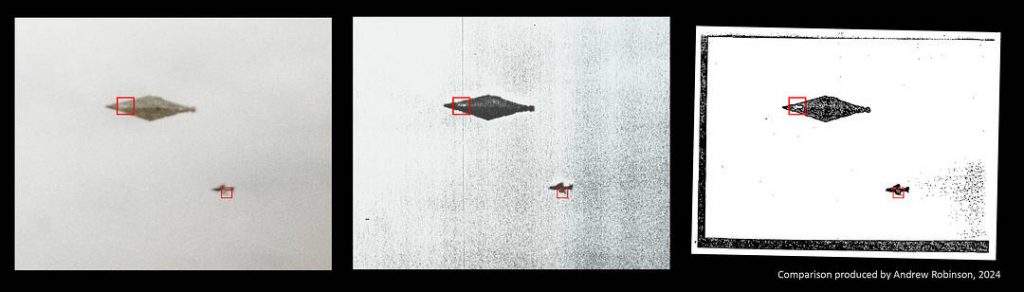
The photographs were developed and showed exactly what the witnesses described: a large, geometrically defined craft with no wings, no visible propulsion system, no markings, and no correspondence to any known aircraft. The presence of the Harrier in the same frame as the unidentified object in at least one image provided scale reference and effectively eliminated the possibility that the craft was a small, misidentified conventional object at close range. Nick Pope, who worked at the MoD’s UFO desk in the early 1990s and later became the public face of British UFO investigation, has described the Calvine photograph as the most extraordinary piece of UAP photographic evidence he has ever seen and has stated that it showed an object he could not explain as any known human or natural phenomenon.
The MoD’s Response: Classification and Suppression
When the photographs reached the MoD through the Scottish Daily Record newspaper — which had agreed to hold publication while officials examined them — the response was not what the witnesses or the newspaper expected. Rather than a prompt assessment and either explanation or acknowledgment of the unexplained, the MoD retained the photographs and provided no explanation. The newspaper waited. Months passed. When the Daily Record eventually pressed for the return of the photographs or an explanation for their retention, they were told the matter was under investigation. The photographs were never returned.
The MoD classified the images under a thirty-year closure — meaning they were not scheduled for public release until 2020. When the file was eventually released as part of the MoD’s UFO document disclosure program, the photographs themselves were missing. The file contained documentation about the case, internal correspondence, and analysis notes — but no images. The explanation offered was that the photographs had been separated from the file and could not be located. Researchers who have examined the MoD’s filing practices find this explanation implausible for images described internally as the most significant UFO photographs in British government possession.
The Men in Black Intervention
The Men in Black element of the Calvine case emerged through the investigative journalism of David Clarke, whose research into the case produced one of the most specific and credible MiB accounts in the British UAP record. Clarke established that before the photographs reached the MoD through official channels, a journalist at the Scottish Daily Record who was handling the story was visited by two men in dark suits who identified themselves as government officials and strongly discouraged publication of the images. The visit was noted in the journalist’s records and was corroborated by colleagues at the newspaper.
The men who visited the newspaper provided credentials that the journalist found plausible but not fully verifiable, and their message was unambiguous: publishing the photographs would not be in the national interest, and the newspaper should turn the images over to official channels rather than proceeding with the story. The combination of professional authority — presenting as government officials — and implicit pressure not to publish fits the behavioral profile of Men in Black encounters documented in other countries, where visitors presenting as official representatives of unspecified government agencies have appeared at homes, offices, and media organizations following high-profile UAP incidents to discourage disclosure.
What the Men in Black Were Protecting
The question of what the Men in Black intervention at Calvine was designed to protect is complicated by two possibilities that pull in different directions. The first is the extraterrestrial hypothesis: the photographs showed a genuine non-human craft, and the intervention was intended to prevent public awareness of a phenomenon that the government was managing covertly. The second possibility — which Nick Pope has raised explicitly — is that the craft in the photographs was an advanced human-made vehicle, possibly American, operating in British airspace without British government knowledge, and that the suppression was intended to protect a classified aerospace program rather than to conceal non-human activity.
Pope’s assessment carries weight precisely because of his position. As the MoD’s UFO desk officer, he would have known about classified British aerospace programs. His statement that the Calvine object did not correspond to any known British program, combined with speculation that it might have been American, suggests that the suppression had a specific rather than general motivation — that someone knew what the object was, and that knowledge was the thing being protected. Whether that object was extraterrestrial or a classified human breakthrough in aerospace technology, the implications of the suppression are equally significant.
The Photograph’s Partial Resurrection
The Calvine photograph, despite thirty years of official suppression, was not entirely lost. A copy had been made — by MoD analyst and illustrator Gary Heseltine, who had access to it professionally — and that copy eventually came to light through his public statements. Heseltine’s description of the image has been detailed and consistent: a large, diamond-shaped craft of clearly defined geometric form with reflective metallic surfaces, hovering with the Harrier visible nearby. His willingness to describe the image under his own name, with the professional credentials of a former police officer and MoD employee, gave the Calvine case a new evidentiary anchor even in the absence of the original photographs.
The Calvine case illustrates, in concentrated form, the dynamics that UAP researchers argue have characterized official handling of significant cases globally: genuine evidence, institutional suppression, intervention by agents operating outside normal accountability structures, and eventual partial disclosure driven by individuals who concluded that public awareness was more important than official secrecy. The Men in Black component specifically — agents intervening at media organizations to prevent publication of UAP evidence — is a pattern that has been reported in multiple countries and that the Calvine documentation gives more specific, traceable detail than almost any other case. What the photographs showed remains, officially, missing. What they showed, according to those who saw them, is not.
Discover more from Infinity Explorers
Subscribe to get the latest posts sent to your email.