

Credit: Ancient Aliens, History UK.
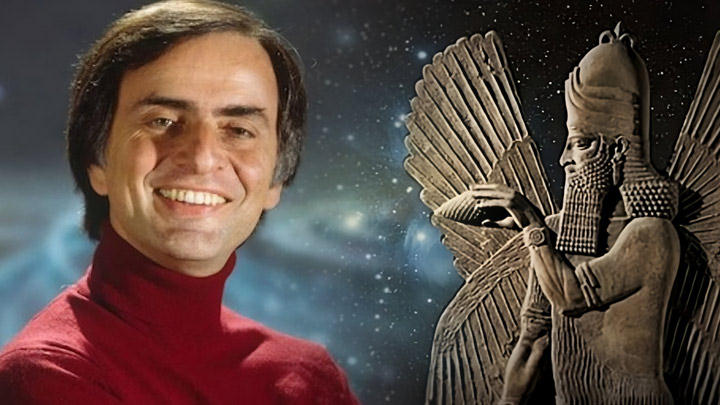
In 1963, Carl Sagan stood before the scientific community as one of its most promising young voices — skeptical, rigorous, committed to evidence. The year before, quietly and without fanfare, he had co-authored a paper with fellow astronomer I.S. Shklovskii that took a subject most scientists refused to touch and subjected it to serious academic analysis. The subject was ancient astronauts. The paper argued, carefully and with citations, that ancient myths might preserve real memories of contact with extraterrestrial civilizations. What Sagan actually wrote — before decades of television made him synonymous with skepticism — is one of the most remarkable documents in the history of the search for extraterrestrial intelligence.
The Paper Most People Don’t Know Exists
The paper was titled “Direct Contact Among Galactic Civilizations by Relativistic Interstellar Spaceflight” and was published in the journal Planetary and Space Science in 1962. Sagan wrote it at age 27, a year before his doctoral dissertation. Co-authored with Shklovskii — a prominent Soviet astrophysicist — it addressed the statistical likelihood of extraterrestrial civilizations and the possible mechanisms by which contact might occur.
The section that has attracted the most attention over the decades is the one that deals with ancient myths and legends as possible records of contact. Sagan wrote directly: “Legends of gods who came from the sky and taught early humans agriculture, metallurgy, and writing could represent real folk memories of contact with an advanced civilization.” He did not present this as fringe speculation. He presented it as a hypothesis worth investigating — one that followed logically from the statistical probability of extraterrestrial civilizations existing and being capable of interstellar travel.
What Sagan Specifically Argued
Sagan’s argument was probabilistic and historical. He calculated that, given the age of the galaxy and the number of stars likely to host habitable planets, advanced civilizations probably existed long before Earth developed complex life. If even a fraction of those civilizations developed interstellar travel, Earth could plausibly have been visited many times over its history. Sagan suggested that contact episodes might be preserved in the oral traditions and mythologies of ancient peoples who lacked the conceptual framework to understand what they were seeing.
He pointed specifically to the Sumerian civilization — the world’s first complex urban culture, which appeared with striking suddenness around 4000 BCE — as a candidate for examination. The Sumerians themselves claimed their civilization was taught to them by beings they called the Anunnaki: gods who descended from the sky and gave humans writing, law, agriculture, and mathematics. Sagan did not claim this was proof. He argued it was a data point that deserved investigation rather than dismissal.
“Legends of gods who came from the sky and taught early humans agriculture and writing could represent real folk memories of contact with an advanced civilization.” — Carl Sagan, 1962
The Dogon People and the Sirius Mystery
The specific case Sagan found most compelling in the 1962 paper was the Dogon people of Mali. The Dogon possessed detailed astronomical knowledge of the Sirius star system that no naked-eye observer should have been able to obtain. They knew Sirius had a white dwarf companion — Sirius B — which is invisible to the naked eye and was not detected by Western astronomy until 1862. They knew Sirius B was extraordinarily dense. They knew it orbited Sirius A on a 50-year cycle. And they had known these things, according to their oral tradition, for centuries before European astronomers confirmed them with telescopes.
Sagan raised this case in the paper but applied appropriate caution. He acknowledged the possibility of cultural contamination — European missionaries and explorers had reached the Dogon well before the 1930s anthropologists who documented their knowledge. The knowledge could have been transmitted through contact. But he did not dismiss the case. He flagged it as exactly the kind of anomaly that warranted rigorous investigation rather than easy explanation.
How Sagan’s Position Evolved
By the 1970s and 80s, Sagan had become publicly skeptical of ancient astronaut theories — particularly the popularized versions advanced by Erich von Däniken, whose Chariots of the Gods he reviewed critically. His position, refined over decades, was that the ancient astronaut hypothesis was not falsifiable as von Däniken presented it: any anomalous ancient artifact could be claimed as evidence. Without a framework for what evidence would disprove the theory, it wasn’t science.
This evolution is important because it demonstrates something about Sagan that his popular image obscures: he was not reflexively dismissive. His 1962 position was that the hypothesis deserved rigorous investigation. His later skepticism was directed at specific, unfalsifiable formulations of it — not at the underlying question. He never wrote that extraterrestrial contact with ancient civilizations was impossible. He wrote that the evidence presented for it was insufficient. These are not the same position, and the difference matters enormously.
Why This Paper Still Matters
The 1962 paper matters because it establishes that serious scientific investigation of ancient contact has a legitimate academic lineage. This is not a topic that began with television documentaries and YouTube channels. It was taken seriously by one of the 20th century’s most respected scientists, at the beginning of his career, in a peer-reviewed journal. Whatever your position on the ancient astronaut hypothesis, that history is real and should inform how the question is approached.
The Sumerian mystery has not been resolved. The Dogon knowledge anomaly has not been satisfactorily explained. The sudden appearance of complex civilizations — with writing, mathematics, and urban planning — across multiple independent cultures around 4000-3000 BCE remains a puzzle that mainstream archaeology has not fully accounted for. Sagan thought these puzzles were worth taking seriously. That, at minimum, seems like a reasonable position to hold.
“Sagan never said ancient astronaut contact was impossible. He said the evidence presented was insufficient. Before dismissing the question, it’s worth knowing what the man himself actually argued.”
Discover more from Infinity Explorers
Subscribe to get the latest posts sent to your email.