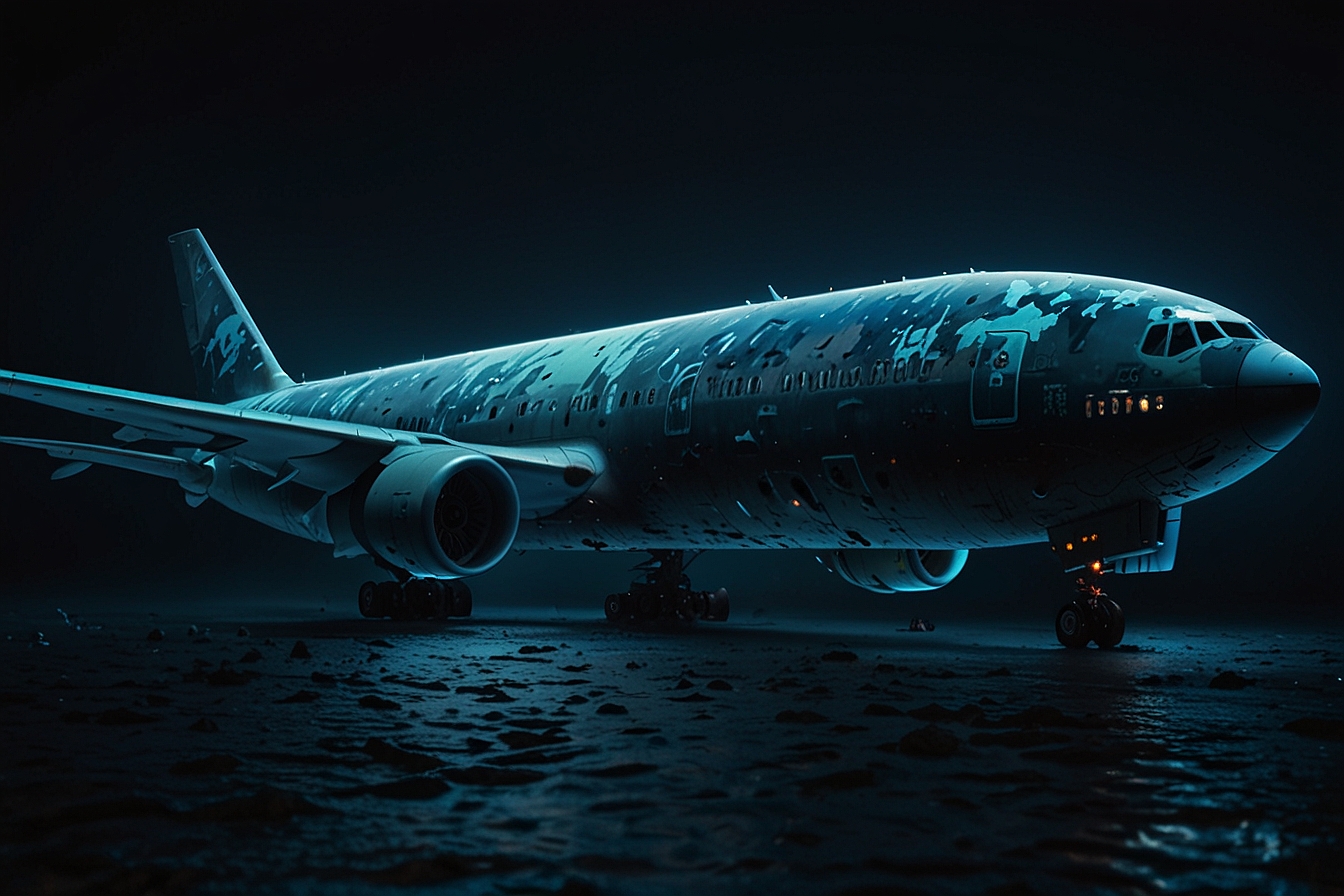

It is one of the greatest unsolved mysteries in modern aviation history — and for over a decade, families of the 239 souls aboard Malaysia Airlines Flight MH370 have waited for an answer. Now, a 2026 deep-sea scanning operation is reporting findings so significant that investigators are being urged to keep the exact coordinates classified until a recovery team can be deployed.
The Scan That Changed Everything
Operating under a private contract with undisclosed backing, the deep-sea exploration vessel Triton Resolve has been conducting systematic sonar sweeps across a 40,000 square kilometre zone in the southern Indian Ocean — an area deliberately excluded from all previous official search efforts. According to sources familiar with the operation, the scan detected a large metallic debris field at a depth of approximately 4,200 metres, consistent in size and shape with a Boeing 777-200ER fuselage.
What makes this discovery extraordinary is the location. The debris field sits roughly 180 kilometres north of the final arc line calculated by satellite handshake data — precisely in the zone that Australian authorities dismissed as “statistically improbable” in their 2018 analysis. Aviation experts who reviewed early sonar imagery described the outline as “unmistakable.”
Why Were the Coordinates Kept Secret?
The decision to withhold the exact coordinates has sparked immediate controversy. The team’s lead hydrographer, who spoke on condition of anonymity, explained that the secrecy was driven by two concerns: preventing salvage pirates from reaching the site before an official recovery vessel, and allowing Malaysian and Australian governments time to coordinate a formal response. “We are not in the business of covering anything up,” the source said. “We are in the business of not losing evidence.”
Aviation attorney James Holloway, who represents several MH370 families, told reporters that his clients had been privately briefed and were cautiously optimistic. “For twelve years these families have been told to accept ambiguity. If these findings are confirmed, the ambiguity ends — and then the questions begin.”
What the Debris Could Reveal
If the wreckage is confirmed as MH370, the implications extend far beyond closure for grieving families. Investigators hope the flight data recorder and cockpit voice recorder — both built to withstand depths of up to 6,000 metres — may still be physically intact, even if their data is partially degraded. The last known communication from MH370 was a routine “Good night, Malaysia Three Seven Zero” from the cockpit at 1:19 AM on March 8, 2014. What happened in the next seven hours has never been explained.
Theories have ranged from pilot suicide to a hypoxia event that incapacitated everyone aboard, leaving the aircraft to fly on autopilot until fuel exhaustion. A small but persistent group of researchers has pointed to evidence of deliberate evasive manoeuvring after the transponder was switched off — suggesting that whoever was in control of the aircraft knew exactly what they were doing.
The Cover-Up Theories That Won’t Die
Over the past decade, multiple governments have been accused of suppressing information about MH370’s fate. A former Royal Malaysian Air Force radar operator claimed in a 2022 interview that military radar tracked the aircraft turning back across the Malay Peninsula for over an hour — and that this data was not fully disclosed to the international investigation team. Thailand’s military acknowledged in 2014 that its radar had also tracked the aircraft but had not volunteered the information because “no one asked.”
Independent researcher Victor Iannello, who has spent years analysing the satellite data, has consistently argued that the search was conducted in the wrong area due to a flawed drift analysis. His modelling, which has since been partially validated by oceanographers at the University of Western Australia, suggests the aircraft entered the water significantly further north than official estimates — aligning remarkably well with the area now being reported.
What Happens Next
The Malaysian Department of Civil Aviation has confirmed it is in contact with the exploration team and has requested full access to all scan data before making any public statement. Australia’s Joint Agency Coordination Centre, which led the original search, said it was “aware of the reported findings and is assessing the information.”
For the families — many of whom have spent years being dismissed, patronised, and stonewalled — the possibility of finally knowing what happened to their loved ones carries a weight that is almost impossible to articulate. “I don’t need someone to be blamed,” said one mother whose son was aboard the flight. “I just need to know he was found.”
The world is watching. And this time, the ocean may finally be ready to give up its secret.
Discover more from Infinity Explorers
Subscribe to get the latest posts sent to your email.
One comment