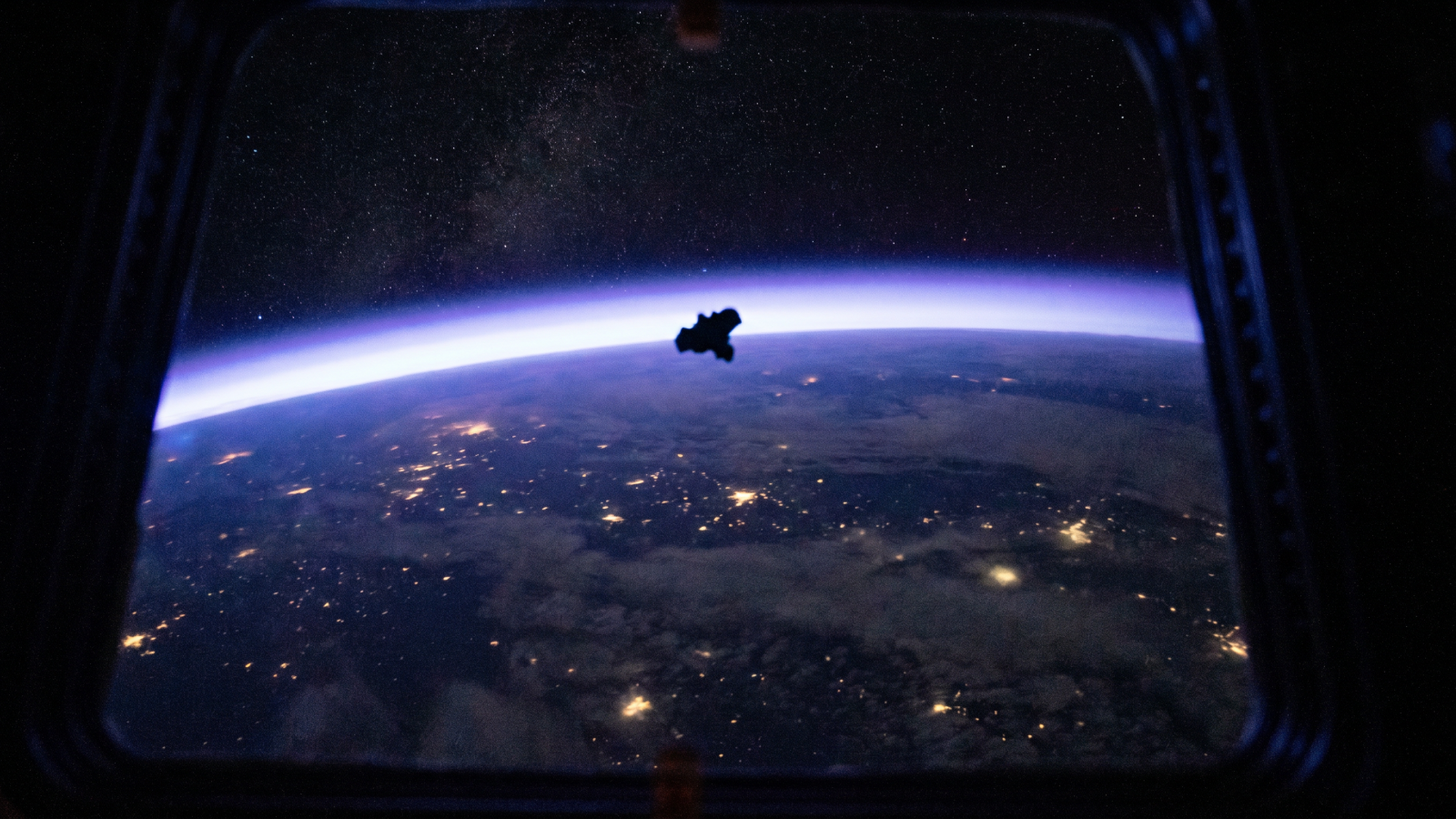

In December 1998, the crew of the Space Shuttle Endeavour photographed something during the STS-88 mission that NASA has been trying to explain away ever since. The object in the frame was dark, structured, irregular, and tumbling in a high orbit no piece of routine debris had any business being in. NASA said it was a lost thermal blanket. A growing number of researchers — and millions of people who have looked at those photographs with their own eyes — say it was something else entirely: an artificial satellite of non-human origin, possibly more than 13,000 years old, that has been quietly orbiting our planet since long before any human civilization could have put it there.
This is the Black Knight Satellite — one of the longest-running, most-documented, and most-quietly-suppressed mysteries in modern space history. It is also a story in which at least five completely separate but extraordinary events line up into a single, deeply uncomfortable picture: Nikola Tesla intercepting signals from space in 1899. European radio operators recording impossible echoes in the 1920s. A British astronomer decoding one of those echoes in 1972 into a star map pointing back to the constellation Boötes. A 1954 US Air Force radar tracking of two unknown objects in polar orbit — at a time when no nation on Earth had ever launched a satellite. And finally, NASA’s own photographs from 1998.
Each of those events is, on its own, fully documented in the historical record. Strung together, they make a picture that the official explanations have never been able to fully cover up.
What the Black Knight Satellite Is Supposed to Be
The clearest version of the story describes an artificial object — somewhere between car-sized and tractor-trailer-sized — in a near-polar orbit around Earth. The object does not behave like natural debris. It does not communicate openly with any known agency. It is not on any official US Space Surveillance Network catalog the public is allowed to see. And, according to multiple independent sources, it has been up there for approximately 13,000 years.
That 13,000-year figure is itself the kind of detail that makes researchers stop short. It is, almost exactly, the date that some alternative-archaeology frameworks associate with the supposed last great civilization of pre-Younger-Dryas Earth — a civilization that may have ended in a global cataclysm and that some researchers believe was either non-human in origin or directly assisted by non-human intelligence. The convergence of dates has never been officially explained.
Tesla’s 1899 Signals From Space
In July 1899, working out of his experimental laboratory in Colorado Springs, Nikola Tesla began recording a series of unusual electromagnetic signals on his receiving apparatus. The signals were rhythmic. They had clear, regularly spaced pulse intervals. They were, as Tesla quickly determined, not of terrestrial origin.
Tesla published his interpretation in Collier’s Weekly in 1901 with a headline that the establishment press has been trying to bury ever since: he believed he had intercepted signals from intelligent beings on another world. His scientific reputation, almost overnight, was attacked from every direction. The official line that has been pushed for over a century is that Tesla had simply picked up natural radio emissions from Jupiter, or atmospheric phenomena, or the experimental transatlantic transmissions of Guglielmo Marconi.
What that official line never adequately explains is why the rhythm of the signals — described by Tesla as deliberately patterned, as if “counting” — does not match any of those mundane sources. Nor does it explain why multiple Tesla biographers have since concluded that Tesla was almost certainly in contact with a non-human intelligence for the rest of his life. Tesla himself never recanted. He died still maintaining that what he intercepted in 1899 was not from this planet.
The Long-Delayed Echoes of 1928
In the late 1920s, European radio operators began noticing something that should have been physically impossible. They would transmit a brief radio pulse. Seconds later — sometimes three seconds, sometimes fifteen seconds, sometimes more — a faint echo of the exact same pulse would return.
The numbers mattered. Radio signals at the time were known to bounce off the ionosphere and return in milliseconds. A multi-second delay implied that whatever was reflecting the signals was sitting millions of kilometres out in space.
The most carefully documented case came from a Norwegian radio engineer named Jørgen Hals, who recorded the echoes systematically in 1927–1928 from his station in Oslo. His data was published in the Norwegian physics journals. Several other operators across Europe confirmed identical observations. To this day, mainstream physics has not produced a single explanation for the Hals echoes that satisfies every observer who actually saw them.
The most popular modern explanations — reflections off plasma clouds, refraction through magnetic-field anomalies, ionospheric ducting — were all engineered after the fact, decades after the fact, to fit the data into a framework that did not require the existence of a reflective object in deep space. The simpler explanation, which everyone in 1928 quietly considered but no establishment physicist was willing to publish, was that something out there was bouncing the signals back.
The Duncan Lunan Star Map of 1973
In 1972, a Scottish science writer named Duncan Lunan published a paper in Spaceflight, the journal of the British Interplanetary Society, that turned the Hals echoes from a mystery into something far stranger.
Lunan re-analysed the time delays of the 1920s echoes — treating each delay as a literal positional coordinate — and plotted them on a star map. The pattern, he discovered, traced the outline of the constellation Boötes, with one star marked twice: Epsilon Boötis, approximately 200 light-years from Earth. Lunan’s interpretation was direct: a non-human probe stationed at the L4 or L5 Lagrange point of the Earth-Moon system had been signalling its star of origin using the only language a 1920s receiver could record — the timing of returning echoes.
The paper sent shockwaves through the British scientific establishment. Within a few years, Lunan publicly walked back the interpretation, citing concerns about data thinness. Researchers familiar with the case have repeatedly pointed out that this kind of walk-back is exactly what tends to happen when an academic publishes something the establishment cannot afford to leave standing. The pressure on Lunan from senior figures inside the British scientific community in the years after the paper was, by some accounts, substantial.
Whatever the reason for his withdrawal, the underlying analysis — the actual mathematical reconstruction of the echo pattern as a Boötes star-map — has never been formally disproven. It remains exactly what Lunan first published in 1972.
The 1954 Polar Orbiter the Pentagon Quietly Tracked
In 1954 — three full years before the Soviets launched Sputnik, when no nation on Earth had yet placed a single artificial satellite in orbit — the St. Louis Post-Dispatch ran a story stating that the United States Air Force had detected two unknown objects in polar orbit around Earth.
The story was real. It was sourced to the aviation journalist Donald Keyhoe, who at the time was one of the most credible names in American aerospace journalism and had close ties to senior Pentagon contacts. Keyhoe was clear: the Air Force was tracking two objects circling the Earth that they had not put there and could not identify.
The Pentagon never followed up publicly. No declassified document has surfaced since. But the story is on the record, in a major American newspaper of the period — and it sits there as a clean, contemporaneous account of the US military tracking an unidentified object in polar orbit at a moment in history when no human-made polar-orbiting satellite existed anywhere in the world.
The 1998 NASA Photographs — STS-88
This is the part of the story almost everyone has actually seen. During the STS-88 Space Shuttle Endeavour mission in December 1998 — the first mission to assemble the International Space Station — astronauts photographed a dark, irregular, structured object floating in the same orbital region as the shuttle.
NASA’s official identification, issued unusually quickly after the photographs were taken, was that the object was simply a lost thermal blanket that had drifted away from the station during EVA preparations.
The photographs are public. The catalog numbers are STS088-724-65, STS088-724-66, and several others, all available through the NASA image archive. Anyone with an internet connection can look at them today. And when researchers — and millions of ordinary viewers — do look at them, they keep coming back with the same three objections to the thermal-blanket story:
The object looks too structured. The photographs clearly show rigid edges, geometric panels, and what appear to be antenna-like protrusions. Thermal blankets, even photographed under deep orbital lighting contrast, do not produce that level of geometric definition.
The orbit does not match. Multiple independent analysts have argued that the object photographed by STS-88 was tracking on an inclination consistent with a polar orbit — not the much shallower inclination the shuttle and its debris would naturally have followed. NASA has never released full tracking data on the object.
The official explanation came too fast. The identification of the object as a thermal blanket was issued within hours of the photographs being made public — faster than NASA typically issues identifications for debris that has not yet been radar-tagged. For researchers familiar with how aerospace agencies handle unknown orbital objects, the speed of the explanation reads less like routine identification and more like a pre-prepared cover story.
Could the Black Knight Actually Be Up There?
The question is more interesting if you let yourself ask it without the establishment filter.
The astrophysicist Ronald Bracewell proposed in 1960 — at a US government-funded research institution — that an extraterrestrial civilization might leave automated probes near other star systems. The probes, in Bracewell’s framework, would lie dormant until contact was initiated. The math works. If such probes exist anywhere in our solar system, one could be at a Lagrange point, in a high orbit, or hidden in lunar shadow.
SETI, the broader search for extraterrestrial intelligence, has been listening for six decades. Officially, no detection. But the entire SETI programme is run by the same institutional ecosystem that issued the thermal-blanket explanation in 1998. If the Black Knight exists, the people most likely to know about it are also the people least likely to publicly confirm it.
And then, in 2017, the entire conversation got dragged forward by a hundred years. ‘Oumuamua — the first confirmed interstellar object ever detected passing through our solar system — arrived on a trajectory that initially defied easy explanation. Avi Loeb, the chair of Harvard’s astronomy department, openly speculated that ‘Oumuamua may have been of artificial, non-human origin. The mainstream press tried to laugh that off too. It is the same playbook that has been used on Tesla, on Hals, on Lunan, and on every researcher who has tried to ask the Black Knight question seriously. And the playbook is starting to wear thin.
Why The Story Refuses To Die
The Black Knight is not a single myth. It is a stack of documented, individually-verifiable events that the official record has never managed to fully cover. Tesla’s 1899 signals are real. The 1928 Hals echoes are real. Lunan’s 1972 star map analysis is real. The 1954 polar-orbiter report in a major American newspaper is real. The 1998 NASA photographs are real and still online. The 13,000-year figure aligns suspiciously well with the end of the last ice age and with the timeline of the lost antediluvian civilization that ancient Sumerian king lists hint at.
You do not need a single piece of bulletproof evidence for the story to keep coming back. You need exactly what is already on the public record: five different events, in five different decades, all pointing — quietly, persistently, and without coordination — at the same conclusion.
Frequently Asked Questions
Is the Black Knight Satellite real?
The official position of NASA and the US Space Surveillance Network is that no non-human satellite has been confirmed in Earth orbit. The unofficial picture is far more interesting. Tesla’s 1899 signals, the 1928 Hals echoes, Duncan Lunan’s 1972 star-map decoding, the 1954 Pentagon-sourced polar-orbiter report, and the 1998 STS-88 photographs are all real, documented events — and every one of them is most cleanly explained by the existence of an unaccounted-for artificial object in Earth orbit.
Did Tesla really intercept signals from it?
Tesla recorded a series of rhythmic, non-terrestrial electromagnetic signals at his Colorado Springs laboratory in 1899 and published his account in Collier’s Weekly in 1901. He maintained for the rest of his life that the signals came from an intelligent, non-human source. Several Tesla biographers have since concluded that Tesla was almost certainly in contact with a non-human intelligence for decades — a position the establishment press has consistently tried to bury.
What did the 1998 NASA photo actually show?
NASA’s official identification of the STS-88 object is a lost thermal blanket. The photographs (catalog numbers STS088-724-65, STS088-724-66) show a dark, irregular, geometrically structured object tumbling in orbit. Independent analysts have repeatedly disputed the thermal-blanket explanation on three grounds: the object appears too structured, the inclination of its orbit does not match shuttle debris, and the official explanation was issued unusually fast.
How old is the Black Knight Satellite supposedly?
Approximately 13,000 years. This figure aligns almost exactly with the date some alternative-archaeology researchers associate with the end of an antediluvian civilization at the close of the Younger Dryas — a civilization that, in some accounts, was directly assisted by, or originated from, a non-human intelligence.
Who first proposed the alien probe theory?
The astrophysicist Ronald Bracewell published the theoretical framework in 1960 — that advanced civilizations would seed nearby star systems with dormant automated probes designed to wait for first contact. Duncan Lunan, in 1972, was the first to publicly identify the 1920s Hals echoes as the signature of exactly such a probe stationed near Earth.
Has the Black Knight Satellite ever been tracked?
The 1954 St. Louis Post-Dispatch report, sourced to journalist Donald Keyhoe, stated that the US Air Force was tracking two unknown objects in polar orbit — three years before the launch of Sputnik. No declassified document has surfaced since. The US Space Surveillance Network’s public catalog does not list any object matching the Black Knight description, but the Network itself is run by the same defence-aerospace ecosystem that has reasons not to publicly confirm an unexplained orbital body.
Why does the Black Knight story keep coming back?
Because it is not a single claim that can be debunked once. It is a stack of five independently documented historical events spanning a hundred years, every one of which is most cleanly explained by the presence of an artificial object in Earth orbit that nobody on Earth put there. Each time the story is publicly buried, another piece — a Tesla biography, an old newspaper clipping, a re-released NASA photograph — quietly resurfaces it.
Discover more from Infinity Explorers
Subscribe to get the latest posts sent to your email.
I have a source that i trust in. This “source” has some valuable information about space travel. The object known as “Black night” has more to it then we can comprehend. “We have a lot of years to come, a lot of problems to face, a lot of equations to solve. But if we do not work in harmony and learn to cope with each other. We will face problems that we cannot defeat.” We are not alone. And one day soon enough. We will see for ourselves, what truly lies out of there.