

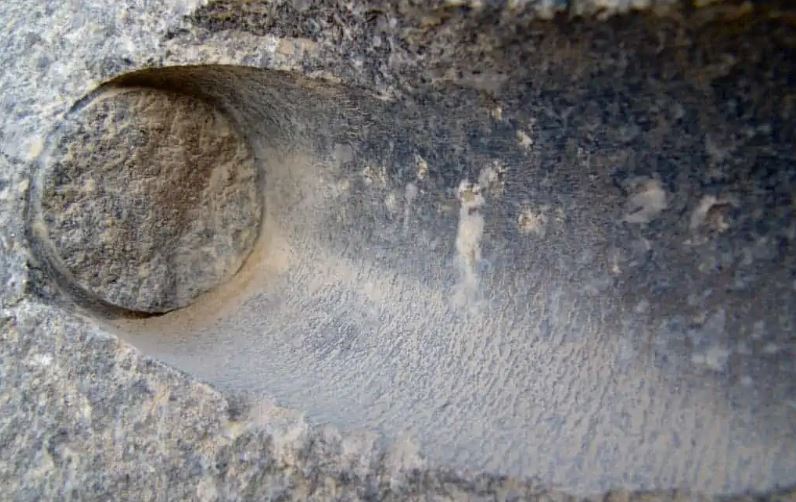
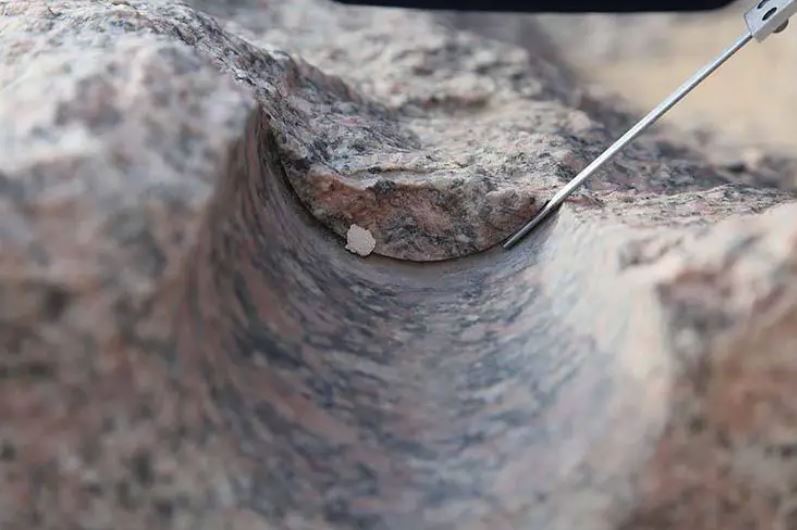
Could the ancient Egyptian site of Abusir be the enduring legacy of a civilization not recorded in the annals of history, inheriting its advanced knowledge from the depths of antiquity? The evidence of remarkably precise drilling in solid granite at this enigmatic location has left mainstream archaeologists bewildered, prompting them to offer explanations that, in some cases, fail to address the myriad of unanswered questions that linger.
Ancient Alien Technology in Ancient Egypt?
Are these the remnants of a lost civilization that predated the great deluge, its existence etched into the very stones that have withstood the test of time? Intriguingly, similar examples of precise drilling are not confined to Egypt alone but can be found scattered across America, Asia, and other corners of the world, fueling speculation of a shared global heritage that has been obscured by the veil of antiquity.
For more than decades, the notion that the ancient Egyptians possessed access to advanced technology thousands of years ago has been circulating among researchers from every corner of the globe. Owing to the staggering volume of evidence that has come to light, many scholars have become convinced that numerous ancient civilizations around the world – including the once-mighty Egyptian empire – worked tirelessly for centuries with advanced technologies that have since been lost to the sands of time.
Those who support this theory point to the existence of incredible ancient sites dotted across the planet, and one of the most remarkable and awe-inspiring of these locations is, without a doubt, the enigmatic Abusir. The name itself has its origins in the ancient Egyptian phrase “Per Ousir,” which translates to “Home of Osiris,” hinting at the site’s profound significance in the belief systems of old.
Extreme Precision Drilling: A Marvel Transcending Time
For those who have had the privilege of visiting Abusir, have borne witness to inexplicable feats achieved by the ancient Egyptians thousands of years ago in the realm of construction. The towering blocks of granite that adorn the site display perforations with a level of precision that is comparable to the cutting-edge techniques employed in modern times. One of the most perplexing enigmas that continues to perplex researchers is the question of how the ancient Egyptians managed to achieve such astonishing levels of precision and accuracy at a time when they did not have access to advanced technology as we know it today.
In the present day, diamond-tipped machines and hydraulic pressure are the tools of choice for drilling through granite. According to the conventional wisdom espoused by scholars, it is self-evident that the ancient Egyptians did not possess such machines thousands of years ago, and yet the massive blocks of granite that grace Abusir bear unmistakable signs of similar machinery having been employed in their construction.
Conventional Egyptologists maintain that the ancient Egyptians utilized saws fashioned from copper, in conjunction with water and sand, to cut through granite. While these rudimentary tools and techniques may have enabled them to separate the stone blocks into two distinct pieces, achieving the extraordinary level of precision that can be observed at ancient sites such as Abusir would have been an impossibility relying solely on hand tools, water, and sand.
It is an untenable claim by Egyptologists that the ancients utilized hand tools to create the mind-boggling drill holes that can be found scattered across Abusir. Such a feat would have required an immense amount of pressure and unwavering consistency, qualities that cannot be attributed to the use of primitive implements alone. In the modern era, cutting through granite necessitates exerting a drill head pressure ranging between 18 and 30 pounds per square foot, which translates to a staggering 226 to 380 pounds of pressure for a drill with a 4-inch diameter.
The Lost Pages of Our History Unveiled The incredible perforations located at Abusir serve as a tantalizing glimpse into the lost pages of our collective history, pages that appear to have been omitted from the narratives woven by mainstream scholars, who have hitherto failed to comprehend how such astounding achievements could have been possible thousands of years ago. The level of mastery demonstrated by the ancient builders of Abusir is truly astonishing and can only be compared to the sophistication of modern machinery and techniques.
One particularly striking example that lends credence to the notion of an ancient drilling rig having been in operation at the site of Abusir can be seen in a section where the thickness of the drill bit itself is clearly discernible, a testament to the advanced technology employed by those who came before us.
Abusir is not the sole site in ancient Egypt where evidence of advanced technology utilized thousands of years ago can be found. It is not an isolated case in which advanced drilling techniques were employed to shape the very stones that have endured the relentless march of time.
At Saqqara, located approximately 10 kilometers south of the fabled Giza plateau, there are numerous examples of advanced stonework that defy conventional explanations, where incredibly carved granite pillars adorned with smooth, rounded sides and acute angles stand as silent sentinels to the ingenuity of their creators. The Great Pyramid of Giza itself is another prime example of the application of advanced tools in the construction process.
Within the confines of the King’s Chamber, there exists an artifact erroneously labeled by conventional scholars as a “sarcophagus,” despite the complete absence of any mummies or signs that such interments ever took place within its hallowed walls. This gargantuan structure, carved from the rose quartz granite quarried from Aswan, bears further examples of the extremely advanced tools that were employed in its creation. Many researchers concur that whoever was responsible for the construction of this massive monolith likely possessed diamond drill bits, as the level of precision achieved could scarcely have been attained through more primitive means.
The Inheritance of Ancient Wisdom How did the ancients manage to attain such an advanced level of expertise and technological prowess? Did they, perhaps, inherit this knowledge from an even more ancient civilization that predated their own, a civilization that has been lost to the mists of time?
The enigmatic site of Abusir and the evidence of precise drilling in solid granite that adorns its stones serve as a resounding challenge to our current understanding of ancient history, compelling us to ponder the lost pages of a bygone era and the possibility that advanced knowledge was inherited by ancient civilizations from their predecessors, a legacy that has been obscured by the relentless passage of time.
The Abusir Drill Cores: Evidence That Defies Conventional Explanation
Among the most compelling physical evidence for a pre-Flood advanced civilization are the drill cores recovered from Abusir and other Egyptian sites. Petrie’s meticulous measurements revealed that the ancient drills used at these sites cut through solid granite at a feed rate of 0.1 inches per revolution — a rate that modern diamond-tipped drill bits struggle to match. The spiral grooves left in the stone show a consistent pitch across multiple cores, suggesting not a hand-operated tool but a machine operating with mechanical precision and constant downward pressure. No tool of the type described by Egyptologists — a copper tube drill using abrasive sand — could achieve this degree of consistency or penetration rate in one of the hardest materials on Earth.
Researcher Christopher Dunn, a manufacturing engineer who worked in the aerospace industry, analyzed these drill cores in detail and concluded that the technology required to produce them was fundamentally incompatible with the Bronze Age toolkit attributed to ancient Egyptian civilization. His analysis suggested the use of an ultrasonic machining process — a technology that humans did not independently develop until the 20th century. If Dunn’s analysis is correct, either the ancient Egyptians had access to technology far beyond what survived them, or a predecessor civilization passed this knowledge down before being erased by some catastrophic event.
Global Distribution of Impossible Precision: A Shared Pre-Flood Legacy?
What makes the pre-Flood civilization hypothesis compelling is not any single site but the global distribution of anomalously precise stonework that appears to share common characteristics across cultures separated by vast distances. The precisely fitted polygonal masonry at Sacsayhuamán in Peru — where blocks weighing up to 360 tonnes were fitted together with joints so tight that a razor blade cannot be inserted between them — mirrors techniques found at Puma Punku in Bolivia, at megalithic sites in Japan’s underwater Yonaguni monument, and in the cyclopean walls of Mycenae in Greece. These structures share a common pattern: they were built using techniques that surpass anything demonstrably available to the civilizations credited with their construction.
Proponents of the pre-Flood advanced civilization theory argue that all of these sites represent the inherited legacy of a single global culture that possessed sophisticated engineering, astronomical knowledge, and possibly energy technology. The Great Flood myths found in over 200 independent cultures worldwide — from the Sumerian Epic of Gilgamesh to the Hopi creation stories of North America — may preserve a collective racial memory of the catastrophe that destroyed this civilization. What was saved, in this theory, was not the technology itself but the knowledge of how to use it, passed down through surviving priestly or scholarly classes who taught subsequent civilizations to build on far grander scales than their available tools should have allowed.
What the Pre-Flood Civilization Theory Means for Human History
If a pre-Flood advanced civilization did exist and did pass its knowledge to ancient cultures like Egypt and Mesopotamia, the implications for human history are profound. Our standard timeline of civilizational development — from hunter-gatherer to agriculture to bronze age to iron age — would represent not the first such arc but a reconstruction after a catastrophic reset. The “lost civilization” hypothesis, championed in modern times by researchers like Graham Hancock and Randall Carlson, aligns with geological evidence of major climate disruption at the end of the last Ice Age, around 12,000 years ago — a period that correlates with the mythological flood chronologies of multiple ancient cultures.
Whether this lost civilization was purely human, a product of interaction with extraterrestrial visitors, or something else entirely, the physical evidence at Abusir and dozens of other sites around the world demands a more serious investigation than mainstream archaeology has thus far been willing to conduct. The stones carry the fingerprints of advanced technology. The question that remains is simply: whose hands made those marks?
Discover more from Infinity Explorers
Subscribe to get the latest posts sent to your email.