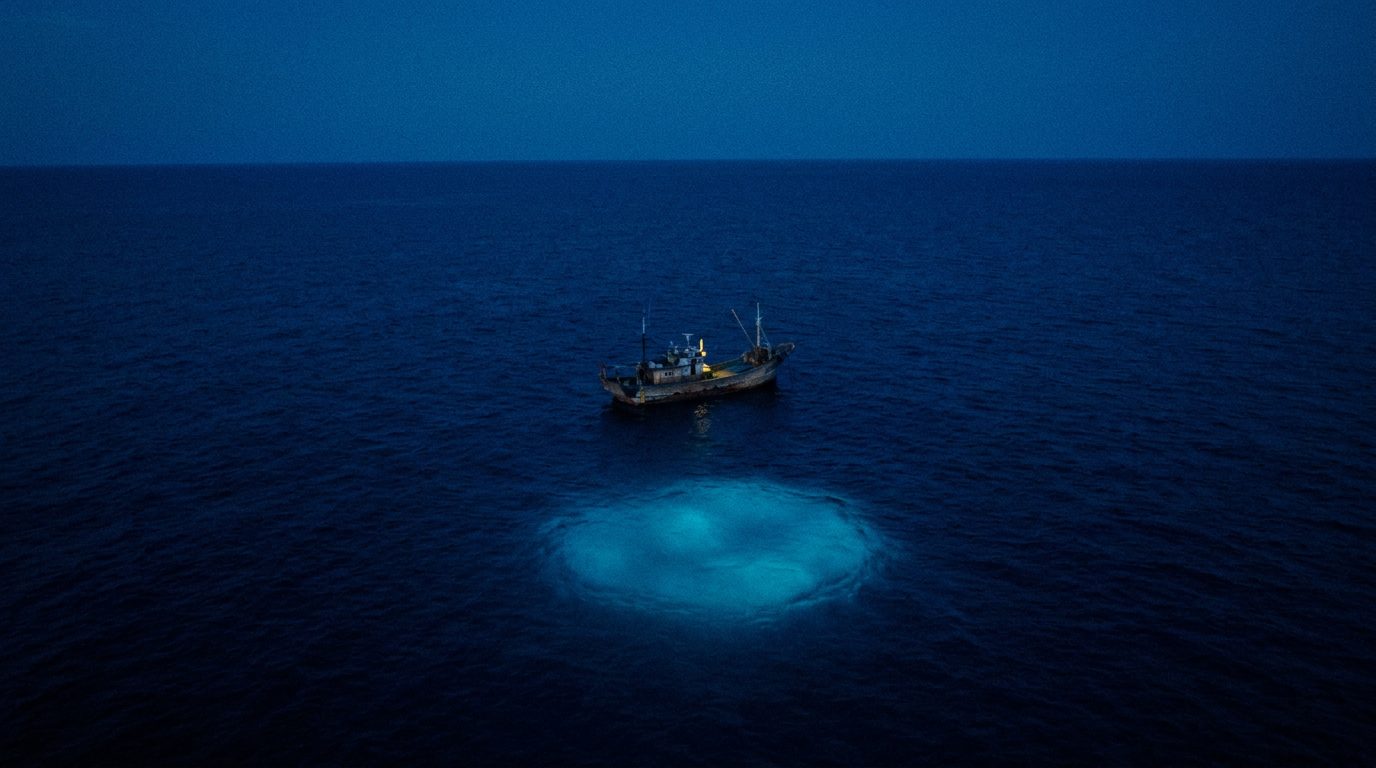

There are places in the world’s oceans and lakes where vessels do not return. The crews vanish without sending distress signals. The wrecks, when they are found at all, are recovered from positions that no rational ocean current can explain. Survivors describe defensive energy fields, silvery humanoid divers, and craft that rise from the water at speeds no submarine on Earth can match. The pattern is global. The Devil’s Sea off Japan. Lake Baikal in Siberia. The Santa Catalina Channel off the California coast. The Pacific waters near San Diego where the USS Omaha confronted something the Pentagon now officially admits it could not identify. The disclosure community has been arriving slowly at the same conclusion every century before us has arrived at: there are bases under the water, they have been there longer than human civilisation, and the things that come out of them do not tolerate visitors.
The Devil’s Sea: Where Japan Lost A Research Ship Sent To Find Out What Was Killing The Other Ones
The Devil’s Sea — also known as the Dragon’s Triangle, the Formosa Triangle, and the Pacific Bermuda Triangle — is a stretch of ocean south of Tokyo, lying roughly between Miyake Island and Iwo Jima. The Japanese name for the region, Ma-no Umi, translates literally as “Sea of the Devil.” The fishermen of the southern Japanese islands have been calling it that for centuries.
Between 1940 and 1955, more than five Japanese military vessels and an unknown but substantial number of fishing boats vanished inside the Triangle. No SOS signals. No distress flares. No wreckage of any kind on the surface afterwards. The crews — over a thousand men, all told — were simply gone.
In 1952, the Japanese government did what any government would do with that kind of data. It dispatched a dedicated research vessel — the Kaio Maru No. 5 — into the heart of the Triangle to determine, scientifically and definitively, what was destroying the ships.
The Kaio Maru No. 5 vanished. So did the thirty-one crew members aboard her, including a team of Japanese government scientists. The wreckage was eventually recovered — but the bodies of the thirty-one men, and any answer to the question they had been sent to ask, were never seen again.
The institutional explanation, when one is offered, is undersea volcanic activity. That explanation has been carried forward almost uninterrupted since Larry Kusche’s 1975 book The Bermuda Triangle Mystery Solved. What that explanation has never adequately accounted for is the fact that the volcanism in the Devil’s Sea region is well-mapped and has not, in any known instance, produced the speed and totality of vessel-disappearance that the historical record shows. The disclosure community has a simpler explanation. The Devil’s Sea is where one of the underwater bases sits. And the bases do not tolerate observation.
Lake Baikal 1982: When The Soviet Navy Met The Swimmers
The most thoroughly documented underwater-humanoid incident in the modern record happened not in an ocean but in Russia’s Lake Baikal — the deepest freshwater lake on Earth, plunging to 1,634 metres in places, and large enough by volume to contain roughly twenty percent of the world’s unfrozen fresh water.
The incident has been documented by the Soviet/Russian ufologist Vladimir Azhazha and confirmed by Soviet-era military documentation that resurfaced as part of the post-1991 partial declassifications. According to the records, in 1982 a team of seven Soviet military combat divers, conducting a deep-water training exercise in Lake Baikal at a depth of approximately 50 metres, encountered something they had not been trained for.
The divers saw what they later described in their debriefing as humanoid figures, approximately three metres in height, wearing silver tight-fitting suits, with what appeared to be transparent spheres or helmets over their heads. The figures moved through the water without any visible breathing apparatus, without any visible propulsion system, and at speeds the Soviet divers could not match in their state-of-the-art military gear.
The divers surfaced and reported the encounter. Their commanding officer — under what the documentation describes as direct order from Moscow — sent them back down with instructions to attempt the capture of one of the swimmers. What happened next is recorded in the original Soviet military report and has never been substantively contested by Russian authorities since:
The divers descended. They were ejected from the water — physically pushed back to the surface at lethal speed — within seconds. Three of the seven divers died from severe decompression sickness as a direct result of the rapid uncontrolled ascent. The remaining four survived but suffered permanent neurological damage. The military report attributed the ejection to “a defensive energy shield” emitted by the underwater entities.
The Soviet Navy never returned to that site. Lake Baikal has not, to the best of public knowledge, been the subject of further deep-water exploration by Russian military divers since.
The Santa Catalina Channel: California’s Open Secret
The Santa Catalina Channel is the stretch of Pacific Ocean lying between the Southern California coastline near Long Beach and Santa Catalina Island, twenty miles offshore to the southwest. It is one of the most heavily-trafficked stretches of water in the entire Pacific Basin. It is also, according to over six decades of consistent eyewitness accounts, the site of one of the most active underwater UFO bases anywhere in the world.
The UFO researcher Preston Dennett spent fifteen years compiling first-hand testimony from witnesses to UAP activity in the Catalina Channel — work eventually published in his 2018 book Undersea UFO Base: An In-Depth Investigation of USOs in the Santa Catalina Channel. His witness pool includes US Navy personnel, US Air Force personnel, US Coast Guard personnel, Los Angeles County police officers, county lifeguards, professional fishermen, civilian pilots, sport divers, and Catalina Island residents. The accounts are consistent across professional categories and across six decades.
The reported activity falls into several recurring categories:
- Hazy disc-shaped craft seen rising vertically out of the water and ascending into the sky.
- Aerial spheres descending into the water at speeds that should have produced visible impact splashes — and producing none.
- Cigar-shaped objects, sometimes hundreds of feet long, hovering above the channel for hours at a time.
- Underwater lights, sometimes in formations of three or seven, moving in synchronised patterns at depths that no human-operated submersible could match.
- “Unidentified submerged objects” tracked on US Navy sonar between Catalina and the mainland — but never publicly described in any official report.
In May 2014, after an extended period of investigation, Dennett’s working group announced what they believed to be the specific location of the base itself — a deep seabed feature near the centre of the Channel that had shown anomalous magnetic and acoustic signatures in multiple surveys. No US Navy or NOAA confirmation of the find has ever been issued. The disclosure community’s reading: the Navy has known about it for decades and the May 2014 announcement simply put public eyes on what the institutional gatekeepers had been quietly avoiding looking at.
The USS Omaha 2019: When The Pentagon Officially Admitted It
The most extensively documented recent USO incident — and the one the United States military itself has officially admitted to without being able to explain — occurred in July 2019 off the coast of San Diego, California, during routine training operations involving the US Navy ship USS Omaha.
The Omaha’s onboard sensors recorded a spherical object — described in the original radar logs as approximately six feet in diameter — moving above the water at the same time as a swarm of similar objects was tracked around the ship. The bridge crew acquired a visual fix. The flight deck filmed the incident. The radar systems tracked the object at speeds and altitudes inconsistent with any known surface or air platform in the region. The object descended into the Pacific — visible on the released video footage — and did not resurface.
A US Navy submarine was dispatched to the impact site. No wreckage was ever recovered. The radar contact had been clear, the visual record had been clear, the descent had been observed. Whatever had entered the water had not stayed at the point of entry — it had continued moving, beneath the surface, faster than the dispatched submarine could pursue it.
The Pentagon released the relevant footage publicly in 2021, partly under pressure from the broader UAP-disclosure cycle. The incident is now formally included in the official US Navy UAP records. There is no official explanation. An object six feet across moved at impossible speed, dove into the ocean off the coast of one of the most heavily-instrumented stretches of water on Earth, and slipped past US Navy submarine pursuit. No one in the Pentagon, asked, has produced a credible alternative to the obvious one.
The Soviet Submarine Incidents: The Cases That Started The Russian Investigation
The Russian Navy has, since the partial post-Soviet declassifications of the 1990s, compiled an internal dossier of incidents involving Unidentified Submerged Objects encountered by Soviet and Russian submarines at depths and speeds that the Russian Navy itself has officially conceded are inconsistent with any known submarine, torpedo, or marine animal.
The most striking of these is the 1984 incident in which a Soviet submarine on patrol in the Atlantic encountered six unidentified submerged objects moving at over 230 knots — roughly seven times the maximum speed of the most advanced Soviet submarines of the period. The objects shadowed the Soviet vessel for hours, then simultaneously disabled the submarine’s navigation, sonar, and communication systems before peeling off and ascending vertically through the ocean surface.
The Soviet captain, identified in declassified accounts as Captain Alexei Korzhev, filed a written report that has since been confirmed by multiple cross-referenced Russian Navy sources. The incident is now part of the Russian Navy’s own internal UAP record. It is consistent with — and arguably the most institutionally-corroborated of — the broader pattern of underwater encounters involving advanced craft and huge humanoid figures that Russian military divers have been quietly recording for over forty years.
What The US Navy Has Actually Conceded
The 2021 Office of the Director of National Intelligence UAP Preliminary Assessment acknowledged that the US military has tracked 144 unexplained UAP incidents between 2004 and 2021. A substantial subset of those — never publicly broken out in detail — involved objects that moved seamlessly between air and water: transmedium craft, in the formal terminology of the report.
The transmedium phrase is the part that should not be skipped past. The Office of the Director of National Intelligence — the senior coordinating body for all US intelligence agencies — has formally admitted, in writing, in a public document, that craft capable of operating across the air-water boundary, at speeds no human vehicle can match, are being tracked by the US military.
The US Navy itself has, in at least one publicly released document, formally considered the possibility that the source of these transmedium craft is an undersea base. That document is not a fringe disclosure leak. It is a publicly-cited Navy briefing.
And in 2023, US Congressman Tim Burchett — speaking publicly during House Oversight Committee hearings — described US Navy officers chasing underwater UFOs at speeds in excess of 200 mph through American territorial waters. Burchett’s framing was direct: there are bases, the bases are real, and the Navy has been engaging the craft that come out of them.
The Pattern Behind Every Vessel That Did Not Return
Read across the four cases — Devil’s Sea, Lake Baikal, Santa Catalina, USS Omaha — and a structure emerges that no individual incident reveals on its own.
Each location is a body of water that is either unusually deep or that contains anomalous deep features. Each location has produced sustained, multi-decade reports of craft of the same general types: spherical, cigar-shaped, hazy-disc, all capable of moving between air and water without producing the impact phenomena the physics of conventional materials would predict. Each location has produced vessel losses — military, civilian, scientific — at rates inconsistent with the underlying maritime statistics. And each location, when investigated directly and aggressively, has produced casualty events: lost crews, dead divers, vanished research ships.
The simple working hypothesis is one the disclosure community has been arriving at for over fifty years. There are bases. The bases are real. The bases have been here longer than the United States Navy. And the things that come out of them are entirely comfortable destroying anything that gets too close.
Frequently Asked Questions
What is the Devil’s Sea?
The Devil’s Sea — also called the Dragon’s Triangle, the Formosa Triangle, and the Pacific Bermuda Triangle — is a region of the Pacific Ocean south of Tokyo, lying between Miyake Island and Iwo Jima. The Japanese name Ma-no Umi means literally “Sea of the Devil.” Between 1940 and 1955 it was the site of over five recorded military vessel disappearances and an unknown but substantial number of fishing-boat losses. In 1952 the Japanese government’s dedicated research vessel Kaio Maru No. 5, sent into the Triangle specifically to investigate the disappearances, vanished with all 31 crew members.
What happened at Lake Baikal in 1982?
According to Soviet/Russian ufologist Vladimir Azhazha and post-1991 declassified Soviet military documentation, seven Soviet combat divers training in Lake Baikal at approximately 50 metres depth encountered three-metre-tall humanoid figures in silver suits with transparent head-spheres. Ordered to return and attempt the capture of one of the entities, the divers were ejected from the water by what was described as a defensive energy shield. Three of the seven died from decompression sickness as a result of the uncontrolled ascent. The four survivors suffered permanent neurological damage. The Soviet Navy never returned to the site.
Is there really an underwater UFO base off Santa Catalina Island?
According to UFO researcher Preston Dennett — whose 2018 book Undersea UFO Base compiles fifteen years of first-hand testimony from US Navy, Air Force, Coast Guard, police, lifeguards, fishermen, pilots, and Catalina Island residents — the Santa Catalina Channel has been the site of consistent multi-decade UAP and underwater-UFO activity since at least 1962. In May 2014, Dennett’s working group announced what they believed to be the specific seabed location of the base. No official US government confirmation has been issued. The US Navy has, however, formally considered the possibility of underwater UFO bases in publicly released briefing material.
What happened with the USS Omaha in 2019?
In July 2019, off the coast of San Diego, the US Navy ship USS Omaha and its escort vessels recorded a spherical object — approximately six feet in diameter — moving above the water alongside a swarm of similar objects. The object was tracked on radar at speeds inconsistent with any known surface or air platform, was visually confirmed by the bridge crew and filmed by the flight deck. It descended into the Pacific Ocean and did not resurface. A US Navy submarine was dispatched but could not locate any wreckage. The Pentagon released the footage publicly in 2021 and the incident is now part of the official US Navy UAP record. No conventional explanation has been produced.
Has the US Navy officially admitted underwater UFOs exist?
The 2021 Office of the Director of National Intelligence UAP Preliminary Assessment formally acknowledged that the US military has tracked 144 unexplained UAP encounters between 2004 and 2021, a subset of which involved transmedium craft — objects capable of operating across the air-water boundary at speeds no human vehicle can match. The US Navy has, in publicly released briefing material, formally considered the possibility that the origin of these craft is an undersea base. US Congressman Tim Burchett, speaking publicly during 2023 House Oversight Committee hearings, described US Navy officers chasing underwater UFOs at speeds in excess of 200 mph in American territorial waters.
Why do these underwater bases seem to destroy vessels that approach?
The consistent pattern across the documented incidents — Devil’s Sea, Lake Baikal, Santa Catalina, USS Omaha — is that close approach to the suspected base locations produces casualty events: lost ships with all hands, dead divers, vanished research crews, and the inability of pursuing military assets to track or recover the craft involved. The disclosure community’s reading is straightforward: whatever intelligence is operating the bases has the capability to defend them, has been doing so for at least a century in the modern record and likely much longer in the pre-instrumental historical record, and is willing to deploy that capability against any vessel — civilian, military, or scientific — that ventures into the protected zone. The mainstream institutional response remains that the disappearances are coincidental and attributable to undersea volcanism, weather events, or ordinary maritime accidents. The disclosure community’s reading is the one that the consistent pattern of evidence keeps quietly supporting.
Discover more from Infinity Explorers
Subscribe to get the latest posts sent to your email.