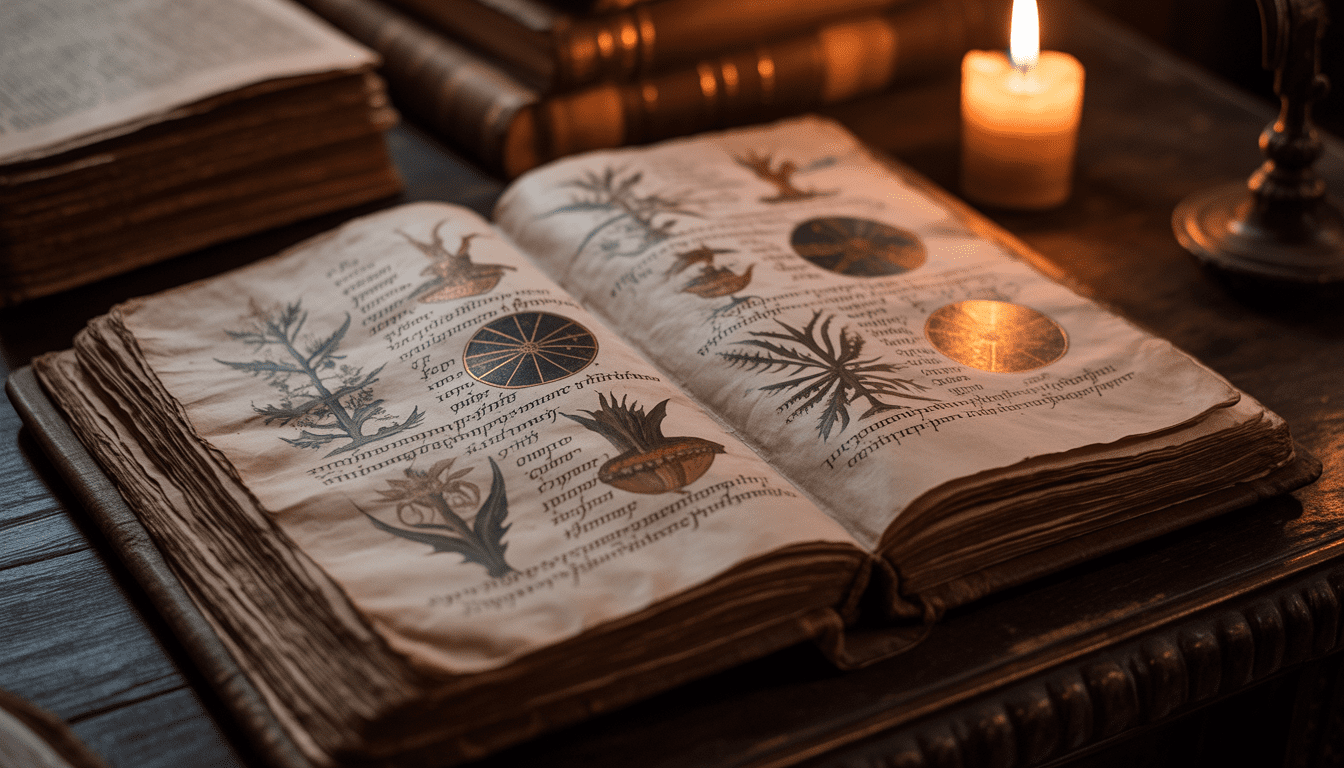

Six hundred years ago, somebody in Central Europe sat down with a goose quill, a pot of iron-gall ink, and a stack of calfskin vellum — and wrote 240 pages in a language that has never been read. Every professional codebreaker of the 20th century tried. William Friedman, who cracked the Japanese PURPLE cipher, worked on it for decades and failed. The NSA has it. The CIA has it. Alan Turing had a copy. In 2025, a large language model trained on 37 million historical texts was turned loose on it — and produced output that academic linguists are still arguing about. This is the Voynich Manuscript, and at the time of writing it remains the most persistent unsolved cipher in human history.
What the Voynich Manuscript Actually Is
The manuscript is a codex of roughly 240 surviving pages (it originally had around 272), bound in limp vellum, measuring about 23.5 × 16.2 cm. The book is illustrated, in color, on nearly every page. The drawings fall into six clear sections:
- Herbal — 113 unidentified plants, many of which do not correspond to any known species.
- Astronomical — zodiac diagrams with tiny nude human figures in each circle.
- Biological — networks of green pools connected by tubes, with small female figures bathing inside them.
- Cosmological — rosettes resembling maps of fortified cities or star systems.
- Pharmaceutical — jars and plant fragments arranged in rows.
- Recipes — dense paragraphs with starred entries in the margins.
And wrapped around every illustration is the script — a flowing, confident, entirely unique alphabet of roughly 25 to 30 symbols, written in ink by what appears to be two or three different hands. Carbon-dating of the vellum at the University of Arizona in 2011 placed the manuscript’s creation between 1404 and 1438. The ink is consistent with that date. This is not a modern hoax.
A Short History of Failed Decoders
The manuscript’s earliest confirmed owner was Holy Roman Emperor Rudolf II, who in the early 1600s paid the enormous sum of 600 ducats for it, believing it to be the work of Roger Bacon. It passed through the hands of court alchemists and Jesuit scholars for two centuries before vanishing. Polish antiquarian Wilfrid Voynich rediscovered it in a Jesuit library in 1912, and the modern mystery began.
Since 1912, the list of people who have tried and failed to crack it reads like a reference book of 20th-century cryptography. William Friedman, the founder of American cryptanalysis, assembled a team at the Riverbank Laboratories and later inside the NSA, and concluded only that the language had “definite morphological rules” but could not be broken. Alan Turing was given a copy during the war. Post-war NSA cryptographers ran it through early IBM mainframes. In each case, the machines returned the same uncomfortable result: the text behaves too much like a real language to be random, and too strangely to fit any known one.
Why It Is Not Gibberish
The strongest argument against the “elaborate hoax” theory is statistical. The Voynich text obeys Zipf’s Law — the frequency distribution of words seen in every real language on earth. It obeys Heaps’ Law, which predicts how vocabulary grows with text length. Its character entropy is unusually low, which rules out random noise. Specific symbols appear more often at the start of paragraphs; others appear almost exclusively at the end of words. This is what linguists call “positional regularity,” and it is remarkably difficult to fake, especially with a goose quill, across 240 pages, without a computer.
Multiple analyses have also identified what appear to be grammatical markers — prefixes and suffixes attached to recurring stems. In 2020, British cryptographer Dr. Gerard Cheshire controversially claimed the script encoded proto-Romance, a pre-Italian language, and published a partial decoding in Romance Studies. The academic reception was scathing. But Cheshire’s central observation — that the text has word-level structure that behaves like an inflected natural language — is not seriously disputed.
The Leading Modern Theories
1. A Constructed Private Language
The theory with the most academic support today is that the author invented a constructed language — possibly a philosophical language of the kind later associated with John Wilkins or Athanasius Kircher. Under this model, the script represents something, but there is no natural language to decode into. The words are keys to concepts in a personal system that died with its creator.
2. A Medical or Alchemical Cipher
The herbal, pharmaceutical, and biological sections strongly resemble contemporary medical manuscripts, particularly balneology texts (books about medicinal bathing). Medieval physicians sometimes used ciphers to protect recipes and proprietary remedies. If the text is a coded medical manual, the key may be relatively simple — but lost.
3. A Glossolalic or Mystical Document
Some researchers, pointing to the stylized female bathers and the cosmological rosettes, have proposed the manuscript is a record of mystical or ecstatic experiences — effectively automatic writing by a literate but religiously idiosyncratic author. This would explain the statistical language-likeness (a fluent human wrote it) combined with the impossibility of decoding (no external referent exists).
4. A Real, Lost Natural Language
The minority theory — but the most tantalizing — is that the Voynich script records a natural language spoken by a small community in 15th-century Europe that left no other written trace. Candidate languages have included Manchu-related Jurchen, a dialect of Nahuatl (which fails on the carbon dating), a Turkic variant, and proto-Romance. None has held up to scrutiny. But the possibility remains.
The 2025 AI Attack — And What It Actually Found
In late 2025, a research team trained a transformer-based model on millions of medieval European texts and then conditioned it on Voynich. The outputs, depending on the section, suggested a botanical-medical register — repeated clusters that behaved like plant-part vocabulary (root, stem, flower) and process verbs (boil, crush, soak). The model did not produce coherent English sentences. It did produce topic coherence: the herbal pages read like plant instructions; the biological pages read like anatomical descriptions; the astronomical pages had time-word clustering. If these results hold up to peer review, they suggest the Voynich Manuscript is a real technical document — not a hoax, not mystical — and that a human-readable decoding may finally be possible within this decade.
Why It Still Matters
The Voynich Manuscript matters because it is a rare case where six hundred years of sustained human intelligence — mathematicians, linguists, cryptanalysts, historians, and now machine-learning systems — have all bounced off the same object. It proves that information survives intent. Somebody, some reader in the 1420s, could pick up this book and read it. We cannot. That gap between then and now, spanned by 240 pages of indecipherable ink, is what keeps the manuscript alive.
Frequently Asked Questions
Where is the Voynich Manuscript today?
It lives in the Beinecke Rare Book & Manuscript Library at Yale University, catalogued as MS 408. High-resolution scans of every page are freely available online — anyone with an internet connection can attempt to decode it.
Has the Voynich Manuscript been decoded?
No decoding has ever survived peer review. Multiple “solutions” have been announced — most recently in 2017, 2019, and 2023 — and every single one has been rejected by professional cryptographers and linguists within weeks. The 2025 AI study suggests the topic structure but does not claim a full decoding.
Could the Voynich Manuscript be a hoax?
Physically possible, but statistically very difficult. A hoax would need to produce 240 pages of text that mimics the deep statistical properties of a natural language — and do so using 15th-century materials, consistent handwriting, and without ever slipping into gibberish. Most modern researchers consider a deliberate hoax the least likely of the major theories.
Who wrote the Voynich Manuscript?
Unknown. Handwriting analysis suggests two to three distinct scribes worked on it. Candidate authors historically proposed include Roger Bacon (impossible, based on carbon dating), John Dee, Edward Kelley, Anthony Ascham, and Wilfrid Voynich himself (also ruled out by carbon dating). In reality, the author was almost certainly someone whose name has not survived in any other historical record.
Related Stories
- AI Finally Cracks the 600-Year-Old Voynich Manuscript — The Decoded Message Has Researchers Unsettled
- The Dyatlov Pass Incident: What Really Killed 9 Hikers?
- Ancient ‘Black Pyramid’ Discovered Buried Beneath the Egyptian Desert
- The Tunguska Event: The Largest Impact in Recorded History
- Roswell 1947: What the Classified Documents Actually Say
Discover more from Infinity Explorers
Subscribe to get the latest posts sent to your email.