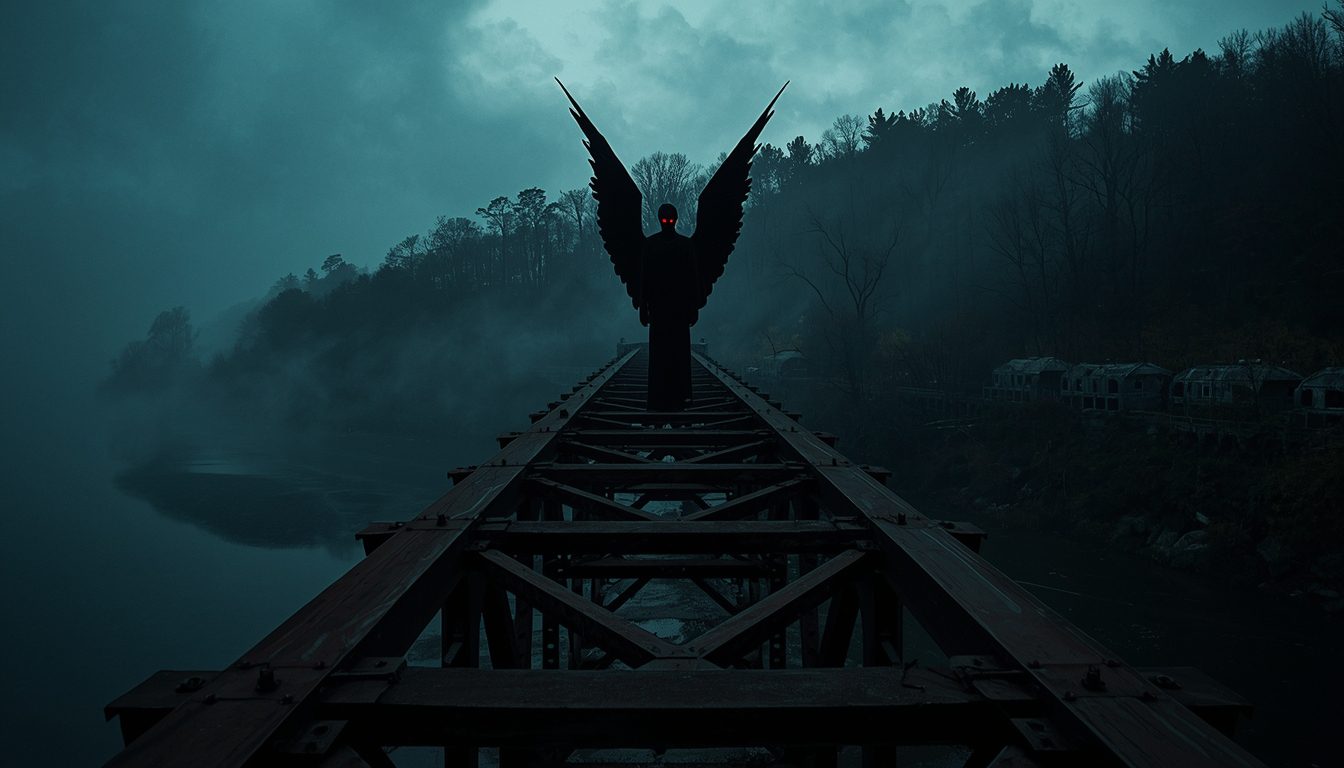

Between November 1966 and December 1967, the small riverside town of Point Pleasant, West Virginia — population just over 5,000 — logged more than a hundred sightings of a winged humanoid with glowing red eyes. Witnesses called it the Mothman. Thirteen months after the first sighting, on 15 December 1967, the Silver Bridge connecting Point Pleasant to Ohio collapsed during rush-hour traffic, killing 46 people.
For almost 60 years, that chronological coincidence has been enough to fuel a durable American legend — one that resurfaced in Mark Pilkington’s reporting, John Keel’s 1975 book, and the 2002 Richard Gere film. The deeper you dig, the stranger the story gets — not because the creature is real, but because the local memory, the engineering reality, and the way Cold War West Virginia processed trauma are so tightly braided together that separating them is almost impossible.
What actually happened in Point Pleasant in 1966–1967
On the night of 15 November 1966, two young couples — Roger and Linda Scarberry and Steve and Mary Mallette — were driving past the old WWII-era TNT Area, an abandoned munitions plant north of town, when they reported a seven-foot-tall figure with folded wings and “glowing red eyes.” They drove to the Mason County sheriff’s office, where Deputy Millard Halstead took their statement seriously enough to write an official report.
Within days, the sightings cascaded. By the end of December 1966, the Point Pleasant Register had collected more than 30 first-hand accounts. National and foreign press, including the London Daily Mirror, sent reporters. Journalist John Keel arrived in 1967 and spent most of the year documenting not just the creature sightings, but an entire cluster of anomalous phenomena: poltergeist activity, anomalous lights, and “Men in Black” incidents involving locals.
The Silver Bridge collapse: what engineering found
The bridge collapse itself has a known, documented engineering cause. In 1970, the National Transportation Safety Board concluded that a single eye-bar on the north chain, I-beam number 330, failed due to stress corrosion cracking and corrosion fatigue. The chain-link design had no redundancy — the moment one bar failed, the entire bridge collapsed within seconds.
The failure was metallurgical, slow-building, and entirely predictable in retrospect — the Silver Bridge had been rated in the 1960s for trucks far heavier than it was designed for in 1928. Forty-six people died because an aging steel alloy had been ignored, not because a cryptid had cursed the town.
So why does the “warning” story refuse to die?
Three factors keep the Mothman-as-omen reading alive:
- Chronological coincidence. The sightings began 13 months before the collapse and tapered off immediately afterward. Pattern-seeking brains find that irresistible.
- The TNT Area. The primary sighting zone was an abandoned WWII munitions facility with underground bunkers, contaminated groundwater, and heavy bird populations — a setting that generates real, nontrivial perception anomalies.
- John Keel’s framing. Keel’s 1975 book The Mothman Prophecies recast a cluster of regional sightings as a predictive pattern. He is the reason most Americans think of Mothman as a warning rather than a sighting.
The skeptical explanation most investigators now accept
The most widely accepted zoological candidate is the sandhill crane — specifically a migrating bird disoriented far from its usual range. Adult sandhill cranes stand roughly five feet tall, have a wingspan near seven feet, and possess a bright red eye-ring that reflects headlights. In the dim light of a rural West Virginia night, a startled crane perched near the TNT Area would match the 1966 description almost exactly.
That does not explain every sighting, nor does it account for the poltergeist and UAP reports Keel documented in parallel. But the original core encounter, the one that fed every subsequent sighting through social contagion, has a plausible zoological match.
What Point Pleasant remembers today
A 12-foot stainless steel Mothman statue now stands in the town square. The annual Mothman Festival draws tens of thousands every September. More quietly, the town also maintains a memorial to the 46 bridge victims, many of whom were local families. The two monuments sit a short walk apart — an accidental but honest portrait of how a small town metabolized a national-class engineering disaster by wrapping it in folklore.
The most careful answer to “was Mothman a warning?” is: probably not in the supernatural sense, but certainly in the social-history sense. The creature became a container for real fears — about industrial decay, groundwater contamination from the TNT plant, and Cold War anxiety — that were never fully processed any other way.
Frequently Asked Questions
Was there ever a physical specimen recovered?
No. No verified physical evidence — feathers, tissue, or photographs of sufficient clarity — has ever been produced. Every claimed photograph has been traced to later re-enactments or has not survived independent analysis.
What was the TNT Area?
It was the West Virginia Ordnance Works, a WWII-era facility that produced TNT for the Allied war effort. After the war, the underground igloos and storage bunkers were abandoned and the groundwater was later found to be heavily contaminated. It is now a McClintic Wildlife Management Area — and, in the 1960s, an ideal roost for disoriented migratory birds.
Did the Silver Bridge collapse have any supernatural cause?
No. The 1970 NTSB investigation identified a specific metal-fatigue failure in a single eye-bar on the north chain. The engineering explanation is complete and has been the basis for national bridge-inspection reforms since.
Are Mothman sightings still happening?
Sporadic reports emerge from the Ohio River valley and from Chicago, where a separate 2017 sighting cluster attracted national press. None have produced verifiable physical evidence, and most investigators attribute them to large wading birds seen in poor light.
Related Stories
- Scientists Finally Have an Explanation for the Bermuda Triangle
- Scientists Deploy Military-Grade Equipment at The Stanley Hotel’s Room 217
- Skinwalker Ranch Scientists Find a ‘Doorway’ That Cannot Be Closed
- The Dyatlov Pass Incident: What Really Killed 9 Hikers
- The Tunguska Event: The Largest Impact in Recorded History Still Has No Crater
Discover more from Infinity Explorers
Subscribe to get the latest posts sent to your email.