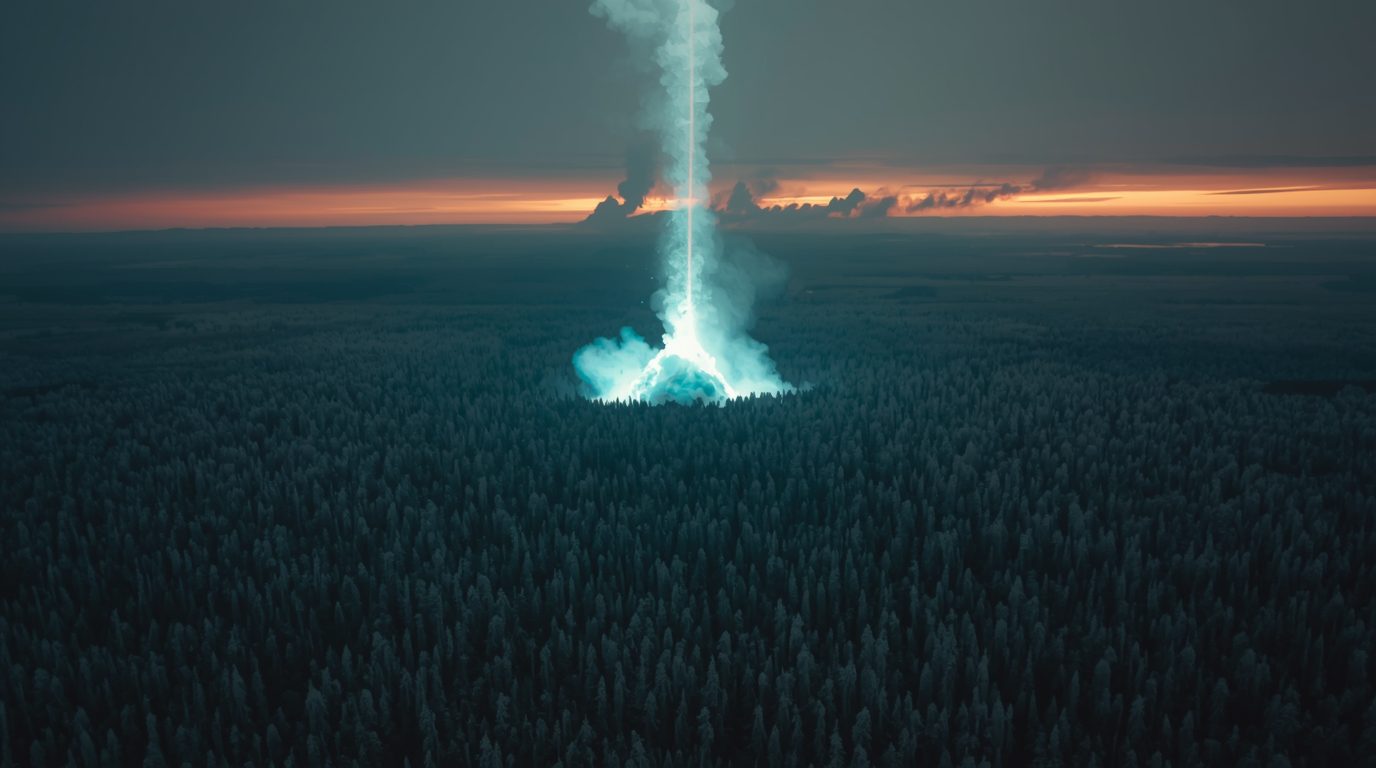

At approximately 7:14 AM local time on 30 June 1908, an explosion flattened roughly 2,150 square kilometers of Siberian taiga near the Podkamennaya Tunguska River — an area larger than modern Luxembourg. An estimated 80 million trees were snapped like matchsticks in a radial pattern pointing outward from a single blast point. The event registered on seismographs across Eurasia. Atmospheric pressure disturbances were recorded in England. For three nights afterward, the sky over northern Europe was bright enough to read a newspaper at midnight.
It was the largest impact event in recorded human history. And nearly 120 years later, despite decades of expeditions, isotopic sampling, and modern satellite and seismic reconstruction, one fundamental fact about the Tunguska event remains unresolved: there is no crater.
What actually happened on 30 June 1908
The event was witnessed. Evenki reindeer herders and Russian settlers in villages 40 to 60 kilometers from the blast point reported a column of blue-white light “brighter than the sun” moving across the sky from the southeast, followed by a series of concussive booms, a shockwave that knocked people off their feet, and hurricane-force winds that stripped the bark off trees.
The first scientific expedition did not reach the site until 1927, led by Soviet mineralogist Leonid Kulik. What Kulik found was a landscape that looked like the aftermath of a nuclear test — 37 years before the first nuclear test. Trees for miles out from a central zone had been felled in a butterfly-wing pattern pointing outward from the blast axis. At the very center, a small elliptical zone of standing dead trees — trunks still upright but stripped of branches — indicated the blast had come from directly above.
Why there is no crater
The best-supported explanation is that the Tunguska body never reached the ground. Instead, it underwent a mid-air detonation — an airburst — at an altitude of roughly 5 to 10 kilometers. Modern modeling places the yield in the 10–15 megaton range, roughly 1,000 times the energy released at Hiroshima.
Two primary classes of objects can produce an airburst of this scale without leaving an impact crater:
- A stony asteroid (chondritic body), ~50–60 meters in diameter, entering the atmosphere at ~15 km/s and fragmenting under aerodynamic loading. This is the mainstream consensus.
- A small cometary nucleus, predominantly water ice with silicate inclusions, sublimating and fragmenting at altitude. The cometary model explains the unusually long “noctilucent cloud” aftereffect but has weaker geochemical support.
Both hypotheses agree: whatever Tunguska was, it disintegrated before it touched the ground. The swamp-like Southern Swamp at the suspected ground-zero contains trace iridium, nickel-rich microspherules, and isotopic anomalies consistent with an extraterrestrial source — but no bolide mass, no impact crater.
The 1999 and 2007 Lake Cheko hypothesis
In 2007, an Italian team led by Luca Gasperini proposed that Lake Cheko — a small oval lake 8 km north-northwest of the blast center — was itself an impact crater formed by a surviving fragment of the Tunguska body. Lake Cheko has an unusually funnel-shaped profile for a Siberian lake and a magnetic anomaly at its base.
The hypothesis is not impossible, but it remains contested. Counter-arguments from a 2017 Russian sediment-dating study suggest Lake Cheko predates 1908 by at least several centuries. The debate is active, and a definitive drilling program of the lake bottom has been proposed but not yet completed.
The more speculative theories — and why most scientists reject them
Over the past century, Tunguska has attracted an unusual density of fringe theories:
- A miniature black hole passing through Earth (first proposed in a 1973 Nature paper and widely dismissed — an exit event over the Atlantic has never been detected).
- An antimatter annihilation event (no radioactive signature consistent with this has been measured).
- A Tesla wireless-power experiment (a common internet claim; there is no credible evidence Tesla ever fired such a system, and the physics is implausible).
- A crashed alien craft, sometimes paired with the observation of a trajectory adjustment during descent. Eyewitness reports of a bright object “maneuvering” are real, but are equally consistent with a fragmenting asteroid undergoing non-uniform ablation.
The scientific community overwhelmingly favors the airburst-of-a-natural-body explanation. None of the fringe theories makes a prediction that has been confirmed, and most make predictions (radioactive signatures, gravitational anomalies) that have been actively ruled out.
What Tunguska teaches us about planetary defense
The most important modern lesson of Tunguska is how much damage a relatively small object can do. A 50–60 meter airburst over a populated area would kill hundreds of thousands to millions of people. The 2013 Chelyabinsk meteor — a 20-meter object that exploded over a Russian city and injured 1,500 people, mostly from glass — was a sobering reminder that Tunguska-class events are not vanishingly rare on geological timescales.
NASA’s NEO Surveyor mission, the first purpose-built infrared space telescope for tracking near-Earth asteroids, is scheduled for launch in this decade precisely because Tunguska-class bodies are currently not reliably catalogued. The 2022 DART mission, which successfully altered the orbit of asteroid Dimorphos, established that kinetic impactor deflection works — but deflection requires knowing the object is coming, which is the capability gap Tunguska still exposes.
Frequently Asked Questions
How big was the Tunguska explosion?
Modern modeling places the energy release at 10–15 megatons of TNT equivalent — roughly 1,000 times the yield of the Hiroshima bomb. It flattened approximately 2,150 square kilometers of forest and was the largest impact-related event in recorded history.
Was anyone killed?
No verified fatalities are documented. The region was sparsely populated by Evenki reindeer herders and Russian settlers. Herders camped closer to the blast reported severe burns and were thrown from their tents, and reindeer herds in the direct path were killed, but no confirmed human death record has emerged.
Could Tunguska happen again?
Yes. Tunguska-class events are estimated to occur once every 300–1,000 years on average, with large uncertainty. NEO Surveyor and ground-based sky surveys are working to inventory enough of the near-Earth asteroid population to give meaningful warning.
Has any Tunguska material ever been found?
Yes — microscopic. Soviet and post-Soviet expeditions recovered iridium-enriched microspherules and trace platinum-group elements consistent with a chondritic (stony) asteroid composition. No macroscopic fragment has been definitively identified.
Related Stories
- The Dyatlov Pass Incident: What Really Killed 9 Hikers
- Dyatlov Pass Finally Explained? Classified Soviet Files Leaked in 2026
- Scientists Finally Have an Explanation for the Bermuda Triangle
- The Voynich Manuscript: The World’s Most Mysterious Book
- MH370 Finally Found? New 2026 Deep-Sea Scan Reveals Wreckage
Discover more from Infinity Explorers
Subscribe to get the latest posts sent to your email.