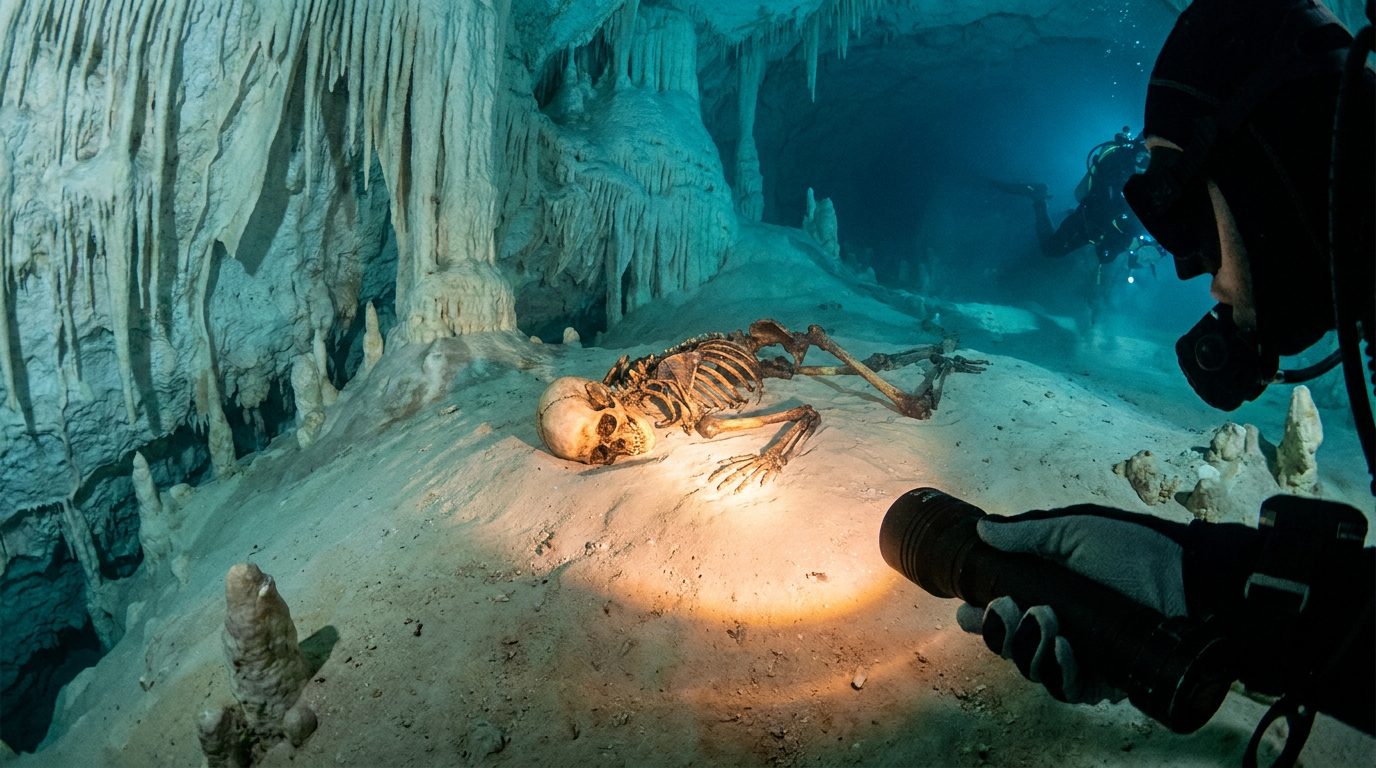

Two hundred metres deep inside a flooded limestone cave system in Mexico’s eastern Yucatán Peninsula, on a small sediment dune in a narrow interior chamber that has been underwater for the past eight thousand years, a team of cave-diving archaeologists led by Mexico’s National Institute of Anthropology and History have recovered the skeleton of a human being who was deliberately laid to rest there at a moment in history when the cave was still dry — at the end of the last Ice Age, before the Yucatán coastline had been redrawn by rising seas. The skeleton is roughly 8,000 years old. It is the eleventh prehistoric human skeleton recovered from this single cenote network. And every single one of them was buried on dry ground that no longer exists.
The discovery was led by Octavio del Río of INAH — the Instituto Nacional de Antropología e Historia, Mexico’s federal antiquities authority — diving the submerged Actun cave system near Tulum on the Caribbean coast of the Yucatán Peninsula. The skeleton was found 26 feet (8 metres) below the present-day water surface, at the end of a 656-foot (200-metre) swim through narrow, light-starved cave passages. The body was positioned deliberately. The cave was dry when the person died. By the time anyone could have re-entered the chamber, it was already underwater.
What 8,000 Years Old Actually Means
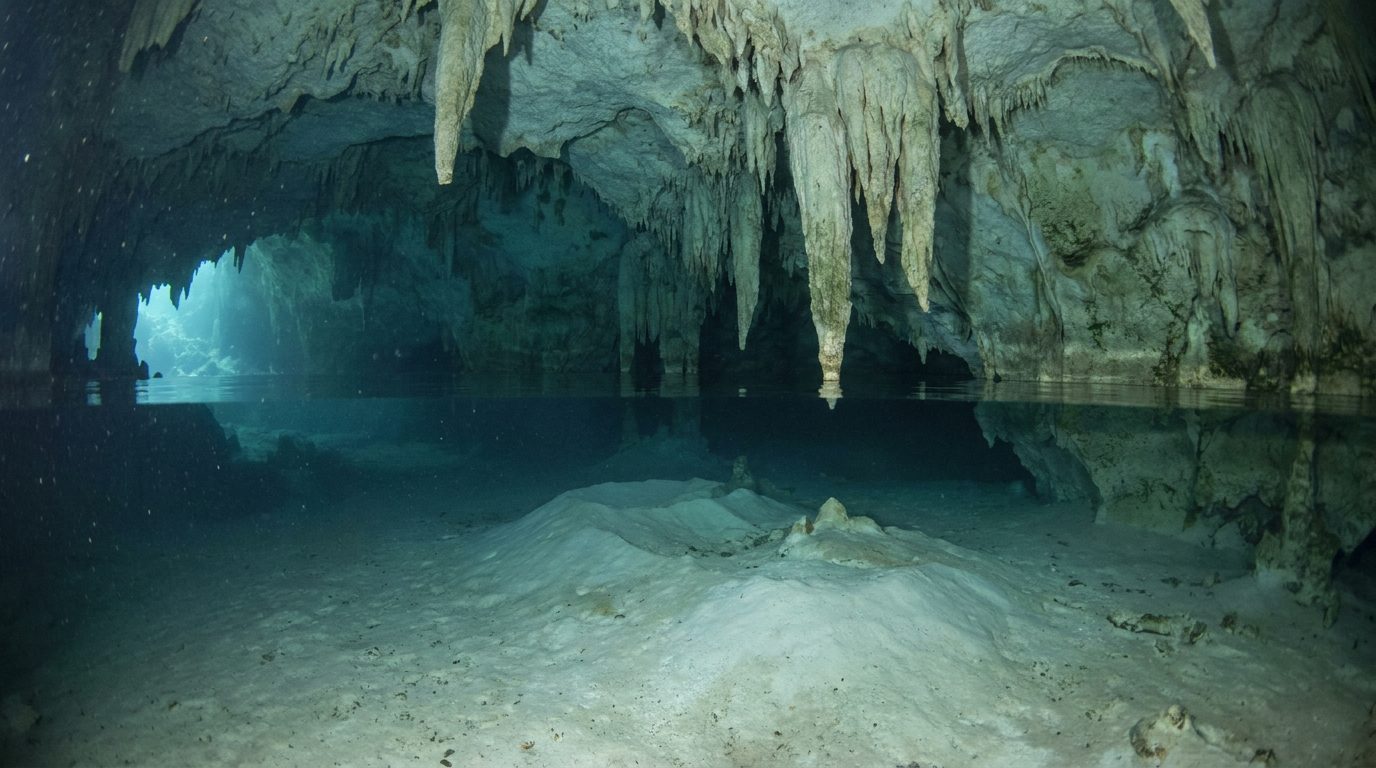
Eight thousand years ago is a date that matters specifically because of where it sits on the global sea-level curve. The end of the last Ice Age, conventionally dated to roughly 11,700 years ago, was followed by several thousand years of melting continental glaciers and rapidly rising oceans. Global sea level rose approximately 400 feet between the end of the Younger Dryas and roughly the middle of the Holocene — and the Yucatán Peninsula’s elaborate limestone cave network, which extends for hundreds of kilometres underneath what is now a densely-vegetated jungle, was dry land for most of that earlier period.
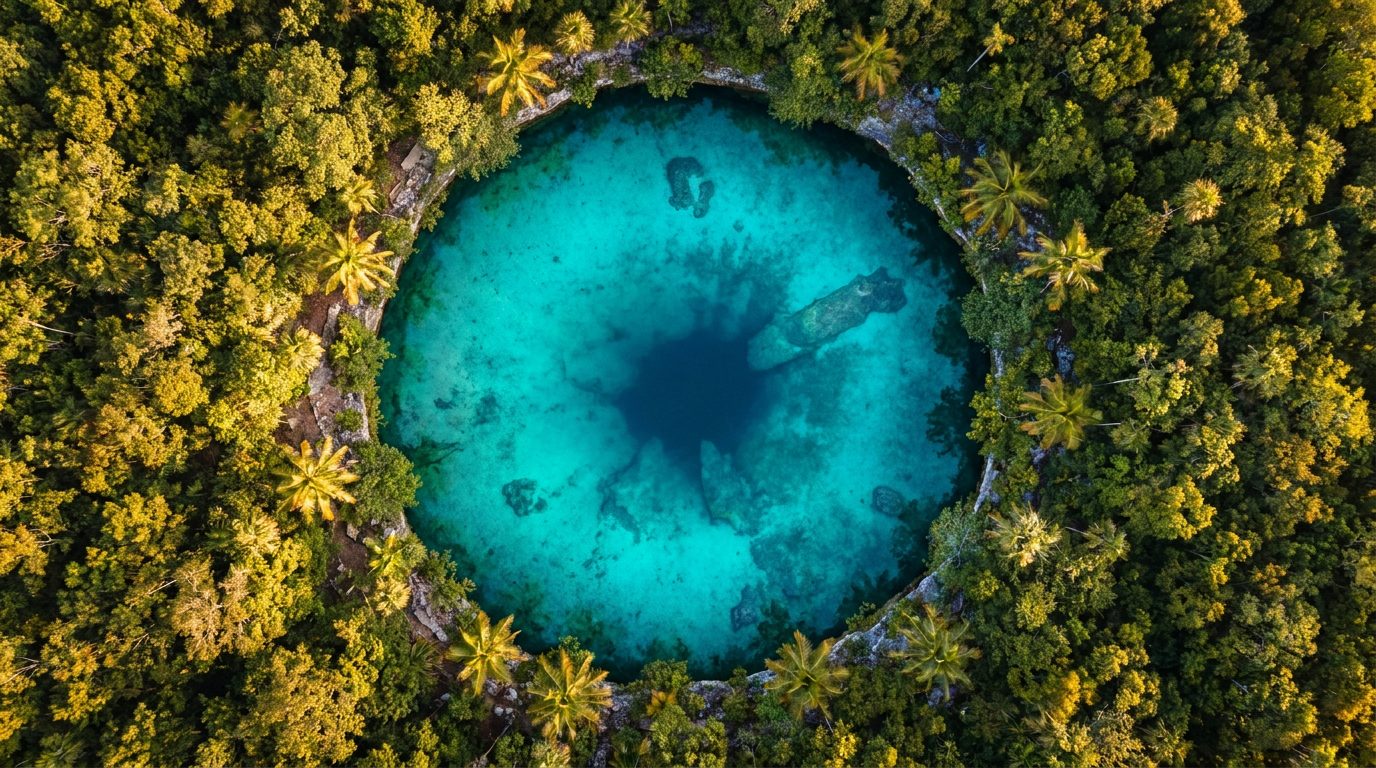
The cenote network we know today — the spectacular blue freshwater sinkholes that dot the modern Tulum landscape and feed Mexico’s tourism economy — is what the cave system became after it was drowned.
This means that the eleven prehistoric skeletons recovered from the cenote network were not buried underwater. They were buried by living people who walked into dry caves. The water came later. The bodies were already there.
The Body Was Placed Deliberately
The reason this individual skeleton has attracted as much attention as it has is the specific positioning of the bones. The skeleton was recovered from a small sediment dune in a narrow chamber set off from the main passage — not where a body would fall if someone died alone in a cave, not where bones would settle if they were washed in by a flood, and not where any animal would naturally drag remains.
It is exactly where you would put someone if you were holding a funeral.
That detail — combined with the fact that this is the eleventh such burial recovered from the same network, all positioned on similar interior dunes, all from roughly the same window of time — has led the INAH team to characterise the find as part of a deliberate prehistoric burial tradition practised by people who lived above the cave system thousands of years before the first Maya temple was constructed.
The Maya themselves famously regarded cenotes as sacred — entrances to Xibalba, the underworld of the Popol Vuh, where the gods were said to dwell. The recovered burials suggest the religious tradition of using these caves as funerary spaces predates the Maya by at least six thousand years.
Who Were These People?
Mainstream archaeology has historically held that the Americas were first populated by humans roughly thirteen to fifteen thousand years ago, in a migration that crossed the Bering land bridge from Siberia and spread south. An 8,000-year-old burial in the Yucatán fits comfortably inside that timeline.
What does not fit comfortably is the ceremonial sophistication implied by the burial. Eleven individuals, all placed in functionally similar interior locations in a single regional cave network, across a window of time, implies organised funerary tradition — and organised funerary tradition implies cultural continuity, religious belief structure, and the kind of social cohesion that is normally associated with much later periods.
It also raises a question the field has so far declined to engage with directly: how much else of the early Americas record is currently sitting on the continental shelf, drowned by the same sea-level rise that drowned the Yucatán cave system? Mexican coastal cenotes are exceptionally well preserved because the cave roofs held when they flooded. Similar arguments have been made about the underwater pyramid features off Cuba, and our companion article on the alleged 12,000-year-old “Crescentis” pyramid site off Louisiana covers the broader pattern. The Yucatán burial is, in that sense, the first institutionally-verified piece of the same picture.
Octavio Del Río’s Career
The find belongs to Octavio del Río’s lifetime body of work. Del Río has been diving Yucatán cenotes for INAH since the mid-1990s, and his name is attached to most of the eleven prehistoric skeletons recovered from this network. He has, by his own count, logged tens of thousands of underwater hours inside the Mexican cave system. He is, plausibly, the single person alive most familiar with the topography, depositional sediment patterns, and burial-context signatures of the entire cenote complex.
When del Río’s team designates a find as “deliberate ritual burial” rather than “natural deposition”, that designation is not a press-release flourish. It is the considered opinion of a single specialist team that has now examined eleven similar cases and is, at this point, the world’s authority on what these specific caves look like when something has been deliberately placed inside them.
The Conservation Race
The new burial discovery sits alongside an urgent conservation problem. The Yucatán cenote network is one of the most archaeologically dense underwater sites on Earth, and it is currently under intense pressure from tourism development on the modern Caribbean coast. Mexican federal authorities have been moving, slowly, toward designating the entire underground river network as a protected natural and cultural heritage area by the end of 2026.
The race is real. Construction projects along the Riviera Maya have already disrupted aquifer flow in several cenote networks. Untrained divers regularly enter previously-undocumented passages. The eleven burials recovered so far are almost certainly a small fraction of what is sitting in the dark, and if the protected-area designation does not pass before commercial pressure intensifies further, an entire chapter of pre-Maya American history will be destroyed before anyone has documented it.
What This Discovery Tells Us
The Yucatán burial does not, by itself, rewrite the archaeological timeline of the Americas. What it does — and what each of the previous ten skeletons did, and what the next ones will do as del Río’s team continues — is keep adding institutionally-verified, peer-reviewable, hard-dated points to a curve that the mainstream of the field has historically tried to keep simple.
The simple version of the curve says: humans arrived in the Americas ~13,000 years ago, lived simple hunter-gatherer lives for several thousand years, and only started building sophisticated culture in the last few millennia. The new burial does not break that timeline. But it does keep adding decoration to it: deliberate funerary ritual in 6000 BCE, organised group selection of sacred locations, intergenerational continuity in burial practice, and a cultural relationship with deep caves that predates the Maya religious tradition by six thousand years and inherits into it cleanly.
Either you treat the cenote record as a series of statistical coincidences — eleven individuals, all on interior dunes, all from a narrow time window, all in the cave network later considered sacred by the people who lived above it. Or you treat it as exactly what it looks like.
Frequently Asked Questions
Where exactly was the skeleton found?
The skeleton was recovered from the Actun cave system near Tulum, on the Caribbean coast of the Yucatán Peninsula in Mexico. The recovery point was approximately 26 feet (8 metres) below the current water surface, at the end of a 656-foot (200-metre) swim through narrow submerged passages, on a small interior sediment dune.
Who led the recovery?
The dive was led by Octavio del Río of Mexico’s National Institute of Anthropology and History (INAH). Del Río has worked the Yucatán cenote network since the mid-1990s and is the lead investigator on the majority of the eleven prehistoric skeletons recovered from the network to date.
How is the skeleton dated to 8,000 years old?
The 8,000-year date matches the period at which the cave system itself flooded — at the end of the post-Ice-Age sea-level rise. Bone dating and sediment context both support this window. The burial necessarily predates the flooding (the chamber had to be dry when the body was placed there), which sets an upper bound on the date.
Is this really a “ritual burial”?
The INAH team’s designation is based on the specific positioning of the remains — set deliberately on a narrow interior sediment dune in a side chamber, in a pattern matching the previous ten prehistoric skeletons recovered from the same regional cave network. That clustering, across multiple independent finds over decades of fieldwork, is what supports the funerary-tradition reading.
How is this connected to the Maya?
The Maya famously regarded cenotes as sacred — entrances to Xibalba, the underworld where the gods of the Popol Vuh were said to dwell. The newly-recovered burials suggest that the religious tradition of treating these caves as funerary spaces predates the Maya by approximately six thousand years. The Maya may have inherited the practice rather than originating it.
What’s the connection to the Crescentis pyramid story?
The same end-of-Ice-Age sea-level rise that drowned the Yucatán cenote network also flooded the Gulf of Mexico coastline. Our companion piece on the alleged 12,000-year-old Crescentis pyramid site off Louisiana covers the broader pattern: large-scale archaeological material currently sitting on the continental shelf, drowned by the same global event, much of it institutionally unexamined. The Yucatán burials are the rare case of that material being formally documented and dated.
How many more burials are likely to be found?
The eleven burials recovered so far are concentrated in a small subset of the Yucatán cave network. Tens of kilometres of submerged passages remain partially or completely unexplored. INAH researchers have publicly stated that they expect significantly more prehistoric remains to be located as the conservation programme moves forward — provided that commercial pressure on the cenote network does not destroy the unexplored chambers first.
Discover more from Infinity Explorers
Subscribe to get the latest posts sent to your email.